Life, Liberty, Property #129: Minneapolis ICE Obstruction: ‘Resistance’ Is Now Open Rebellion
Forward this issue to your friends and urge them to subscribe.
Read all Life, Liberty, Property articles here, and full issues here and here.
IN THIS ISSUE:
- Minneapolis ICE Obstruction: ‘Resistance’ Is Now Open Rebellion
- Video of the Week: Minnesota: Land of 10,000 Frauds – In the Tank #521
- U.S. Senator’s Bogus Claim Undermines Constitution, Individual Rights
IT’S BACK! SAVE THE DATE. SPRING 2026.

Minneapolis ICE Obstruction: ‘Resistance’ Is Now Open Rebellion
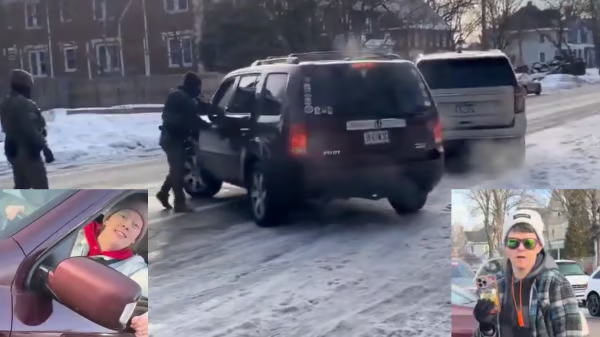
The shooting of a driver apparently attempting to escape from ICE agents and striking one of them with her SUV in Minneapolis is an appalling event and not something that one should see through a political lens.
Of course, the general reaction to the matter has been to do exactly that. There is, however, a clear and direct line of responsibility visible in these events, and it demonstrates very well that the decades-long process of replacing personal morality and responsibility with political positions is creating ever-greater havoc in the United States.
The solution to that ongoing debacle, as this article will make clear, is to return to the traditional vision in which individuals are judged on their chosen actions, and not on immutable status conditions (such as race or sex) or stated political positions.
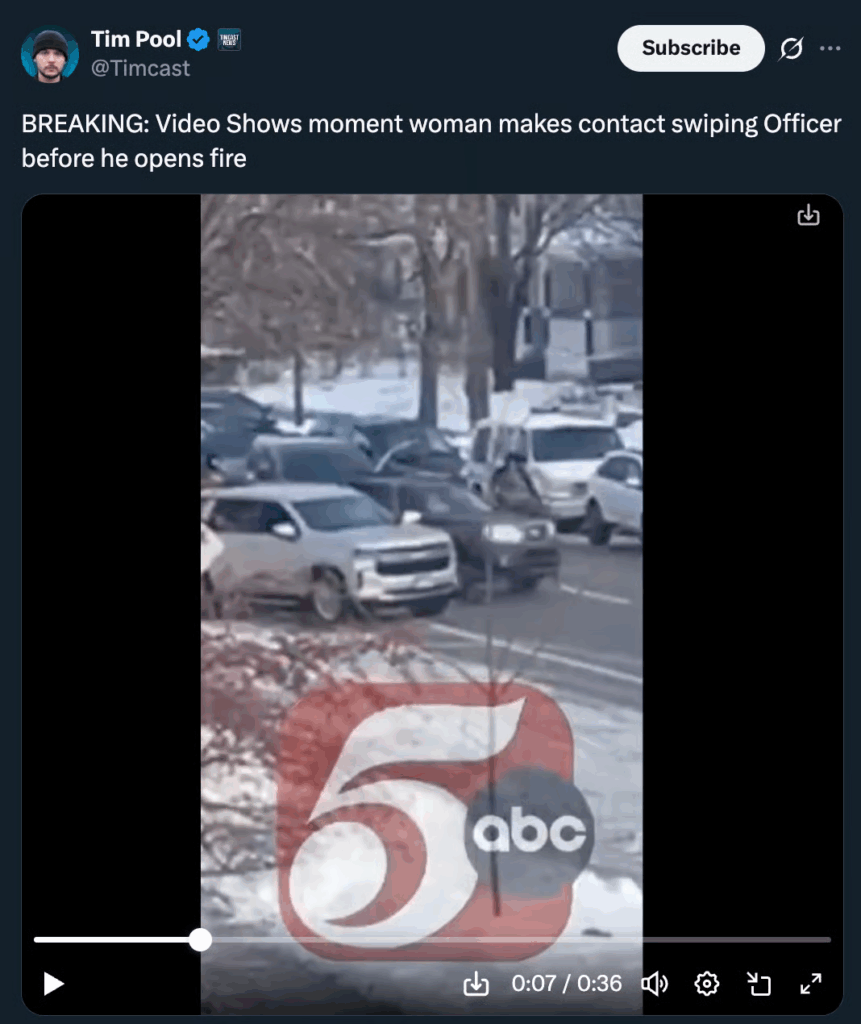
To do so in the present case requires that we simply observe what happened and what the participants can be seen to have intended. A local ABC station’s video reposted by podcaster Tim Pool shows Renee Nicole Good driving her SUV directly into an ICE agent, who shoots her in response:
Another on-scene video shows Good’s reaction when an ICE agent attempts to open the vehicle door, with the apparent intent of arresting her or holding her in custody while others will move her vehicle out of the way of traffic. Good surges the SUV forward on the icy street, clearly endangering the life of the agent before her on the slippery street, as both these videos show. The agent fires at her three times and kills her:
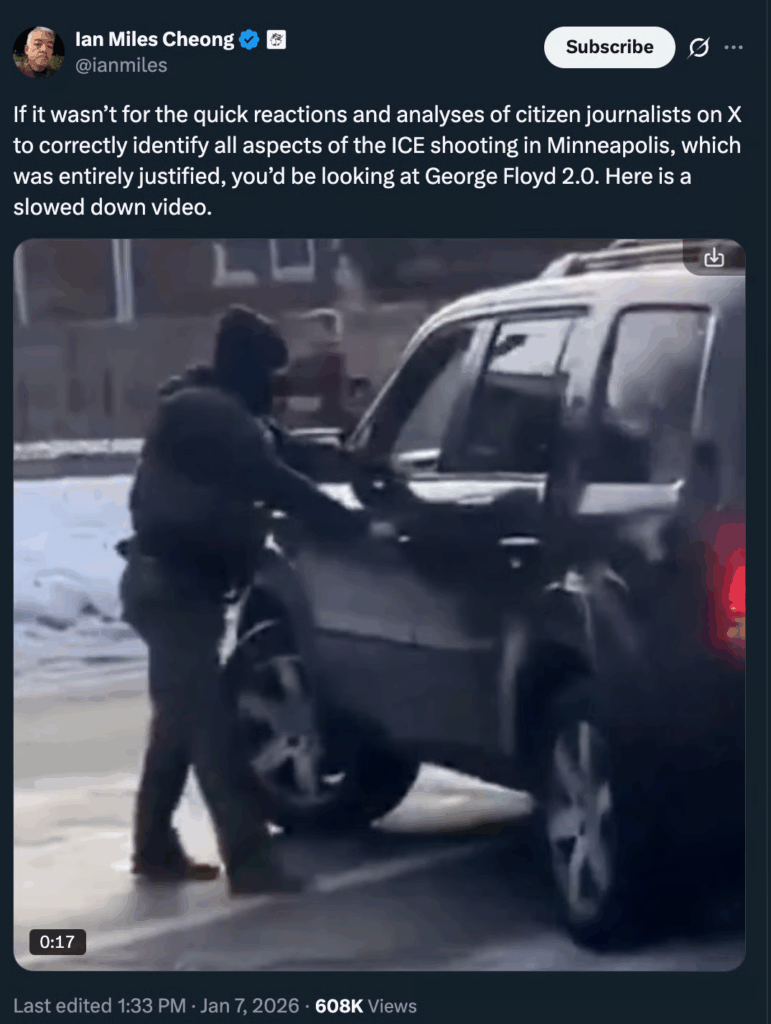
The second and third gunshots are from the side of the car as Good rapidly drives forward. Those shots would not be justifiable if not for the fact that they happen in a very brief time and it is arguable that the car surges forward into the firing line before the agent has time to react. Fast-moving crises create fog of war and make second-guessing difficult to justify and overcome reasonable doubt.
A video from Alpha News shows Good and her passenger blithely expressing superiority over the ICE agents and Good then driving directly at one of them and striking him with her SUV:
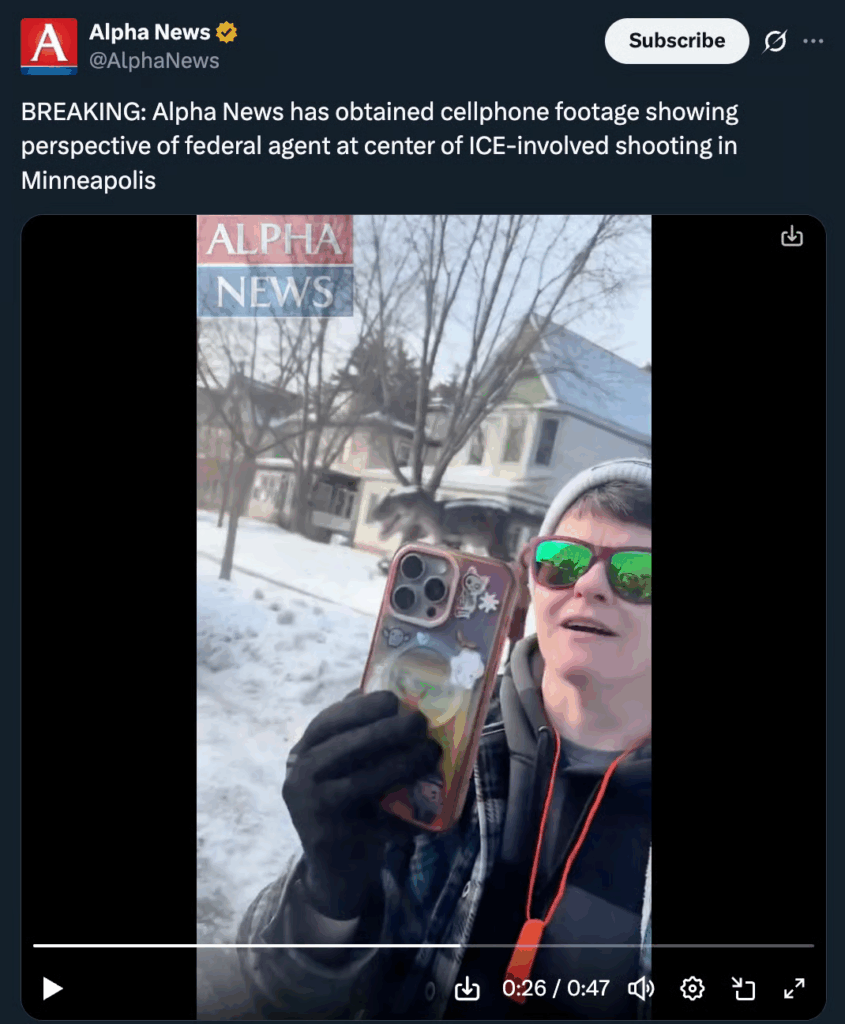
As the incident began, Good’s car was stopped perpendicular to the normal flow of traffic, and in at least one video the honking of car horns indicates that she is indeed blocking traffic. (It is clearly audible in the Alpha News clip.) The fact that Good’s car was stopped in an unusual position that prevented travel on the street shows that she was there to interfere with the law enforcement action, which is a crime (and should be).
Right up until the violence begins, both Good and her companion, who was outside the car as the situation escalated, show a sense of invulnerability to consequences from the incident. Good is seen smiling at the agent and saying, “That’s fine, dude. I’m not mad at you.” Her companion, having gotten out of the car, actively taunts the ICE agents, saying, “You want to come at us? You want to come at us? I say go get yourself some lunch, big boy.”
The woman then moves to enter the vehicle, grabbing the door handle, and when the agent tells Good to get out of the car, the woman seems to yell, “Drive, drive!” Good accelerates forward, hitting the officer, who shoots her.
The incident spiraled out of control when one of the ICE agents began to reach into the woman’s car through the driver’s door window. It is possible that the agent had no intention of arresting Good and her companion but simply intended to detain them to prevent exactly the kind of thing that ended up happening (perhaps by removing the ignition key).
It seems reasonable to conclude that Good panicked at this and was not thinking clearly when she accelerated the car forward toward an ICE agent standing directly before her. That is by no means a certainty, however. A still from video taken from the scene does not indicate fear on her part as she drives into the officer:

The use of a vehicle to ram someone is a serious crime, of course. The critical issue is mens rea, meaning the person’s intent. However, even driving into a person to escape a mob attack is against the law, notes Greg Ellifritz at the Active Response Training website:
You can’t just run people over if they are in the road. The safest thing to do in a situation like this is to keep moving, bumping people out of the way with your car. Unfortunately, that usually isn’t legal. It’s considered vehicular assault. Even if people are illegally blocking the road, you will likely go to jail if you run them down absent a legitimate threat to your life.
The facts of the situation seem pretty clear. Unfortunately, that does not stop people from reinterpreting the obvious to fit their political agendas. As is the way of things these days, the reactions bruited in the media have been entirely colored by political perspectives, specifically about immigration.
Reporting on the Minneapolis incident, ABC News rushed to emphasize the political angle, characterizing it as a clash of perspectives, as did much of the regime-media coverage: “We have two totally different stories here,” the ABC anchor said immediately:
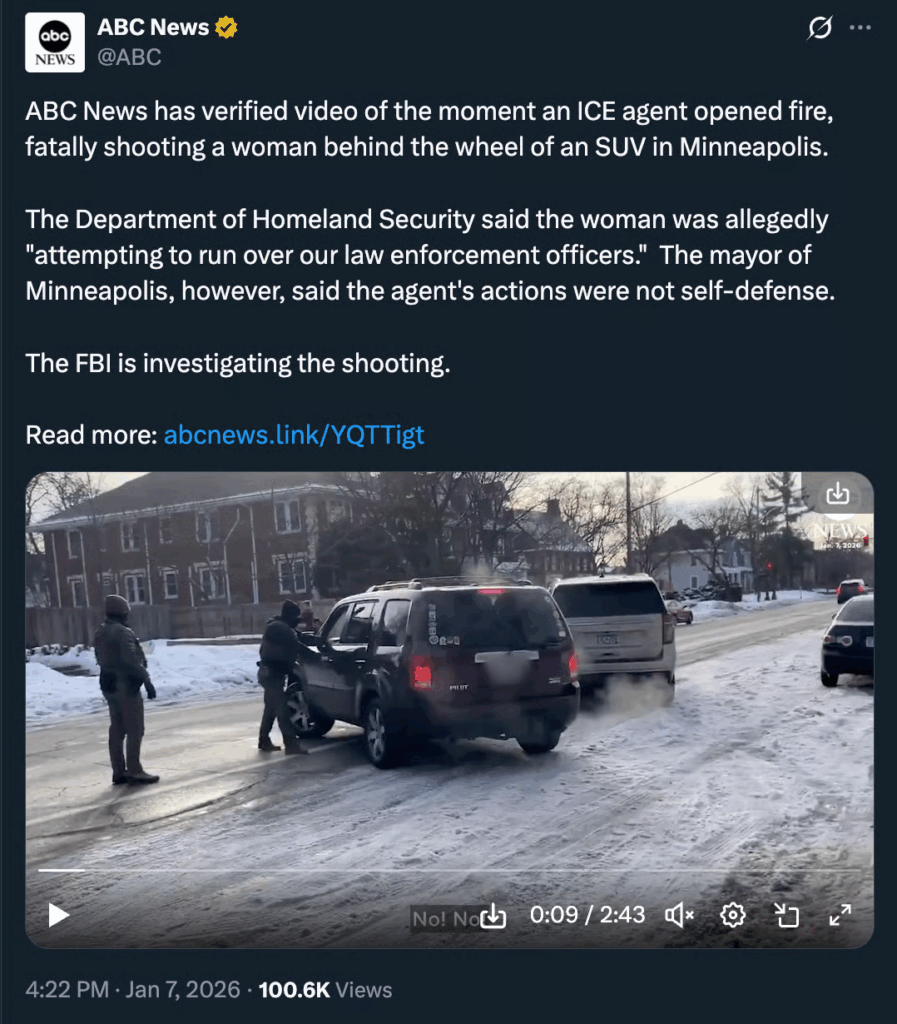
“We have a total disconnect, as you say, between what the federal government is saying and what local authorities are saying,” ABC’s Chief Justice Correspondent Pierre Thomas said in response. “You saw the government of Minnesota express his frustration with ICE and the enforcement that’s going on in the city of Minneapolis, but he was very clear in trying to point out and urging citizens to peacefully protest and to conduct themselves in a way that did invite—that did not invite—more violence.”
ABC-TV correspondent Thomas told the network audience that “split-second decisions [were] being made” in the incident, while observing that “we don’t have any information from the woman’s perspective and what she feared was going to happen to her.”
This framing of the incident, however, is misguided. It suggests an equality between the positions of the ICE agents and those of the driver. That is not the case. The agents were authorized to be there and to arrest or otherwise manage people who interfere in their activities. The driver had a right to be there (possibly), but she certainly had no right to resist arrest by attempting to escape the scene.
In any case, the two parties had very different intentions, as the videos make clear. The agent’s “split-second decision” to shoot was based on self-protection, an inherent right, whereas the driver’s “split-second decision” to run her car into a human being and a federal officer was based on a desire to escape the consequences of a crime she had just committed, interference in a legitimate law-enforcement activity.
Whether one thinks that the ICE enforcement action was a good idea or not is immaterial to the consideration of guilt and innocence of the parties involved in this incident. Its only value in the case is as a way of deflecting attention and moral judgment from the actions onto the individuals that did them.
In addition, whether Good considered the enforcement action to be legitimate is not a valid excuse for her actions. The ICE officers were human beings doing their duty, duly authorized by the elected government of the United States. Good’s actions, and all such actions to interfere with these operations, are committed against other human beings, not institutions or abstract political positions.
These activities are not civil disobedience. Civil disobedience means refusing to participate in legal government actions (including, for example, paying taxes, reporting for a military draft, or even reporting crimes). It can be considered moral, though that is true only if the individual does not pick and choose: living in a society requires one to agree to the social contract or face the consequences.
In his essay on “Resistance to Civil Government” (1849, also known as “Civil Disobedience”), Henry David Thoreau made the point that those who choose to disobey laws they consider unjust are morally obliged to accept the punishments the state imposes for those violations: “Under a government which imprisons any unjustly, the true place for a just man is also a prison. The proper place to-day, the only place which Massachusetts has provided for her freer and less desponding spirits, is in her prisons, to be put out and locked out of the State by her own act, as they have already put themselves out by their principles. … Cast your whole vote, not a strip of paper merely, but your whole influence.”
When Thoreau was jailed for refusing to pay a tax to support the church, he called it “unfortunate” that someone paid his fine and effected his release.
In the present case, by contrast, the perpetrators wanted and expected to escape the ordinary legal consequences of their crimes. Good and her companion were not engaging in civil disobedience; they were establishing themselves as soldiers of an alternative government. Their interference demonstrated a blithe refusal to accept the social contract or reject it outright.
Good and her companion expected to receive the benefits of state protection from force and fraud while denying their obligation to accord those rights to others—specifically the ICE agents. That is both immoral and criminal, and it is not kind and sympathetic, as they undoubtedly thought it was. It was and is, on the contrary, a personal commitment to rebellion and tyranny.
Vice President J. D. Vance demonstrated this perspective in a post on X: “You can accept that this woman’s death is a tragedy while acknowledging it’s a tragedy of her own making. Don’t illegally interfere in federal law enforcement operations and try to run over our officers with your car. It’s really that simple.”
The near-instantaneous explosion of this event into violence suggests diminished capacity on the part of both the driver and the ICE agent, with all parties reacting instinctively to a highly tense and confusing situation. Other people put them in that situation, however, and it is reasonable to consider their potential levels of responsibility in the matter.
Heated rhetoric has raised anger in both major U.S. political parties and ideological movements, and abusive language has been ubiquitous. However, the positions of the two parties are quite different.
The president and his administration are in the same position as the ICE officers: they have been assigned a task and are in the process of doing their jobs. The Democrat governors and mayors who have been indulging in increasingly bellicose threats toward ICE and other federal government officers are in the same position as Renee Good was: breaking the law to interfere with legal actions of government authorities.
Like it or not, the voters (and Electoral College as delegated) in 2024 called for Donald Trump to be sworn in as president. They gave him the sweeping authority that comes with the office, which Trump is using to do the things he promised he would do.
This is not a partisan, political matter. The moral and legal statuses of all the people involved are clear.
Governors and mayors who whip up mobs to interfere with the federal government’s legitimate actions are placing them in harm’s way, using them as political pawns, and endangering the lives and health of federal officers.
Just one day after the Minneapolis incident, U.S. Customs and Border Protection officers in Portland, Oregon shot and injured two members of Tren de Aragua who “attempted to run over the law enforcement agents” when the border patrol agents stopped the vehicle for a check, the Department of Homeland Security told Fox News. Politicians’ efforts to undo the results of the 2024 election are unleashing increasingly deadly violence.
After the initial reports of the death of Renee Good, Gov. Tim Walz stirred up even more hatred against the federal government under President Trump. Fox 9 Minneapolis reports:
“Donald Trump will make this about me, about politics. This is about public safety. To Americans who are watching this, stand with us against this. This was so preventable, so unnecessary. I don’t know, maybe we’re at their McCarthy moment. Do you have no decency? We have someone dead in their car for no reason whatsoever,” Walz said. “I don’t want to be right about this, but I said if they do this, they’re going to create a chaotic situation where someone innocent is going to get killed, and they did it. Now we [hear] more political rhetoric, enough is enough. To Minnesotans, don’t take the bait, do not allow them to deploy federal troops, to invoke the Insurrection Act, to declare martial law, do not allow them to lie about the security and decency of this state.”
If these politicians’ actions are not illegal, they are certainly immoral. The same is true of media figures who amplify their reckless and cynical calls for forceful and, as they all continually imply, forcible, violent “resistance” to be achieved “by any means necessary.” The numerous well-funded nongovernment organizations (NGOs) that feed and finance these obstruction efforts are also very much to blame. Those private-sector entities abuse their liberty to attack the very system that grants them those freedoms.
These politicians, the NGOs that finance their efforts, and their regime-media pilot fish are the ones responsible for the rising lawlessness, defiance of legitimate authorities, and any injuries and deaths that arise from their reckless and arrogant abuse of their positions of authority and their liberties.
Sources: Tim Pool (X); Ian Miles Cheong (X); Alpha News (X); Malmesburyman (X); ABC News; Active Response Training; Vice President J. D. Vance (X); Fox News; Fox 9 Minneapolis

Video of the Week
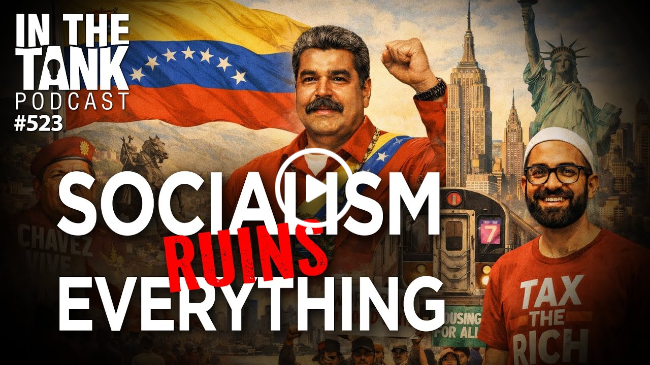
On In The Tank Podcast #523, Linnea Lueken, Jim Lakely, Chris Talgo, and S. T. Karnick break down the latest reminders that socialism doesn’t “fix” anything—it wrecks it. From political theater in Washington to chaos in corporate America, and from Venezuela’s collapse to what’s brewing in New York City, the panel connects the dots on how bad ideas keep spreading.

U.S. Senator’s Bogus Claim Undermines Constitution, Individual Rights
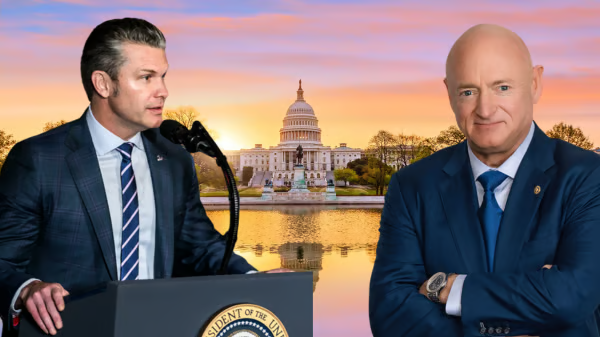
In response to War Secretary Pete Hegseth’s announcement of the forthcoming demotion of retired Navy captain and current U.S. Senator Mark Kelly (D-AZ), which also involves a cut of the former officer’s retirement pay, Kelly claimed (among numerous insults and other fulminations) that Hegseth was violating Kelly’s right to freedom of speech.
Kelly tweeted,
Over twenty-five years in the U.S. Navy, thirty-nine combat missions, and four missions to space, I risked my life for this country and to defend our Constitution – including the First Amendment rights of every American to speak out. I never expected that the President of the United States and the Secretary of Defense would attack me for doing exactly that.
Kelly is somewhat right and absolutely wrong in stating that.
Kelly has the right to say whatever he wants to say about the U.S. military, its leaders, and their policies, including the claim in contention (that military personnel should and shall suffer no consequences for disobeying orders that do not directly require them to commit war crimes, etc.).
Kelly exercised that right.
When he joined the armed forces, however, Kelly agreed to the rules of that organization. Those rules include restrictions on personal conduct. As a retired officer, Kelly is still subject to those strictures.
In addition, upon entering the U.S. Senate, Kelly took an oath to support and defend the Constitution of the United States. Kelly’s claim that the Secretary of War cannot enforce the military’s code of conduct undermines the Constitution by denying the president’s powers as commander in chief.
Even worse, Kelly’s outburst overturns the meaning of individual rights. Our rights to life, liberty, and property predate the Constitution and set the boundaries of government, as the Declaration of Independence and Constitution make clear. Those documents authorize and in fact require the government to protect us from force and fraud.
That is what the social contract is. Without those requirements, all government is overt tyranny, either extant or in the making.
Hegseth’s decision fits under the heading of protecting service members from fraud, specifically statements that could endanger the lives and liberties of military personnel that follow Kelly’s advice, an action which in turn undermines the armed forces’ ability to protect the American people from invasion. (The latter is the one undeniable justification for the existence of a standing army, if any is possible. I think that there is a strong case that we should not have such an army, but that is a discussion for another time).
Hegseth’s demotion of Kelly is in fact a very small consequence for conduct that the Secretary of War believes endangers the lives, liberty, and property of the nation’s entire population, no matter how unlikely it was that the senator would be particularly successful in his attempt to undermine legally and morally justified activities of the military.
Regardless of whether Hegseth has correctly identified Kelly’s statements as a danger to military personnel and the American people, the Secretary of War has the authority and the responsibility to institute appropriate discipline, as delegated by the Commander in Chief.
The Bill of Rights is meant to codify the government’s obligation to protect people from force and fraud. It is not a “Get Out of Jail Free” card.
It is dismaying to witness a sitting U.S. senator demonstrating a complete failure to understand the Constitution, the Bill of Rights, and, most importantly, the foundations of our individual rights. Unfortunately, it is commonplace these days.
Source: CBS News
NEW Heartland Policy Study
‘The CSDDD is the greatest threat to America’s sovereignty since the fall of the Soviet Union.’

Contact Us
The Heartland Institute
1933 North Meacham Road, Suite 559
Schaumburg, IL 60173
p: 312/377-4000
f: 312/277-4122
e: [email protected]
Website: Heartland.org