There are reports that during the Trump-ordered military raid on Venezuela to oust and capture President Nicolás Maduro, at least one US helicopter was hit by surface fire or possibly small missile, but the chopper managed to keep flying – with the pilot wounded – and the damaged aircraft made it back from the mission safely.
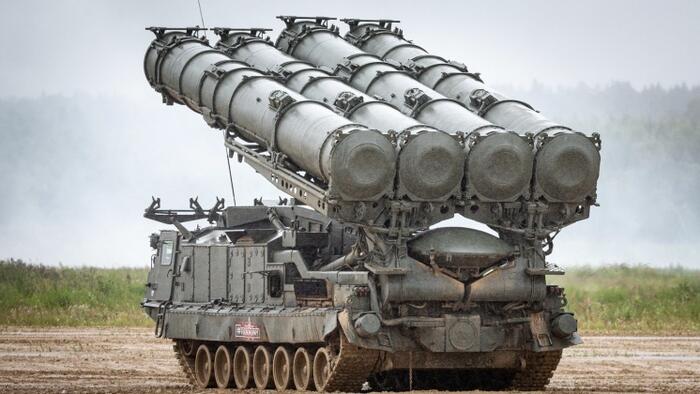
But this raised the question: what happened to Venezuela’s Russian-supplied anti-air defenses, including S-300 and Buk-M2 surface-to-air missile systems purchased in 2009?
While at this point it is well understood that the US military and CIA had help from inside the Venezuelan government – making it essentially a US-backed coup topped off with a special forces nab and grab against Maduro and his wife, there’s still the question of whether the entire Venezuelan armed forces were ordered to stand down, or else that their defense systems simply didn’t work or were inactive.

The New York Times says it was actually more the latter scenario – Russian-built air defense systems stationed in Venezuela were mostly inoperable and did not react to the major initial US strikes which paved the way for the ground operation in Caracas.
When American military aircraft entered Venezuelan airspace on Jan. 3, the missile systems were not even linked to radar, according to US officials privy to the mission to The New York Times.
The publication further explained the systems were not integrated with one another and may have actually been unusable for several years. Satellite imagery and photographs further suggest that critical elements of the air defense systems were being kept in storage rather than deployed.
Interestingly the Ukraine war has played a role, after early in the conflict US defense officials said they would support and supply the Zelensky government in order to ‘weaken’ Russia by bogging it down in a proxy war.
US officials explained to the Times that Venezuela (and presumably other Russian defense allies) has faced ongoing difficulties maintaining its Russian-made air defenses because of limited access to Russian technicians and spare parts – all of which have had to be diverted to support Russia’s ‘special military operation’ in Ukraine.
Much of the initial US strikes appeared to focus on areas where Buk missile systems had been positioned or stored, and locations close to the capital.
“The Venezuelan armed forces were practically unprepared for the U.S. attack,” Yaser Trujillo, a military analyst in Venezuela, told The New York Times.
“Their troops were not dispersed, the detection radar was not activated, deployed or operational. It was a chain of errors that allowed the United States to operate with ease, facing a very low threat from the Venezuelan air defense system,” Trujillo added.
And a separate source concludes:
Venezuela’s much-touted antiaircraft systems were essentially not connected when U.S. forces entered the skies over Venezuela’s capital, and they may not have been working for years, former officials and analysts said.
“After years of corruption, poor logistics and sanctions, all those things would have certainly degraded the readiness of Venezuela’s air defense systems,” said Richard de la Torre, a former C.I.A. station chief in Venezuela who now runs Tower Strategy, a Washington-based lobbying firm.
The below OSINT account predicted this outcome back in mid-November:
For some context to those who haven’t been following for a while.
This is Venezuelas S-300 system and its storage at Captain Manuel Rios airbase in Guarico.
The missiles for the unit are stored just 100m away from the vehicles in a hangar.#Venezuela https://t.co/ka06CDPnVt pic.twitter.com/PqlCOZurqS— CNW (@ConflictsW) November 15, 2025
The report throws open another interesting possibility, with two former US officials stating their view that Moscow may have permitted the systems it sold to Venezuela to fall into disrepair in order to avoid escalating tensions with Washington.
Loading recommendations…