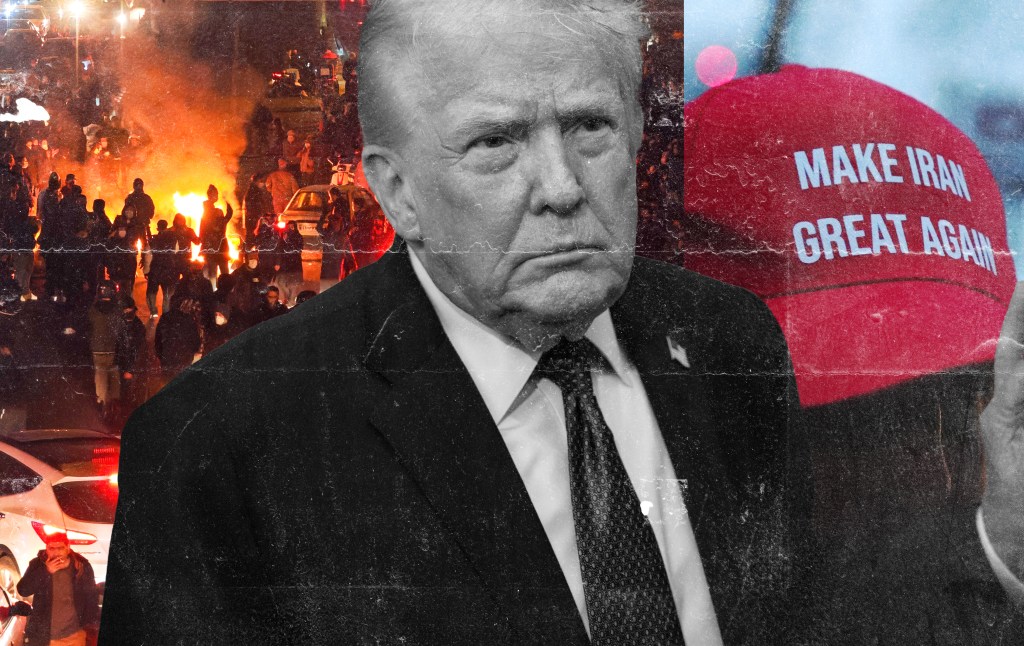
Even the timing is weird: In between his denunciations of violence in Iran, the president has spent the last few days justifying Renee Good’s killing by an ICE agent in Minneapolis. His latest rationalization is that she was “highly disrespectful of law enforcement,” which isn’t true of her confrontation with the agent (and wouldn’t matter if it was) but surely is true of many of the Iranians confronting security forces in the streets. Why is ICE entitled to use violence against disrespectful lawbreakers in the name of keeping order but Iranian goons aren’t?
A few days ago, Homeland Security Secretary Kristi Noem went as far as to address the matter of Good’s death from a podium emblazoned with the words, “One of Ours, All of Yours.” That slogan (which may or may not have a Nazi pedigree) appears to be an allusion to collective punishment—i.e. if you harm one of ours, we’ll harm all of yours. Any military following a policy like that would be guilty of war crimes under the Geneva Conventions; for the head of a U.S. law enforcement agency to endorse it with respect to citizens of her own country is pure fascist insanity.
I’ll bet it aptly describes the attitude of Iranian regime forces as they battle protesters in the streets, though. So, once again: What gives? Why is an authoritarian American regime that’s forever seeking chummier relations with authoritarian regimes like Russia’s and China’s so determined to see an authoritarian regime in Iran fall?
Iran first.
The easy answer to that question is that Iran and its proxies have killed a lot of Americans over the years. From the Beirut barracks bombing in 1983 to the attacks on U.S. troops by Shiite militias during the occupation of Iraq, the mullahs’ hands are dripping with American blood. Supporting their overthrow isn’t just a matter of seizing an opportunity to neutralize a lingering threat with nuclear ambitions, it’s a matter of payback.
But the easy answer is too easy. After all, as we’ve just seen in Venezuela, America doesn’t need—or necessarily even want—regime change in order to bring a hostile government to heel.
Nicolás Maduro’s Chavista outfit isn’t as dangerous as Iran’s militarized revolutionary entity but it too has harmed the United States in many ways, to hear the president tell it. It stole “our” oil when it nationalized the assets of American oil companies operating locally; it exacerbated America’s immigration crisis by terrorizing Venezuelan citizens, sending many fleeing north as refugees; it made common cause with traditional U.S. enemies like Moscow and Beijing; and, oh right, it supposedly helped rig the 2020 election that turned Trump out of office.
The White House owes the Chavistas some payback too, yet it hasn’t encouraged any Iran-style popular uprisings against the Maduro-less Maduro regime that now runs Venezuela. On the contrary, it prefers to keep his vice president, Delcy Rodríguez, in charge for the sake of stability than to install opposition leader María Corina Machado as the country’s new leader. It’s even turned a blind eye (so far) to Rodriguez’s iron-fist approach to dissent, seemingly believing that a compliant, orderly authoritarian state is preferable to a chaotic mess in which the people are in open revolt and no one is in charge.
Trump could have taken that approach to Iran. Instead of backing the protesters, he might have reached out quietly to leaders of the Islamic Revolutionary Guard Corps with a proposal: If they agree to depose Ayatollah Ali Khamenei and his clerical inner circle and cooperate with the United States (starting with giving us a cut of their oil!), the White House will lift sanctions and do what it can to keep the IRGC functionally in control of the country. Its leaders would remain free to enrich themselves at the people’s expense by maintaining their various corrupt rackets, just as Rodríguez and her cronies in Venezuela remain free to do so.
That would have been consistent as a matter of policy and ideology. Venezuela is “America First” in action, prioritizing bottom-line U.S. interests like resource extraction over the welfare of the locals. The kind of proposal I’ve described would be an Iranian version of it.
But the White House’s approach to Iran, thus far, is more a case of “Iran first.” (MIGA!) By supporting popular protests, Trump is risking the same sort of anarchy he’s trying to prevent in Maduro’s country. In scrambling to dislodge the regime, he’s even threatened to impose 25 percent tariffs on countries like China that continue to do business with the Iranian government. That would amount to a new tax on Americans when voters are already struggling with the cost of living, precisely the sort of thing that “America First-ers” normally resent as an example of their leaders prioritizing the welfare of foreigners over their own.
A new military strike in support of the demonstrations would be the icing on the cake. The president chatters endlessly nowadays about the “Donroe Doctrine,” which is shorthand for pivoting away from policing the East and instead shaking down countries in the West. This is our hemisphere, and that is their hemisphere, as I put it a few days ago—except now here we are, meddling in “their hemisphere” again, and in the riskiest possible way by preparing to drop bombs in the middle of a nascent popular revolution.
Why is Iran a grand exception to Trumpism’s preference for authoritarianism?
Breaking the snake.
I think there are defensible strategic reasons for the White House to approach Iran differently, which is not to say that those are Trump’s actual reasons for approaching Iran differently.
The calculus might be this simple: Iran’s clerical regime has been so dangerous for so long that ousting it is worth doing even if anarchy reigns afterward for some length of time. It’s an opportunity that can’t be missed, especially since the alternative I proposed earlier would involve leaving a sinister element like the Revolutionary Guards in charge. Khomeinist remnants can’t be trusted with the country’s long-term stewardship, even if they’ve vowed to play nice with the United States. Their cooperation might (and probably would) end someday, and if it did, Americans would kick themselves for not seizing the current chance to bury the Islamic Republic.
I can only imagine the look on the faces of Mohammed bin Salman and other Sunni leaders around the region if their friend Donald Trump floated the idea of saving the Revolutionary Guards from the wrath of Iranian demonstrators. No one, maybe not even Israel, stands to benefit more from the demise of a Shiite fundamentalist state than Iran’s Sunni neighbors do. The snake is suddenly underfoot; they expect the president to seize a once-in-a-half-century chance to break its neck.
The calculus for Venezuela is different. As loathsome as the Chavistas are, they’re no danger to the United States. In their case, and unlike in Iran, extending their rule might impose less of a cost on Americans than removing them would, risking a civil war and potentially triggering a new refugee crisis that could land at our southern border. The fact that Iran’s uprising is happening in “their hemisphere” reduces the cost of U.S. intervention, notwithstanding the “Donroe Doctrine” argle-bargle about prioritizing hemispheric dominance.
We can further simplify the calculus by noting that the White House isn’t starting from the same point morally with Iran as it did with Venezuela. In propping up Delcy Rodríguez and the Maduro-ite remnant, Trump didn’t take sides against a popular uprising. At worst, by removing the dictator but not his regime, he preserved the unhappy status quo; if anything, by pressuring the new government to make modest concessions to human rights, he’s marginally improved life for Venezuelans.
By contrast, intervening in Iran to prop up the mullahs in the name of “stability” and “America First” when a popular uprising is already in full swing would be the filthiest thing he’s done as president. Americans would hate him for it, not only because the Khomeinists have been a despised enemy since the U.S. Embassy was overrun in 1979 but because there’s still enough love of liberty left in our national DNA to make us sympathize instinctively with people risking death for freedom. There’s no “Delcy Rodríguez option” for Trump with Iran, only neutrality or full-throated support for the demonstrators. For once lately, he’s doing the smart thing politically.
And don’t forget that the man hates being aligned with losers. The only thing worse than trying to rescue the mullahs from the wrath of the Iranians they’ve oppressed for decades would be trying and failing, turning a gross moral humiliation for America into a political one as well. Siding with the protesters carries no such risks, as the White House will have the consolation of having been on the side of justice even if the uprising is suppressed.
Saving the world.
We can only guess whether, and to what extent, any of these considerations are influencing Trump. I do think there are other factors influencing him, though.
The prospect of avenging the embassy takeover in 1979 appeals to him viscerally, I’m sure. In some ways our very old president has never quite left the 1970s and 1980s; even his obsession with oil seems anachronistic in an era when China is racing ahead on clean energy. As much as Americans bear the Iranian regime a grudge for the Iran hostage crisis, a man like Trump who lives in the past and runs on pure grievance likely bears it more heavily than most. If so, his unquenchable thirst for retribution would be justified for once.
The president also values personal relationships and has a nose for “weakness,” both of which point to antagonism toward the mullahs. Iran has never looked weaker than after spending the last two years being slapped around by Israel, which might be enticing Trump to align himself with the protesters in the belief that they’re the stronger horse in this fight. And he has no relationship with Khamenei of the sort he has with, say, Vladimir Putin or Xi Jinping that might cause him to back off if similar protests arose in Russia or China. Trump wouldn’t want to betray an, ahem, “friend” by supporting his ouster; there’s no such incentive with Iran’s ruler.
His relationship with Israel surely matters, too. There might be no country on Earth where the president is more popular, so much so that he’ll soon become the first foreign leader to be awarded the Israel Prize. Last year he backed Benjamin Netanyahu’s operations in Gaza to the hilt, then sent bunker-buster bombs down the chimney of Iran’s nuclear facilities to try to neutralize an existential threat to the Jewish state. One poll taken a few months ago found that Israelis believe Trump has more influence over their country’s security decisions than Netanyahu does.
Now he has a chance to help topple their archenemy, a regime that’s been waging war on the country through proxies intermittently for nearly 50 years. So tight is this administration with Israel that U.S. Ambassador Mike Huckabee held a “friendly” meeting a few months ago with Jonathan Pollard, who served 30 years in federal prison for … spying on the United States on Israel’s behalf. You think Trump’s going to suddenly draw the line on maximum cooperation at a moment when the mullahs are teetering?
Even if you removed Israel from the equation, the fact that a new revolution in Iran would represent an epochal geopolitical earthquake might suffice to get Trump involved. He has a messianic complex and a need for attention unlike any we’ve seen from a world leader in a good long while. He’s not going to watch the world change in Tehran without trying to get some credit for it.
Which brings us back to the question we began with: How does he reconcile leading the anti-authoritarian parade in Iran with behaving like an authoritarian at home? The typical autocrat dislikes uprisings in other countries, fearing that they might inspire his own subjects to get funny ideas. Not Trump. He’s simultaneously in favor of Iranians taking over their institutions and in favor of American women being shot in the head if they behave “disrespectfully” toward ICE.
What seems like a contradiction really isn’t, though. The president views the world in terms of friends and enemies, not resistance and oppression or order and disorder, and so the fact that ICE protesters seek resistance through nonviolent disorder while Iranian goons seek order through violent oppression is neither here nor there. They’re each Trump enemies because each, in wildly different ways, is impeding his administration’s agenda. It’s not complicated: Whether here or in Iran, if you get in his way, you’re playing with your life.
That’s how he can sound like a freedom fighter one minute in calling on Iranians to rise up and a mullah the next in vowing that “THE DAY OF RECKONING & RETRIBUTION IS COMING” soon in Minnesota. If you’re not with him, you’re against him. Iran’s regime, like Renee Good, made its choice and will now take the consequences.