Since appointing Powell in 2018, Trump has grown distant and annoyed with his pick and by the end of that year had even started discussing his desire to fire Powell. But Federal Reserve Board chairs serve four-year terms. After being renominated by then-President Joe Biden and confirmed by the Senate again in 2022, Powell’s current term is slated to end in May of this year. By statute, a president can remove Federal Reserve chairs only “for cause.”
It appears that with the central bank’s renovation projects, Trump thought he may have found cause to do so, and brought up firing Powell again last summer. That was the context for his June 15 testimony before the Senate Banking Committee to defend and answer questions about the renovation.
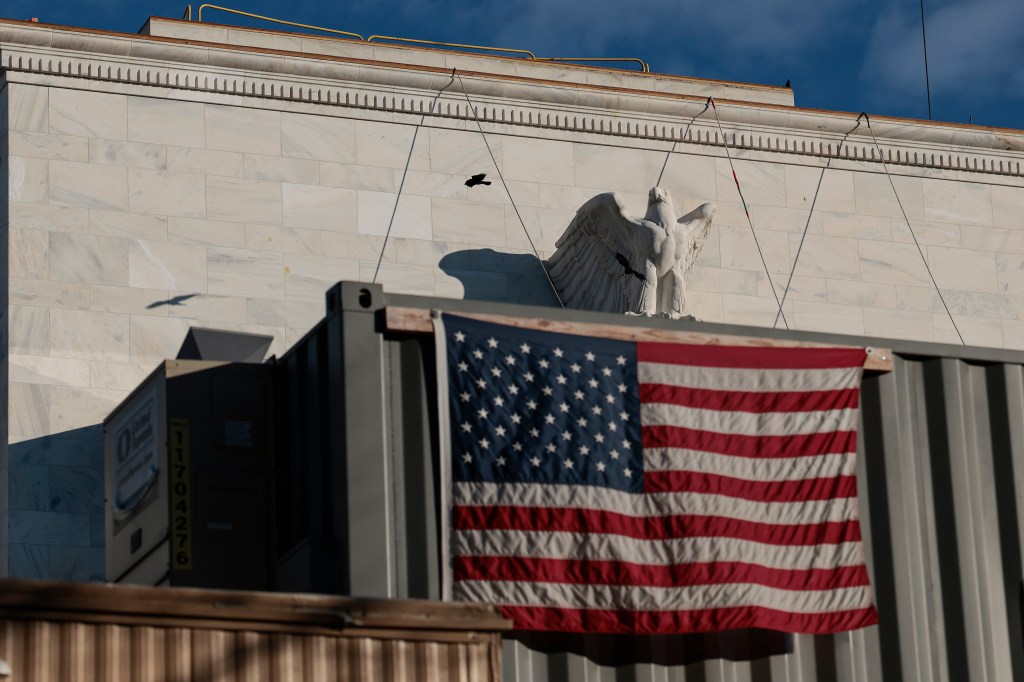
The Federal Reserve’s two main headquarters buildings in Washington, both constructed in the 1930s, have never undergone comprehensive renovation. They also contain asbestos and lead contamination. According to Powell, the two buildings are “not really safe” or “waterproof.” Powell also denied that there would be any speculated flamboyant addons: There would be “no VPI [sic] dining room,” “no new marble,” “no new water features, and “no beehives and there’s no roof terrace gardens.”
In July, White House Office of Management and Budget Director Russ Vought sent Powell a letter asking him to answer further questions about reconstruction plans. Vought tweeted that Powell’s congressional testimony the previous month “has led to serious questions that now require additional oversight,” and that various luxuries were included in the renovation plans, despite Powell testifying otherwise. Powell responded a week later, saying that, per the construction plans approved by the National Capital Planning Commission in 2021: The only “garden terrace” included is a ground-level lawn placed above an underground parking lot; there are no plans to construct “VIP dining rooms,” though renovations would include multi-use conference rooms used for “mealtime meetings”; construction is preserving the buildings’ original marble with new material only replace damaged components; there are no plans to build “VIP elevators” but to restore the original ones and bring them up to code; and initially proposed new water features have been “eliminated” with original water fountains at one building being restored.
None of that stopped former Fox News host and U.S. Attorney Jeanine Pirro from reportedly opening the investigation into Powell in November 2025. Pirro claimed Monday night that her office had repeatedly tried to contact the Federal Reserve over the matter and was “ignored,” prompting her team to pursue legal action. On Monday, a Justice Department spokesman told outlets that Attorney General Pam Bondi had “instructed her U.S. attorneys to prioritize investigating any abuses of taxpayer dollars,” but wouldn’t say more about her knowledge of the investigation. Multiple outlets reported that Pirro did not seek approval from senior Justice Department officials, nor did she inform the White House or Treasury Department before issuing subpoenas. Trump told NBC News on Sunday that he was not aware of the investigation, nor that it had any connection to the president’s vocal support for looser monetary policy. “No. I wouldn’t even think of doing it that way,” he said. “What should pressure him is the fact that rates are far too high. That’s the only pressure he’s got.”
But such claims have not comforted Republican lawmakers. On Monday, Senate Majority Leader John Thune emphasized that any legal case involving Powell should be “resolved quickly” so as not to appear as political interference, and that the potential charges “better be real and they better be serious.” Sen. Lisa Murkowski of Alaska described the legal probe as “coercion.” Sen. Susan Collins of Maine said Powell’s video raised “a lot of disturbing questions” and that Powell was a “person of integrity.” Sen. Thom Tillis of North Carolina said Sunday that he would oppose all central bank nominees—including for another Federal Reserve chairman—“until this legal matter is fully resolved.” He stated he had no “remaining doubt,” the administration advisers “are actively pushing to end the independence of the Federal Reserve. Several other Republican senators—Kevin Cramer of North Dakota, John Kennedy of Louisiana, and David McCormick of Pennsylvania—also expressed skepticism. Even the Trump administration itself didn’t seem unified. Axios reported that Treasury Secretary Scott Bessent was unhappy with the news and warned Trump on Sunday that the move could spook financial markets.
On Monday, a bipartisan group of former lawmakers and senior economic government officials—including every living former Federal Reserve chairman—signed a statement rebuking the criminal probe, which it called “an unprecedented attempt to use prosecutorial attacks to undermine that independence” that “has no place in the United States whose greatest strength is the rule of law.” Several notable Wall Street executives—including JPMorgan Chase CEO Jamie Dimon and BNY Chief Executive Officer Robin Vince—independently told reporters they opposed the probe.
Though stock indices dropped Monday morning, they largely recovered that afternoon, but that doesn’t indicate a lack of concern. “It looks like markets are taking the view that the president is going to walk this back,” Michael Strain, the director of economic policy studies at the American Enterprise Institute, told TMD. If he doesn’t, “Then we could see some volatility.”
Francesco Bianchi—an economics professor at Johns Hopkins University who co-authored a paper finding that Trump’s public attacks on the Fed moved rate expectations and pushed up breakeven inflation—told TMD that the lack of volatility may also indicate that markets have already priced in White House pressure on the Fed. “Trump has been pretty vocal for a while about the fact that he wants monetary policy change,” he said.
Trump has previously said that the Fed’s monetary policy is responsible for keeping mortgage rates high, writing on social media in August that “people can’t get a Mortgage because of [Powell].” But, Bianchi explained, “If the ultimate goal were to lower mortgage rates, I think this vocal pressure on the Fed is really not going to help. In the end, long-term interest rates are driven by market expectations about inflationary risk.”
Strain added: “What President Trump did in subjecting Jerome Powell to the thrill of criminal prosecution is put upward pressure on those long-term interest rates, and so this is a self-defeating policy.”
Kedia explained the underlying dynamic: “So much of current inflation depends on people’s expectations of inflation in the future”—and an independent central bank helps anchor those expectations.
Powell’s chairmanship ends on May 15, and Bessent said on January 8 that the administration was likely to announce its nominee for Fed chairman later this month. But that may be complicated by the investigation into Powell. “It’s going to be harder for that [nominee] to convince the world that he is really independent if the president is acting like, ‘If I don’t like what you do, I’m going to find some funny excuse to get you fired,’” David Wessel, director of the Hutchins Center on Fiscal and Monetary Policy at the Brookings Institution, told TMD.
“It’s a wonderful thing to be able to print your own money, but it’s an incredibly dangerous temptation,” Jason Furman, former chair of the Council of Economic Advisers under President Barack Obama, told TMD. “One of the few institutional arrangements that lets you have the upsides of fiat currency without the tremendous downsides is an independent central bank.”