I don’t foresee how the anger at ICE will abate. Public anxiety about affordability might ease if the economy brightens, but it’s impossible to imagine the president or head goon Stephen Miller reining in the secret police force they’ve built. That force is the tip of the Trumpist spear, the purest official expression of the postliberal id, the place where populists’ ruthlessness, xenophobia, and unaccountability converge. It’s no exaggeration to say that a renegade ICE is the whole point of the second Trump administration.
The White House won’t restrain it. The agency will get more aggressive in its conduct, and the public will grow more resentful of its tactics.
Which brings us to a question for the right: Do you want immigration enforcement to be discredited in the eyes of Americans? With apologies to Frum, if Republicans insist that only fascists can enforce borders, voters might decide that not enforcing borders isn’t so bad after all. How is that good for the long-term cause of making America great again?
The rough stuff.
There are many things wrong with ICE, but the basic problem was distilled efficiently by John Sandweg, a former acting director of the agency, when he posed a question of his own during a recent interview with Politico. Why on earth is the administration announcing its operations before they happen?
“This is so bizarre to me,” Sandweg marveled. “How high-profile [it is], we announce weeks in advance that ICE is coming to town. Candidly, that just puts the officers in greater jeopardy. You’re telling all the potential targets, ‘We’re coming to get you next week.’ I mean, what?”
Why put local protesters on notice, giving them time to prepare an organized response? Why give violent criminals who are in the U.S. illegally a heads-up to leave town before agents arrive?
It makes no sense as a strategy for effective law enforcement—but lots of sense as a pageant of domineering law-and-order assertiveness. The Trump administration wants confrontation. Its top priority isn’t to unobtrusively detain and remove the most dangerous immigrants, as the deportation numbers prove. Its priority is to intimidate its cultural enemies with heavy-handed displays of authority and promises of official impunity for those who carry them out.
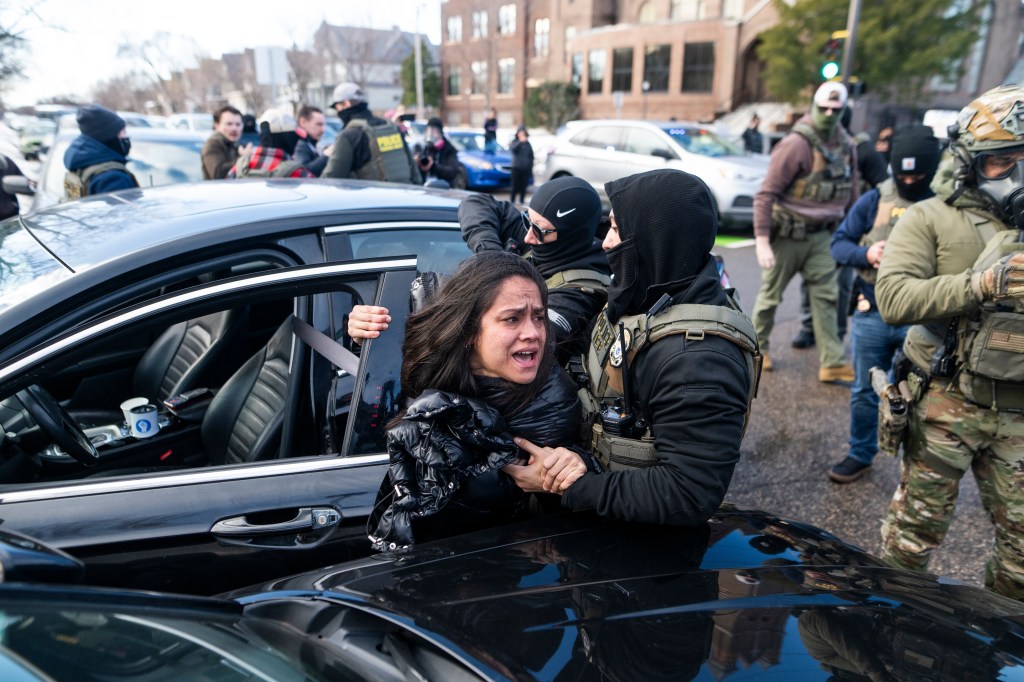
That’s why ICE wears masks, a privilege even U.S. combat troops don’t enjoy, and why some agents are kitted out in camouflage despite the fact that they’re not trying to “blend in” to their urban surroundings. (There’s nothing stealthy about ICE.) They’re not enforcing the law, they’re going into battle. And their anonymity signals, to you and to them, that no one will hold them accountable for what happens during that battle if you make trouble.
They might bust out your car window and drag you from your vehicle. They might knock you down when you’re filming them. They might do … whatever the hell this is. Or, of course, they might shoot you. Everyone—everyone—understands that they’ll pay no price legally. The goon squad has a free hand to behave like goons because the president, his team, and most of his supporters fervently believe that letting the authorities behave ruthlessly with impunity toward “the bad guys” is the only way to keep order in society.
The lengths to which the administration has gone to demonstrate that belief in Renee Good’s case is already the stuff of dark farce. Last week “gun-toting feds in ski masks” were seen removing items from the home of the ICE officer who shot her, but FBI agents don’t typically hide their faces when executing search warrants. One can only wonder if those “feds” were ICE personnel disposing of potential evidence that might incriminate their colleague, not cops collecting it for investigative purposes.
To all appearances, the Justice Department is more concerned with wrongdoing by the victim and her family than with a federal officer killing a U.S. citizen. The FBI is reportedly probing whether Good belonged to any left-wing networks, presumably to bolster the White House’s case that she deserved what happened to her and to justify a campaign of legal harassment against those networks. And the U.S. attorney’s office in Minneapolis is trying to jumpstart an inquiry into Renee Good’s wife, a move so dubious that six prosecutors in the office have resigned in protest of it.
Normally when a federal agent shoots someone fatally, the criminal arm of the DOJ’s Civil Rights Division will look into it to make sure the use of force was proper. In Good’s case, division head Harmeet Dhillon has already informed deputies that she won’t open an investigation, according to sources who spoke to the New York Times. Although Wednesday’s CBS News report that John Ross, the officer who shot Good, suffered internal bleeding might raise enough questions to warrant a change of heart.
An immigration officer can shoot an American citizen dead, on video, in a manner that a majority of the public believes was unjustified, and the president’s law enforcement team won’t even go through the motions of pretending to care. How’s that for restoring public confidence in immigration enforcement?
All of this is happening, meanwhile, in the context of the White House very publicly deprofessionalizing ICE in its haste to bulk up the force. It would be one thing to give agents an extra benefit of the doubt if Homeland Security were recruiting the best of the best, but it’s done the opposite. The agency’s lowered hiring standards and truncated training already have become fodder for South Park gags, and it’s reportedly now planning a “wartime recruitment” strategy that will target gun shows and military enthusiasts—not the sort of people, one would think, whose first impulse during confrontations will be to de-escalate.
Renee Good won’t be the last U.S. casualty of Trump’s secret police behaving too aggressively, and the White House is fine with that. Americans are not.
A temporary solution.
The most one can say in favor of all of that as a strategic matter is that it has short-term deterrent value.
All postliberal policies do. Trying to scare the bad guys into not being bad is the One Neat Trick of authoritarianism, an expression of its faith that any social ill is potentially solvable if we apply enough force. Trump ended Biden’s border crisis, didn’t he? Well, the prospect that would-be migrants now face of masked goons pummeling them at Home Depot and tossing them into the back of an unmarked van destined for parts unknown probably has something to do with that.
But if revulsion at ICE’s methods causes Americans to rethink the costs and benefits of immigration enforcement, border hawks potentially have a long-term problem. Already some polling has detected a meaningful shift in attitudes: In July of last year, Gallup found 79 percent of Americans now believe immigration is a good thing for the United States, the highest level recorded this century. If the goal of right-wing nationalists is to set America on a permanent trajectory of allowing in fewer immigrants, they’re going about it in a funny way.
Then again, that’s been a hallmark of Trump’s second term. For all of the president’s pretensions about leaving his mark on the country indelibly, virtually everything he’s done in his first year back in power is at risk of being wiped away on day one of the next Democratic administration. With rare exceptions like the One Big Beautiful Bill Act, his agenda has been written in the disappearing ink of executive orders. Despite the fact that his party controls both chambers of Congress, he and it have done little to try to make his policies permanent by enacting them legislatively.
It’s one thing to risk an electoral drubbing for the sake of passing important but unpopular laws, as Democrats did with Obamacare in 2010. They were crushed in the midterms that fall, but the health care program they created endures to this day. It’s another thing to risk an electoral drubbing for the sake of implementing an immigration enforcement policy that can and will easily be reversed by the opposition the moment they have the chance.
That’s what Trump is doing now with ICE. Why? What’s the endgame? The administration isn’t going to deport 14 million illegal immigrants before January 2029, and no one would like the economic consequences if it did. But by tossing all forms of accountability out the window, it might succeed in convincing Americans that tough immigration enforcement just isn’t worth the civic and social costs. That would be a disaster for those of us who think that securing the border is, in fact, a worthy goal and an inescapable priority of national sovereignty.
Many Trump voters are smart enough to understand that. Certainly, Stephen Miller is smart enough to understand it. That they insist on proceeding anyway with a policy destined to turn Americans against immigration enforcement can be explained in one of only two ways.
It could be that they’re so drunk on ruthlessness that it’s become an end in itself, not the means to an end of some social outcome (i.e., fewer immigrants long-term) that they’re trying to achieve. A cynic like me would tell you that that’s always been the case for postliberals, but even if you disagree, there’s just no denying that the president’s ruthless gambits are turning more stupidly, self-destructively ruthless by the day.
Threatening Jerome Powell with criminal prosecution, for instance, isn’t going to scare the Federal Reserve chairman into resigning. It’ll deepen his resolve to stay put, anger congressional Republicans, potentially spook bond markets, and remind America’s global creditors that they really should be demanding higher interest rates to park their money in a country run by a Peronist madman.
Ditto for threatening to seize Greenland. Invading the island would be phenomenally unpopular, would destroy NATO, would weaken every alliance on earth that America currently maintains, would cause the hawkish Republican majority in Congress to lose their minds, and would probably end in 2029 with a Democratic president returning the territory to Denmark with an apology.
These are idiotic, self-sabotaging stunts. The only reason to move forward with them is if Trump and his toadies find the pleasure of behaving ruthlessly so intense that they don’t mind if their actions ultimately backfire. That could plausibly explain the president’s attitude toward ICE.
Or this might explain it: Trump and his party don’t intend to surrender power if they lose the next election. If he can’t make his immigration agenda permanent by persuading Congress to codify it, he’ll make it “permanent” by conniving to ensure that either he or J.D. Vance is still in charge in 2029, one way or another.
Americans’ changing views on immigration might even supply him with the pretext. “We can’t risk letting Democrats abolish ICE! It’ll be the end of the country!” Trump might say. And the swing voters who are now surprised to find his immigration officers behaving like a goon squad will be surprised anew that a guy who attempted a coup once before is attempting one again.
The more alienated Americans are by Trumpism, the more the right will insist that national survival depends on not submitting to the will of voters. That’s their attitude with respect to public opinion about Renee Good’s killing and, as the president becomes more unpopular, it’ll be their attitude with respect to everything else.