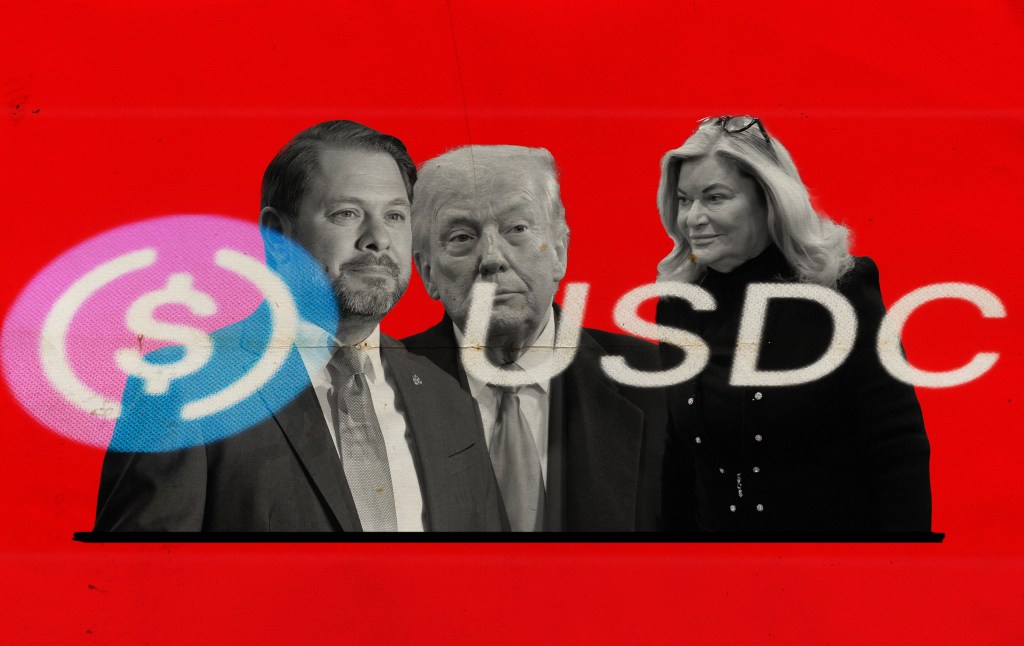
As bedroom lights switched off and heads hit pillows across the nation’s capital on Monday evening, many representatives of the country’s influential crypto industry remained awake at their desks, faces illuminated by the white light of computer screens. Shortly before the hour and minute hands met each other at midnight, what they were waiting for arrived: the draft text of a market structure bill that could shape the future of digital assets in America.
This wasn’t the first time that a draft of the bill—the Digital Asset Market Clarity Act—has circulated. The Senate Committee on Banking, which has been working on a version of the legislation in parallel with the Senate Committee on Agriculture, released an initial discussion draft last June, followed by a revised version in September. But for those in the digital asset industry—which includes everything from cryptocurrencies and their exchanges to decentralized finance (DeFi) platforms and Bitcoin mining operations—the banking committee’s draft is a hinge point of the years-long project to build a comprehensive regulatory framework for crypto.
The bill, which essentially seeks to clarify how and by whom different elements of the digital asset industry will be regulated, was slated to undergo a markup in the banking committee today. But roughly 12 hours before senators were planning on taking their seats in the committee’s hearing room, defections within the crypto industry forced a postponement while negotiations continued.
The release of the draft language mattered to industry insiders because of three areas that have proven to be sticky issues in negotiations thus far: The extent to which DeFi firms and software developers should be subject to traditional financial regulations, whether stablecoins should be allowed to pay interest or rewards to their holders, and conflict-of-interest language that would prohibit senior government officials and their families from issuing, endorsing, or profiting from digital assets while in office. On the first two issues, the crypto industry’s powerful lobbying apparatus has been competing with influential representatives of traditional financial institutions like banks, brokers, and securities exchanges. On the final issue, however, Senate Democrats have been going head-to-head with the White House and President Donald Trump himself.
One of the most contentious and complex areas of debate around the market structure bill involves DeFi technology, meaning financial services like lending, trading, and earning interest that operate through automated computer programs on blockchain networks—distributed databases that record transactions across multiple computers—rather than through traditional banks or brokers. The key question at hand is the extent to which DeFi platforms and their creators should be subject to the same regulations—such as customer identification requirements, trade reporting, and registration as broker dealers—as traditional financial services providers.
Traditional finance firms like Citadel Securities, which sent a letter to the Securities and Exchange Commission in December outlining its position, argue that DeFi platforms and their intermediaries should not be granted broad exemptions from being classified as exchanges or brokers and that the Securities Exchange Act should be extended to cover the technology. If DeFi is given exemptions, they argue, it could create opportunities for regulatory arbitrage where U.S. securities that typically trade on regulated exchanges could instead be traded in tokenized versions on decentralized exchanges with none of the investor protections that typically attach to trading.
DeFi advocates argue that decentralized financial networks are fundamentally different from traditional financial institutions and that they would be incapable of adhering to the same regulations. Entities like the DeFi Education Fund—a nonprofit advocacy organization—have been particularly concerned with ensuring that the software developers that build DeFi protocols and infrastructure aren’t treated as money transmitters under U.S. criminal codes and the Bank Secrecy Act—a burden that DeFi advocates argue would effectively snuff out DeFi development and innovation in the U.S. “It would put them out of business,” a source within the DeFi industry told The Dispatch.
DeFi companies were particularly worried by definitions for decentralized trading protocols laid out in one section of the draft—a provision that had not appeared in previous versions of the bill. “It was just a surprise overall,” Cody Carbone, chief executive officer of the Digital Chamber, a blockchain and digital asset trade association, told The Dispatch.
According to Carbone, the DeFi community is concerned that language defining what does and doesn’t count as “decentralized” is too broad and would subject them to the sorts of traditional regulatory requirements that DeFi advocates have been pushing hard against. “The fear from our DeFi members is that everyone, no matter what, was going to be considered decentralized in name only and have to comply with all these requirements that they just cannot comply with,” Carbone said. Following feedback from industry stakeholders, on Tuesday, Nebraska Sen. Pete Ricketts filed an amendment to address issues with that section of the bill, one of more than a hundred amendments senators submitted between the bill’s release late Monday night and Tuesday’s 5 p.m. deadline.
While regulatory carveouts for the DeFi industry have been a major tension point between the crypto industry and traditional financial institutions, it might not be the biggest. The two industries are also having heated debates about whether stablecoins—a form of cryptocurrency designed to maintain a constant value, usually by being pegged one-to-one to a currency like the dollar—should be able to offer yield payments or rewards to their holders, similar to interest payments made by banks. Under the GENIUS Act, a bill designed to govern stablecoins that was signed into law last summer, stablecoin issuers are required to back their offerings with safe and liquid assets like Treasury bills at a one-to-one ratio. When used as reserves, those Treasury bills then earn stablecoin issuers interest—interest that many in the crypto industry believe they should be able to pay back to stablecoin holders.
Traditional banks, however, and especially smaller community banks, fought hard to ban stablecoin interest payments in the GENIUS Act, with industry groups like the American Bankers Association arguing that if stablecoins were allowed to pay interest, banking customers would pull their money from lower-interest savings accounts in favor of higher-paying stablecoins, drying up bank reserves and making essential community lending more difficult. Crypto firms, on the other hand, argued that customers should be allowed to benefit from interest and that banks simply wanted to prevent competition. The banks won the argument, at least temporarily, and the GENIUS Act was passed with a prohibition on stablecoin interest.
But the stablecoin issue is now back in the conversation. Traditional banks are now pushing the Senate to close a loophole that has allowed stablecoin issuers to pass interest onto holders indirectly through third parties. For example, while the crypto company Circle cannot pay interest to holders of its USDC stablecoin, it can pay some of that interest to an exchange like Coinbase, which then pays “rewards” to the stablecoin’s holders in turn. Critics argue that, through this loophole, stablecoin issuers can still effectively pay interest to holders, circumventing the GENIUS Act’s restrictions and putting bank deposits back at risk.
This month, community bank leaders and financial trade associations have lobbied the Senate to tighten stablecoin interest prohibitions and ensure that stablecoins are used as a means of payment, not as stores of value. Influential crypto firms, meanwhile, are pushing back. “This is a knock-down, drag-it-out fight,” Lee Reiners, a fellow at the Duke University Financial Economics Center and expert on cryptocurrency policy, told The Dispatch. “It’s pitting two of the most powerful industry lobbying groups in D.C. against one another.” On Wednesday, Coinbase—the largest crypto exchange in the U.S.—announced that it would not be supporting the bill in its current form, citing the fact that draft amendments “would kill rewards on stablecoins,” as one of its reasons. The company’s late defection resulted in a last-minute scramble inside the industry as crypto firms and advocacy groups decided whether to back the draft bill or join Coinbase in opposition. Influential players largely chose the former, with Andreessen Horowitz, Circle, Kraken, The Digital Chamber, Ripple, and Coin Center all speaking in support of the bill.
The issue appears to have reached some sort of compromise—be it an unstable one—in the bill’s most recent draft. Under its new language, rewards can be offered to stablecoin holders in some circumstances linked to specific uses, but not simply for holding the coins. One industry lobbyist, who was granted anonymity to speak freely about sensitive industry issues, told The Dispatch that the bill’s language around stablecoins was likely to shift. “It’s very clear and very telegraphed from the Senate drafters that this is definitely not a firm issue that’s solidified among them,” the lobbyist said. “So it’ll likely change before the markup and likely change after markup.”
Discussions around stablecoins are complicated further by the fact that President Trump and his family are directly involved with the technology. Last year, World Liberty Financial—a DeFi platform controlled primarily by the Trump family—launched USD1, a dollar-backed stablecoin. In December, crypto exchange Binance announced the USD1 Booster Program, a reward system for holders of USD1 like those being debated in the market structure bill. While Binance does not currently operate in the U.S., it is pursuing a return to the country following the pardon of its former CEO by Trump last year, and how the bill is eventually worded could significantly affect the Trump family’s ability to grow and earn money from users’ adoption of USD1.
There is no evidence that the White House is pushing for more relaxed stablecoin rules in order to benefit the president’s family, but the potential conflict is on the minds of policy experts all the same. “Trump has got skin in the game on this particular issue,” Reiners said. “Is the president really going to support a policy position that would run counter to his financial interest? He makes money based upon the market flow of USD1, so anything that increases the market cap of USD1 is good for the president.”
Conflicts of interest also threaten to sink the bill entirely. Democratic senators have been advocating for conflict-of-interest provisions that would prohibit certain government officials and their families from issuing, endorsing, or profiting from digital assets. The provisions are clearly aimed at Trump and his family, who have embraced the crypto industry not only as a policy priority, but as a tool for personal enrichment. House Democrats punted on similar demands for conflict-of-interest provisions in this summer’s GENIUS Act, but Senate Democrats have drawn a red line on the issue and thus far stood firm.
“This is largely between the White House and the Democrats at this point,” one blockchain policy advocate told The Dispatch. Republican Sen. Cynthis Lummis of Wyoming, who is the chair of the banking committee’s Subcommittee on Digital Assets, and Democratic Sen. Ruben Gallego of Arizona reportedly worked on ethics language together late last year, but that the language was rejected when presented to the White House, which has also refused to budge on its position that no conflict-of-interest language should be included in the bill.
Whether the red line drawn by Senate Democrats or the White House shifts remains to be seen, but the crypto industry hopes that years of hard work won’t be undone by what is, at its core, a political disagreement. “At the end of the day, if they get through all the other issues, and that’s the sort of last outstanding thing, I can’t imagine the White House is going to let all this work go down and not come up with something,” the blockchain policy advocate said. “But I don’t know. I mean, it’s Trump, right? He can kind of dig in sometimes.”
Recent political developments also threaten to overshadow bipartisan work on the bill. The White House’s probe into Federal Reserve Chair Jerome Powell and Trump’s endorsement of a cap on credit card interest rates are taking attention away from market structure negotiations and drawing ire from key banking committee members like Tillis. Members of the crypto industry have even suggested that the Trump administration might purposefully be supporting credit card interest cap legislation as a show of force to traditional financial institutions that are resistant to crypto-friendly compromises on issues like stablecoin yield. Administration officials aren’t doing much to ease the suspicion either. On Tuesday, in response to a post about whether credit card interest rate caps should be attached to the market structure legislation, Patrick Witt, executive director of the President’s Council of Advisers for Digital Assets, told banks in an X post that “now might be a good time for you to take the deal being offered on stablecoin rewards and yield.”
Despite the hurdles, the crypto industry still feels optimistic that progress will continue toward eventually passing what would be the most significant financial services legislation since the 2010 Dodd-Frank Act. But industry advocates are also cautious—pieces are still moving, language is shifting, and there’s more than a few ways that negotiations could fall apart quickly. “This is a key moment. And I think it’s hopefully one that we can celebrate. But there’s certainly a lot of things that are going to have to be navigated between now and then,” the blockchain policy advocate said.