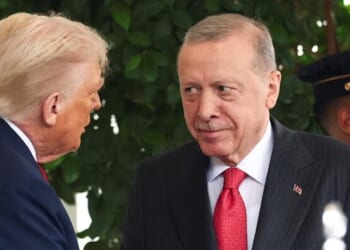
After weeks of White House threats, the sit-down seemed to be a quiet de-escalation. Yet, “We didn’t manage to change the American position,” Rasmussen said. And Trump, in Rasmussen’s view, still wants to “conquer” Greenland.
U.S. acquisition of Greenland is not a new idea—nor are the arguments. In 1946, President Harry Truman offered Denmark $100 million to buy Greenland, citing its strategic importance as a bulwark against the Soviet Union.
Fast forward to 2026, and the president was once again making a similar point: “The problem is there’s not a thing that Denmark can do about it if Russia or China wants to occupy Greenland,” Trump told White House reporters after yesterday’s meeting. On Fox News last week, Vance also stressed that the island was key to defending the North American continent and argued the Danes and Greenlanders had not done enough to bolster defenses.
“People do not realize that the entire missile defense infrastructure is partially dependent on Greenland,” he said. “If, God forbid, somebody launched a nuclear missile into our continent, they launched a nuclear missile at Europe, Greenland is a critical part of that missile defense.”
Vance isn’t wrong, according to Troy Bouffard, the director of the Center for Arctic Security and Resilience at the University of Alaska. Air and missile defense is “part of a complex system of systems that Greenland is part of more than ever before,” he told TMD. Recent advances in hypersonic missiles, such as the Russian Oreshnik, have made target trajectories that fly over Greenland more viable, requiring a recalibration of U.S. missile defense systems.
But that revamp would not require owning Greenland, Bouffard said. The U.S. also has an existing military installation in Greenland, Pituffik Space Base, which is capable of hosting upgraded defense capabilities. “To adapt to changing threats would not be an issue; this would be in the benefit of everyone and part of the normal relationship we already have,” Bouffard said.
Russian and Chinese activity in the Arctic has recently increased, Heather Conley, a senior fellow at the American Enterprise Institute, told TMD. But it’s unclear whether U.S. ownership would improve Arctic security. “We have these great defense agreements and partners who want more economic cooperation,” Conley said. While Arctic nations like Canada and Denmark have increased their defense spending, Conley argued the U.S. has fallen behind on Arctic defense. The Coast Guard currently has only three icebreakers—specialized vessels designed to move through ice-covered seas—though more are under construction.
Along with its defensive interests, the administration has been less vocal about its other, more urgent reason for interest in Greenland: critical minerals, especially rare-earth elements. Greenland has the eighth-largest deposits of rare earth elements in the world, which are crucial for a host of modern technologies, from wind turbines to smartphones to guided-missile systems. But none have been extracted to date due to Greenland’s Arctic location and its frigid, largely ice-covered terrain.
Meredith Schwartz, an associate fellow with the Center for Strategic and International Studies’ critical minerals program, noted that Greenland—with only 93 miles of primary roads—lacks the infrastructure to quickly solve the U.S.’s rare-earth problems. “Rare earth and critical mineral mining in Greenland requires long-term investment,” she told TMD.
Any defensive benefit to acquiring Greenland would be undone if the president were to do so by force. Article 5 of the North Atlantic Treaty, which established NATO, obligates all signatories—such as the U.S. and Denmark—to assist when another is attacked. Article 5 has only been invoked once in history, by the U.S. after the attacks of September 11. Over the course of nearly two decades, Denmark deployed tens of thousands of troops to Iraq and Afghanistan, losing 50 soldiers over the course of both wars.
As an autonomous territory of the Kingdom of Denmark, Greenland is part of NATO and covered under the mutual defense commitment—which would end if the Trump administration attempted a hostile seizure of the island. “If the United States were to choose to attack another NATO country, then everything would come to an end,” Frederiksen said last week.
It would also be illegal. Article 2(4) of the U.N. Charter—to which the U.S. is a signatory—prohibits aggression against the territorial integrity of another state. “Any military action against Greenland would be a violation of both international law and domestic law, as it incorporates international law,” Milena Sterio, an expert in international law and professor at Cleveland State University’s law school, told TMD. The Constitution also prohibits the executive branch from unilaterally adding territory, but Daniel Immerwahr—a professor of history at Northwestern University and the author of How to Hide an Empire: A History of the Greater United States—told TMD that usually hasn’t been constraining. “Presidential action has often led the way, but at a certain point this has to be ratified by Congress,” he said.
Even without an invasion, Otto Svendsen, a European security analyst at the Center for Strategic and International Studies, told TMD that U.S. pressure on Europe to force a sale of Greenland—such as cutting off arms sales to Ukraine or renewing the trade war—could result in severe retaliation on the part of Europe. “There are second-order effects in this crisis that just haven’t been thought through,” Svendsen said. “It’s quite clear, based on everything the Europeans are saying, [that] there would be a very robust European response.” These could include punitive trade measures targeting U.S. industries in swing states and European states host military bases critical to U.S. strategy, like Germany’s Ramstein Air Base. Restricting access to European territory would not only hinder U.S. operations in Europe but also in Africa and the Middle East.
But Rasmussen appeared guardedly hopeful on Wednesday, saying he believed upcoming conversations could “take down the temperature.” That afternoon, the Danish Defense Ministry also announced it would lead a multinational ramp-up of the European forces already deployed to Greenland, for an exercise titled Arctic Endurance.
Ulrik Pram Gad, a senior researcher at the Danish Institute for International Studies, told TMD that Europeans understand they will have to develop defense capabilities strong enough that they need not rely on the U.S. “It’s wrapped into the general doubts about the Western alliance to trust the U.S., or not, ever again,” he said. “So in that sense, nobody wants to rush this, except for the American president.”