It’s the affordability, stupid.
The 2024 election blackpilled me about our country’s virtue, as regular readers know. An ex-president whose last major act during his first term was to attempt an autogolpe was returned to office because swing voters hoped he’d reduce prices at the supermarket.
George Washington’s heirs elected a fascist in exchange for cheaper groceries. (Oops.) The lesson going forward, inescapably, is that if your party has an advantage on kitchen-table issues, it would be insane to run on anything else. Especially appeals to civic conscience, which is what messaging about ICE’s brutality or respecting Denmark’s sovereignty would necessarily involve.
Last week Politico asked Barack Obama’s former chief of staff, Rahm Emanuel, how Democrats should address the capture of Nicolás Maduro and the White House’s exploitation of Venezuela this fall. They shouldn’t, Emanuel replied—except to use the subject as another example of Trump losing the plot on affordability. His recommended line of attack: “The president wants to focus on Venezuela? Democrats are focused on Virginia. He wants to talk about what’s happening in Caracas? I want to talk about what’s happening in Columbus.”
Seems right to me. If “he’s a fascist” didn’t work in the last election, why would it work in the next one? If the winds on managing the cost of living have shifted to favor Democrats, why would they trim their sails and squander such a momentous advantage by focusing on anything else? Pivoting to other issues would signal that the party still has yet to learn its own lesson about the primacy of affordability after the debacle of 2024, a political gift to the White House.
Besides, the issues of ICE and Greenland are fraught for liberals even if they’re momentarily (and maybe only momentarily) on the right side of both in polling.
Americans don’t typically prioritize foreign policy in elections. Even when they do, Democrats are perennially suspected of being too timid to advance U.S. interests abroad because of their anti-war tilt since the Vietnam era and their devotion to international coalitions. That probably contributed to Trump’s switch from “America First” isolationism to ousting Maduro, threatening Iran, and menacing Greenland. Projecting military power to show “strength” is, on some level, just another presidential reaction to left-wing “weakness.”
Voters might not end up opposing Greenland’s seizure as decisively as the current polling suggests either, especially if Trump figures out a way to do it bloodlessly and without shattering NATO. And maybe he will, as Europe will be reluctant to sever ties with America so long as Ukraine still desperately needs Pentagon support. If the White House captures Denmark’s island, puts messaging muscle into selling voters on the strategic and economic benefits, and contains the diplomatic fallout, why would anyone assume it’ll be a factor in how people vote this fall?
If focusing on Greenland would be risky for Democrats, though, focusing on ICE would be downright political malpractice.
The left is too compromised on immigration to run effectively on the issue. Already, hands are being wrung in Washington at the “abolish ICE” rhetoric emerging among liberals, knowing how that will play with swing voters. “The last thing we need to do … is to make the same mistake when it comes to ‘Defund the Police’ rhetoric,” Sen. Ruben Gallego of Arizona complained to the New York Times. “That ended up not actually helping communicate what people wanted.” Never mind defunding the police: Some progressives want Democrats to defund the federal government itself when the money runs out at the end of the month to protest ICE’s conduct in Minnesota.
It’s a terrible idea. Democrats will win the fight over ICE, I think, by making it a referendum rather than a choice—that is, by staying largely out of the way and letting voters approach the issue by asking themselves, “Do I approve of what Trump is doing here?” That’s an easy question to answer. If instead Democrats insist on confronting the president and his party about it, they risk inviting voters to ask themselves, “Do I prefer the way Trump is handling immigration to the way Joe Biden’s administration handled it?”
That’s a much harder question, forcing them to weigh the pros and cons of non-enforcement versus fascist enforcement. Americans might have reached the point where they’ll take the former over the latter, but I sure wouldn’t want to bet a midterm on it.
Affordability should remain not just the persuasive focus of Democrats’ 2026 campaign but the heavy focus. But that’s different from saying that they should ignore ICE and Greenland altogether.
A moral gut check.
If I were on the Democrats’ comms team, my goal would be to minimize partisan “messaging” about those two issues while maximizing public awareness of the controversies around them.
Every time the ICE goon squad is caught on video behaving like an occupying military force, it should be a Democratic priority to circulate the footage. Every time diplomats from Denmark visit the United States to kindly ask the president to stop behaving like Putin, that news should be circulated too. The moral stakes around both issues scarcely require elucidating in the form of a “message.” Do Americans want a deprofessionalized secret police force to be able to shoot U.S. citizens in the head with impunity? Do they want their soldiers turned into pirates, robbing other countries—even friendly ones—of their land and wealth at gunpoint?
These are moral gut checks more so than policy conundrums, and are therefore largely beyond the reach of “persuasion.” All Democrats can do is lay them in front of voters and hope that they react virtuously. They’ll be pleased to know that the shooting of Renee Good has landed, to the point where no less than 82 percent(!) of registered voters claim to have seen the footage of her shooting. And if the president makes a move on Greenland, that will “land” too—it’ll be the biggest geopolitical story since Russia’s invasion of Ukraine, with potentially far greater implications for global conflict.
The problem that the president faces with both issues is that Americans like to think of themselves as the good guys. To say, correctly, that most of them don’t care as much about liberty, democracy, or the constitutional order as they do about cheap eggs is not to say that they don’t care about those things at all—including some who voted for Trump.
The good guys won the Revolutionary War, avoiding the Jacobin bloodletting and Napoleonic imperialism of their counterparts in France. The good guys won the Civil War, freeing African Americans from bondage. The good guys won World War II, liberating Europe from Nazi degeneracy and the Far East from fascist Japan. And the good guys won the Cold War, ending communism’s bid for global conquest. Most Americans are proud of it.
Postliberalism is the belief that ruthless self-interest alone, not “goodness,” should drive political calculations. Some postliberals, like the president, are amoral: Their preference in each of the four conflicts I just named would be driven by how much they would personally benefit from a victory by either side. Others are immoral: In at least two of the four, the sleaziest people in the modern right-wing coalition would have supported the enemy against a liberationist America.
The president is not a good guy and disdains those who are, but he has a reptilian instinct for leveraging Americans’ aspirations to goodness toward his own ends. He was clever last year in how he chose the targets of his innovative power grabs, zeroing in on unsympathetic figures whom he knew the public would be reluctant to ally with. The migrants shipped off to El Salvador without due process were (supposedly) gang members; the boat crews in the Caribbean that he bombed without consulting Congress were (supposedly) drug traffickers.
Even the capture of Maduro was a shrewd test case for legitimizing Trump’s power to take out foreign heads of state when he feels like it. No one will shed any tears for a tinpot caudillo who refused to leave office even after Venezuelans voted him out.
Gangsters, drug dealers, dictators: In each instance, a voter might have disapproved of the president’s methods yet reassured himself that the outcomes were compatible with America’s “good guy” tradition. With the White House’s recent turn on ICE and Greenland, that’s out the window.
Only the most zombified right-wing droog could believe that Renee Good and others brutalized by renegade immigration officers are, to a man or woman, “terrorists.” Only the most dogmatic Putinist could believe that forcibly seizing territory from Denmark, a NATO partner that has shed blood to defend America, is justified in the name of national security. And only the most ruthless fascist could believe that it shouldn’t matter that the democratically elected government of Greenland has made it as clear as can be that it doesn’t wish to join the United States.
Normal people won’t be able to reconcile any of that with their American birthright of being one of “the good guys”—which might not matter if the president had followed through on his campaign promises to reduce the cost of living, but he hasn’t. Trump is remaking the United States into a rapacious criminal and bully in his own image and ground beef is still expensive. Democrats barely need to say a word to voters to make that hurt.
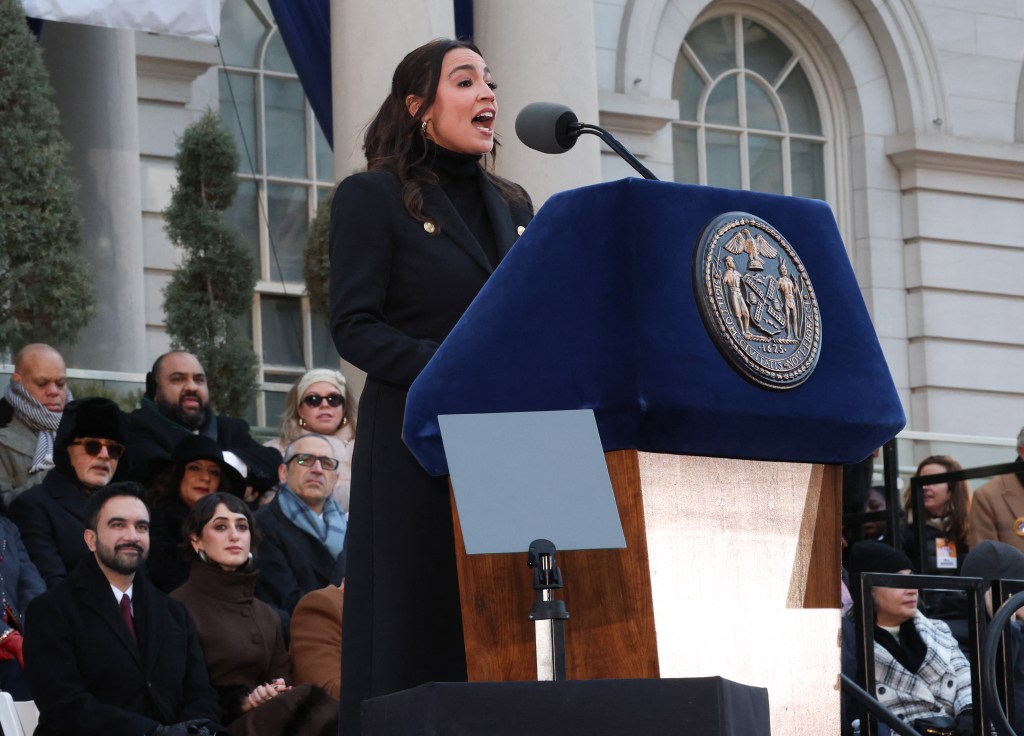
When they do say something, they should connect the two the way Alexandria Ocasio-Cortez did recently when she was asked about ICE. Federal money that should be paying for Obamacare subsidies is instead paying for masked immigration agents to harass Americans at will with legal impunity, she said; according to data scientist David Shor, that was the single most effective Democratic talking point on Renee Good’s death out of a dozen his firm tested. “Trump is doing terrible things” is iffy message-wise at this stage of national decline, but “Trump is doing terrible things and you’re getting screwed because of it” is a solid play.
It reflects the chimerical nature of American identity in the age of Trump. We’re still liberal enough as a country that the president abusing his power matters, but we’re now postliberal enough that it doesn’t matter much unless the objections to those abuses can be explained in terms of ruthless self-interest. ICE, Greenland, blatant shakedowns and bribe-taking, siccing the Justice Department on political opponents, ignoring Congress in matters of war and peace—hardly a bit of it would matter to the rotten swing voters of the United States if inflation had receded and the economy were rocking and rolling right now.
Editor’s note: Boiling Frogs will be off until Tuesday.