President Donald Trump is not always accurate in his characterization of historical events, but he is absolutely correct in his criticism of President Barack Obama’s weakness when he set a “red line” on Syrian use of chemical weapons only to do nothing when it was crossed in 2013, and of the implications of that decision in terms of adversary decision making and understanding of America’s will to stand up to them. It is odd, then, that he seems to be making a similar mistake.
In the summer of 2003, I was a newly promoted captain in the 82nd Airborne trying to convince an Iraqi Shiite university professor to take more of a leadership role in the emerging district council we were establishing in Rashid, the southern portion of Baghdad. While U.S. forces had taken control of the Iraqi capital to celebrations and the toppling of statues, there was still an air of uncertainty about the future. Saddam Hussein had not been captured yet, and there was a fear he would return to power if America lost interest in transforming Iraq. Those we were asking to stand up and stick their necks out had questions—namely, could they count on Americans to help them rebuild Iraqi governance?
As we sat in the sweltering heat, the professor recounted to me that his father and older brother had risen up against Saddam in 1991 when asked to by President George H.W. Bush—part of a larger uprising by Shias and Kurds in the aftermath of the Gulf War—only to have those populations suffer massive casualties in a brutal crackdown by the Ba’athist government, while the U.S. largely sat idly by and observed. Eventually, these led to Operations Provide Comfort, Northern Watch, and Southern Watch to enforce no-fly zones and provide humanitarian aid—but the damage was done. Tens of thousands of civilians lay dead. This professor went on to say we had done the same thing to the Czechs in 1968 and the Hungarians in 1956.
While the criticism of the U.S. during the latter two Cold War era uprisings is not entirely fair—there was very little the U.S. could have done to prevent the communist crackdowns in either case without escalating to a third world war—they demonstrate an internationally held perception. Maybe we could not have helped Central Europeans throw off communism earlier, but we have failed to support pro-freedom movements at times when we should have. And in some cases, we failed to support those whose movements we encouraged to rise up.
America, under Obama’s timid leadership and based on the counsel of a Tehran-accommodating Ben Rhodes, sat idly by during the 2009 Green Movement as the Iranian people protested the questionable election of Mahmoud Ahmadinejad over the perceived reformer Mir Hossein Mousavi. This cool disinterest as protesters were shot remains a stain on Obama’s legacy.
But the Trump administration seems poised to repeat, if not magnify, two of Obama’s failures—first, not supporting Iran’s popular movement and, second, setting a “red line” with neither the plan nor the will to enforce it.
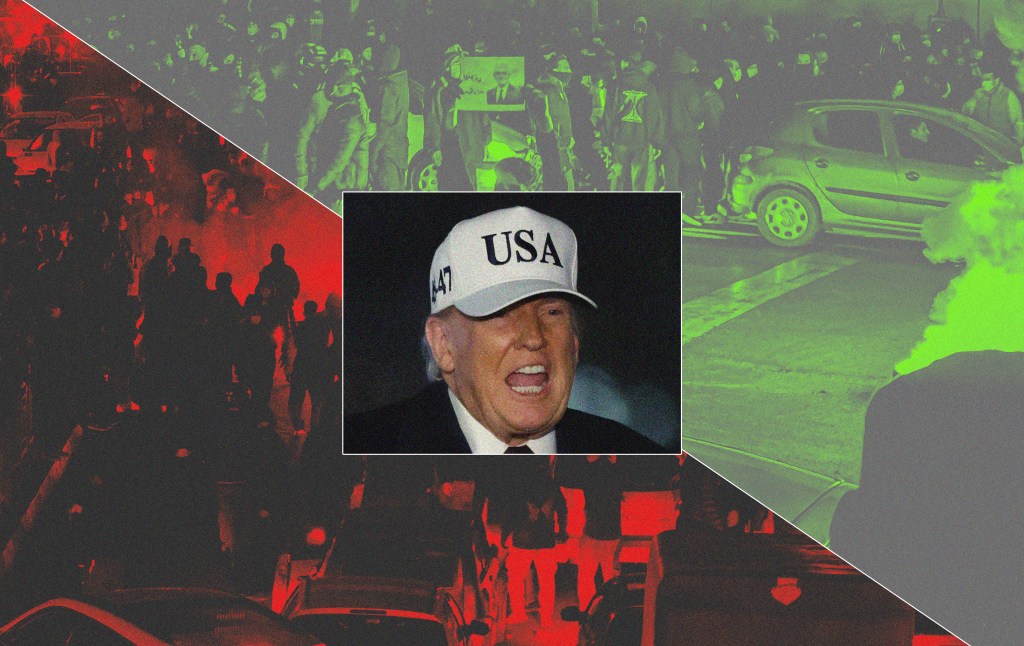
As protests grew and intensified across the country last week, Trump proclaimed that if the Iranian regime took lethal action against its citizens, America would respond to protect the protesters—setting his own red line akin to Obama’s.
The regime responded by killing thousands of civilians and sentencing others to death after hasty kangaroo-court proceedings. Activists and human rights groups have estimated the death toll to be upward of 12,000, with even the regime admitting to mowing down at least 2,000 of its citizens. This, at a minimum, demonstrated the ayatollah’s government was not taking the president’s admonition seriously and, by any measure, had not stepped over the red line but leapt over it. Trump responded by signaling support for the protesters, suggesting they should keep rising up and assuring them “help is on its way.” As recently as Wednesday, the official Senate Republican X account posted a graphic with Trump’s picture and his words encouraging Iranians to continue to resist, and reiterating his promise of help.
Nobody should be under the mistaken impression that there is an easy solution to the situation in Iran, as though a single night of strikes (à la the Midnight Hammer operation in June that struck Iran’s nuclear facilities) will remove the regime, result in a quick transition, and sweep in a popular, democratic, pluralistic government aligned with the liberal West. That’s a pipe dream. But there are myriad actions available to the president. Striking purely military targets away from population centers creates multiple dilemmas for Iran’s leaders, diverting their attention and resources away from the protesters so they can defend their airspace. Striking the barracks and staging areas of the IRGC and Basij units cracking down on the protesters provides citizens some relief from the government violence and perhaps changes the calculus of the commanders of these units before they carry out further regime directives.
Any option demonstrates resolve and commitment to the president’s clear and unequivocal statements in support of the protests. It is possible that any action would restrain further retribution toward the Iranian people during the current upheaval. And it is possible that punishing Iran for crossing the red line would serve as a deterrent if there are future protests, as with Trump’s 2018 strikes against the Assad regime after it used chemical weapons against its own people. And it is possible that these strikes bolster the people’s spirit, weaken the regime, and start a chain of events that lead to the end of an already weakened and vulnerable Iranian government. That outcome would no doubt be complex and involve more American attention to assist in the transition, but if Trump were not prepared to deal with that, he should not have encouraged the popular uprising.
It would be a mistake, and an enduring source of shame—both for the country and Trump’s legacy—if the president goes back on his promises of support based on the word of an evil regime, as he now seems to be taking Iranian assurances about canceling or postponing planned executions as an indication that everything can go back to normal. Obama used the dubious fig leaf of Russian promises to take possession of and destroy Syrian chemical weapons as an excuse for inaction; it would be an equally amateur and weak mistake for President Trump to do the same.
It will be a grim task to tally the butcher’s bill, determining exactly how many Iranian protesters, yearning for freedom and putting their faith in the words of the leader of the free world, were killed after Trump posted his statements of support and encouragement. But signaling that he may take the word of the regime as a way to let the mullahs move past the bloodletting of the past two weeks is shameful. Without fulfilling his promise of help on the way, this will remain a stain on Trump’s otherwise good record on Iran. It’s a decision far more in line with the thinking of Ben Rhodes than a demonstration of the kind of leadership Trump exercised when he ordered the strike on Qassem Suleimani or approved Operation Midnight Hammer. Just as Obama had Rhodes whispering in his ear, Trump may have appeasers and apologists for the worst regimes whispering in his, but the decision and the responsibility belong to the president. He would do well to reject this counsel where Obama did not.
It may be that too much time, wasted through deliberation and inaction, has already passed, that Iran has successfully killed a large enough number of its people to put down the protests. The killing may indeed have stopped—the same way, as my old medic used to joke darkly, “All bleeding stops eventually.”
If this is true, we may have squandered the best opportunity to help the Iranian people, oppressed by an evil regime for too long, and we may have added another black mark on the ledger of American reliability when supporting the popular movements we asked to cast off their oppressors.