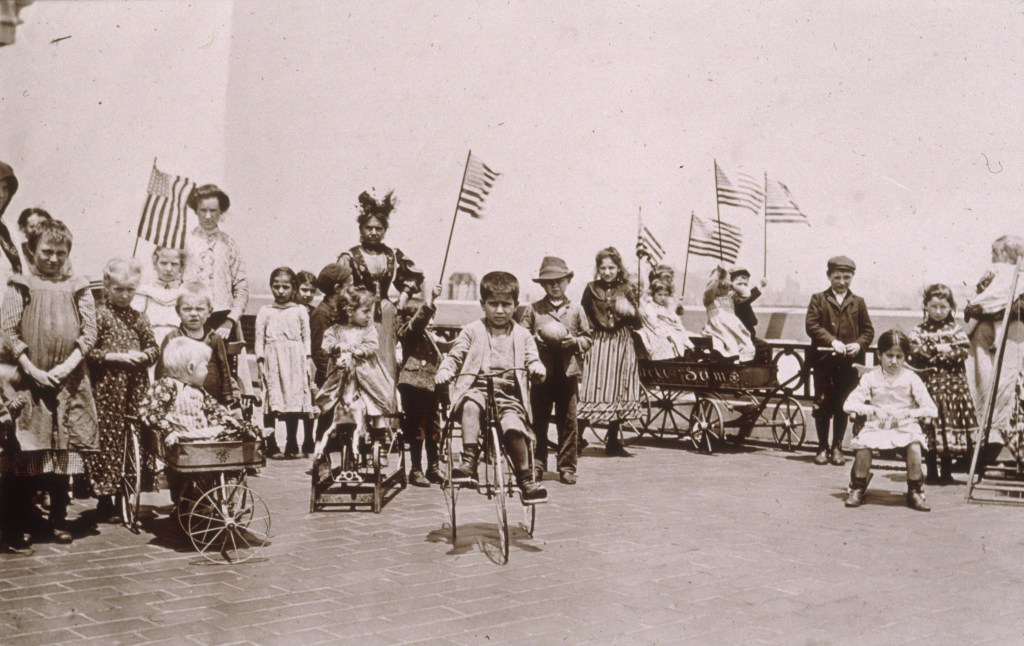
Ellis Island looms large in America’s historical imagination as the place where foreigners were welcomed and sought refuge as they took their first steps toward becoming a part of the American nation. This positive memory of Ellis Island is so persistent that many Americans may be surprised to know that it was an immigration processing center for only 30 years. By the time Ellis Island opened in 1892 in New York Harbor, the United States was more than a century old and had already received 16 million immigrants. It was only an immigration processing center up to 1924, and was thereafter a site to detain and eventually deport immigrants until 1954. It became a museum in 1990. In sum, Ellis Island has been a tourist attraction longer than it was ever an immigration center.
Why is this positive image of Ellis Island so durable even though its tenure as a place of immigration was relatively short? Why do we remember this historical site fondly while the issue of immigration itself bitterly divides Americans today? Perhaps because it represents an America we want to believe in, a country whose founding principles of life, liberty, and the pursuit of happiness have universal and timeless appeal.
Immigration itself raises a fundamental question about nationality and nationhood in American history. Essentially, what is at the root of what makes an American, a civic commitment to values that are commonly maintained and shared across the polity, or a common ethnic background that binds the people of the nation together? And even for immigrants themselves, Yale University historian Matthew Frye Jacobson asserts in his book Barbarian Virtues, there is a “peculiar tension in American political culture between the ideal of universal inclusion and the fact of very real and often harsh exclusion.” Immigrants face a fundamental question, Jacobson continues: “Do we stake our claim to American participation on sameness (we are no different from those who already enjoy the rights and privileges of citizenship), or on difference (we have special gifts that will benefit the republic)?”
While the popular image of Ellis Island comports with a civically focused notion of American identity, the context of Ellis Island’s founding and operation witnessed an effort to promote and preserve an exclusive notion of America.
According to Donna Gabaccia, an immigration historian, we learn from a young age that “immigrants built America … settled the American West, worked in American industry, and populated American cities.” Then we are exposed to the “typical high-school history of the American nation,” which describes the immigrants’ experiences beginning at Ellis Island in the 19th century, and “then goes on to tell of their difficult cultural adjustments and of natives’ hostility toward the newcomers,” she writes in her book Foreign Relations. That lesson ends with discussion of immigrant assimilation, either into the white American mainstream or into a racialized minority group. Finally, Gabaccia concludes, we later learn from scholars “far more complex stories” about the nature of immigration and assimilation, even though “they too consistently analyze immigration as a metaphor for American nation-building as embodied in the motto of the Great Seal of the American nation– ‘out of many, one’ (E Pluribus Unum).”
Narratives by their very nature are synthetic, and historical memory tends to obscure reality. Shedding analytical light onto Ellis Island does indeed reveal a place of inclusion and renewal. In its prime Ellis Island processed the great majority of immigrants to the United States, somewhere between 70 and 80 percent. Ellis Island’s main purpose was to facilitate immigration: Most of the people who passed through the facility were only there momentarily. Few of them failed the “perfunctory” medical examinations, and the rejection rate was very low: 1 percent, according to historian Roger Daniels in his book, Guarding the Golden Door.
Yet, while it was literally an island in New York Harbor, Ellis Island was also an island of inclusion in a stormy sea of exclusion. The opening of the facility coincided with one of the sharpest nativist periods in American history, the 1880s to the 1920s. It was one of several virulent, anti-immigrant phases in America’s past. Antipathy at the sudden influx of Irish and German immigrants during the 1840s and 1850s became so pronounced that a new political party emerged calling itself the American Party. Nicknamed the “Know Nothing” Party, this group sought to limit immigrant access to citizenship and public office. Much later, during the 1980s and 1990s, public concern over undocumented (“illegal”) immigration to the United States became so palpable that the federal government conducted workplace raids and border sweep operations looking for undocumented immigrants and broadened its ability to expedite the deportation of immigrant felons. Yet between the 1880s and 1920s, Congress passed a series of anti-immigration laws that contrasted sharply with the popular image of Ellis Island as a place of welcome and inclusion.
Xenophobia of this era can be attributed to several factors. First, the economic depression of 1893, since immigrants are commonly scapegoated when Americans are losing their jobs. Second, large immigration numbers of the period. Between 1871 and 1901, 11.7 million persons entered the United States. That was more than had immigrated to North America during the first 250 years of American history. Another 12.9 million came to the nation between 1900 and 1914. Essentially, in less than 50 years between 1870 and 1920, more immigrants entered the United States than during any other period in modern North American history.
A final factor that sparked American animosity toward immigrants was their place of origin, languages, cultures, and religions. Most of the “new” immigrants of this period came from southern and eastern Europe. They practiced Catholicism and Judaism; they were Orthodox Christian or Islamic. Many of them were poor and from rural settings that weren’t comparable to the rapidly industrializing and urbanizing American landscape. Quite a few of them were illiterate, and barely any of them came from political systems that resembled the United States. For critics of immigration, such people were aberrant, ignorant, disease-ridden, crime prone, superstitious, and uncivilized. Prescott F. Hall, a prominent anti-immigration advocate of the time, argued that Americans had a choice on whether they wanted the United States “to be peopled by British, German, and Scandinavian stock, historically free, energetic, progressive, or Slav, Latin, and [Jewish] races, historically down-trodden, atavistic, and stagnant.”
The 1880s to the 1920s were a time of heightened immigration restriction. In 1882, Congress banned immigration of Chinese laborers, while the Supreme Court decided in a series of cases that anyone who was ethnically Chinese could not become an American citizen. In the 1890s, the Immigration Restriction League, an anti-immigration pressure group, began efforts to push through Congress a literacy bill to block the entry of illiterate immigrants to the country. Compliant legislators passed it, though it was vetoed successively by three presidents: Grover Cleveland, William H. Taft, and Woodrow Wilson. Justifying this veto in 1915, Wilson said that had the bill been adopted earlier in U.S. history, it “would very materially have altered the course and cooled the humane ardors of our politics.” All three presidents, and many like believers, were convinced that the United States needed immigrants for economic development, and that the nation had a sacred obligation to serve as a refuge for immigrants. Their political opponents disagreed. By the 1910s, especially after the onset of the Great War in 1914, public support for anti-immigration measures was formidable, enabling Congress to override Wilson’s veto and pass the literacy bill.
But the culmination of this long period of nativism and xenophobia came in the immediate postwar years. The literacy bill didn’t reduce the overall rate of immigration to the United States as much as restrictionists had hoped, so they took more comprehensive legislative steps to exclude immigrants. Congress passed new immigration laws in 1921 and 1924 that restricted the annual number of immigrants allowed to enter the United States. The nation-by-nation “quota” was not fixed arbitrarily, but rather with a racialized belief that the “national origins” of America’s historical development were attributed to Anglo-Protestant peoples. Under this scheme, western and northern European countries like Great Britain and Germany were afforded large immigration quotas (65,721 and 25,957, respectively) while southern and eastern European nations like Italy and Russia were not (5,802 and 2,784, respectively), according to figures in historian Mae Ngai’s Impossible Subjects. Immigration restriction was now a global endeavor. The prospect of awaiting immigrants’ arrival at Ellis Island under the shadow of the Statue of Liberty almost seemed quaint–even naive–in the face of a comprehensive mission to tailor the streams of foreign nationals who wanted to immigrate to America. Subsequently, the immigration processing center closed and Ellis Island became a mixed-use site partly focused on the detention and deportation of immigrants.
Ellis Island was a welcome center to a rapidly exclusionary country. It opened at a time when the United States was starting to embrace nativist thinking and closed when that xenophobic mindset reached full maturity. How do we reconcile this imbalance of symbolic progress and socio-legal restriction?
Ellis Island was designated an official national monument by the Johnson administration in 1965, the same year U.S. immigration laws were liberalized. The nation-specific quotas were replaced with annual caps on immigration from the Eastern and Western hemispheres without regard for the ethnicity of immigrants. The reform wasn’t perfect. It would unwittingly lay the groundwork for a new, seemingly implaccable phenomenon, “illegal immigration.” Nevertheless, it shunned the nativism and racism that had underwritten immigration laws for decades.
If Ellis Island can’t be an unalloyed symbol of inclusion and diversity, what is it then? Can it be a symbol of hope, offering a view of America that is welcoming and inclusive? Maybe it is such symbolism that keeps Ellis Island high on tourists’ itineraries. Can it be a symbol of new beginnings and renewal during our current time when nativism and xenophobia are resurgent? Hope, like trust, is surprisingly intangible and vulnerable. And yet, properly cultivated, preserved, and defended, hope is a powerful force for positive change–the type of positive change that compelled far-flung colonial settlements to push for better governance 250 years ago.