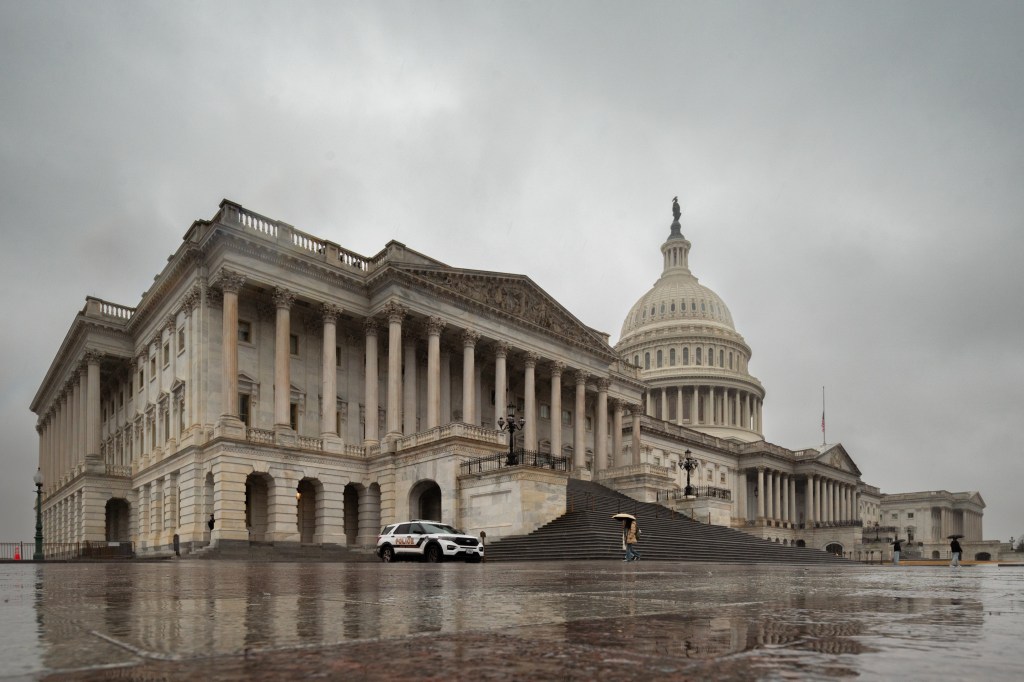
As of now, Congress appears likely to pass at least eight of its 12 appropriations bills this month, and if the remaining four miss their deadline, lawmakers will resort—as they often do—to a continuing resolution, or CR. Both parties claim to hate CRs because they freeze spending at current levels rather than adjusting to new priorities, but a CR beats a shutdown, and bipartisan cooperation has already ensured that most government agencies would still get updated funding, regardless of what happens over the next few weeks. And each new bipartisan bill that passes makes a shutdown less likely.
Much of the incentive to work together is that the last shutdown was miserable for everyone involved. Constituents suffered, government employees did not get paid, and the mood on Capitol Hill was tense and frustrated. Many lawmakers don’t want a rerun. TMD asked Senate Democratic Whip Dick Durbin if there was the possibility of another shutdown.
“I hope not,” he said. “I think that’s a painful exercise, and there are a lot of innocent victims.”
Bipartisan work to avoid another shutdown hit its stride last fall. The agreement to end that shutdown included the passage of three appropriations bills funding the Department of Agriculture, the Department of Veterans Affairs, and the legislative branch through September of this year. That means that whatever happens in two weeks, SNAP funding is safe, and Capitol Hill reporters won’t need to feel bad because their friends who work for congressmen aren’t getting paid.
Republicans and Democrats have also engaged in successful negotiations on other bills since then. This week, the Senate approved a “minibus” collection of three appropriations bills that deal with the Departments of Commerce, Justice, and the Interior, as well as the EPA, by a vote of 82-15. The House passed the package last week by a vote of 397-28, so it is ready for Trump’s signature. With those bills passed, national parks would stay open even if the government shuts down at month’s end.
Sen. Patty Murray of Washington, the top Democrat on the Senate Appropriations Committee, spoke in support of those bills at a Tuesday press conference.
“Was there more that I would have liked to do? Of course, but you don’t win anything if you take your ball and go home,” she said. “The programs that are funded in these bills are meaningful, and because Democrats were at the negotiating table, we were able to protect resources for programs that families rely on.”
Also this week, appropriators released texts of two bipartisan bills to fund the State and Treasury Departments, as well as federal courts and the White House. The House passed the bills on Wednesday by a vote of 341-79, and Murray has praised the legislation, so it seems to be on a steady course to the president’s desk.
Still, that’s only eight bills, and key funding measures have yet to be passed. The bill to fund the Department of Defense has not yet passed, meaning a shutdown would leave members of the military without pay, nor has the appropriations bill for the Department of Transportation, which includes funding for air traffic control. Without that bill, flight disruptions that plagued travelers during the fall shutdown could recur if a hypothetical lapse lasts long enough.
But the thorniest bill for lawmakers has been the one that funds the Department of Homeland Security, including Immigration and Customs Enforcement. The appropriations process—which Congress needs to finish every year and is subject to the Senate’s 60-vote filibuster threshold—is the only place Democrats have real leverage to squeeze concessions out of Republicans, so it is no surprise that they are trying to use that bill to rein in some of the Trump administration’s immigration enforcement practices. The much-covered shooting of Renee Good by an ICE officer in Minneapolis has especially affected those negotiations.
“I understand we would have to get Republican votes, so I’m not proposing we fix this overnight,” Sen. Chris Murphy of Connecticut told reporters the day after the shooting. “But I think it should be clear to Republicans that if they want Democratic votes for a DHS appropriations bill, they’re going to have to work with us on our concerns. That’s how the Senate works.”
Murphy was one of the loudest voices calling for Democrats to keep the government shut down in the fall, saying he was “angry” after enough members of his party capitulated—and he’s the top Democrat on the Senate Appropriations subcommittee that oversees DHS funding.
For a while, it seemed the two sides would be at such an impasse that they would need to resort to a CR for DHS, but there has been some progress. Rep. Mark Amodei of Nevada, the chairman of the House Appropriations subcommittee that oversees the bill, said it was in “final negotiations” with only a few remaining issues to resolve.
“It’s down to the short strokes,” he told TMD. “Again, as long as everybody behaves themselves in the hinterland, we should be good.”
But Democrats are not as optimistic. House Minority Leader Hakeem Jeffries said Wednesday that there was “no bipartisan path forward” for the bill. Murphy did not sound as dire as that, but he was not as comfortable as Amodei.
“Every single minute, we’re learning new ways that the department is acting lawlessly and ways that they are wasting taxpayer money,” he told TMD. “So we’re trying to be reasonable. I know Sen. Murray is trying to find a path forward here, but we don’t have a bill yet.”
It’s unclear what happens if lawmakers can’t reach an agreement. They would need a CR for DHS, but it is not a guarantee that all Democrats would vote for it. “A CR doesn’t fix any of the problems, either,” Murphy told reporters. “A CR doesn’t stop them from terrorizing our citizens. Doesn’t stop the violence.”
DHS remains the sticking point, and lawmakers have two weeks to reach an agreement—or decide what to do in the absence of one. But the broader picture is one of progress: Appropriators have passed more bills in recent weeks than they managed all fall. Congress governed by CR for the entire 2025 fiscal year, shutting down at the end of it. But since the shutdown, lawmakers have worked in a bipartisan fashion to fund parts of the government. That process isn’t exciting—but it’s how the government is supposed to work.
“You’re never in the stands watching it because it’s so boring,” House Appropriations Committee Chairman Tom Cole told TMD. “You guys are sitting there writing your stories and chatting away. There’s nothing going on down there. That’s perfect. That’s the way Congress should work. And we’ve seen a glimpse of it the last couple of weeks.”