Capping credit card interest rates, limiting CEO pay, barring institutional investors from owning rental properties: Republican President Donald Trump? Or Zohran Mamdani, the democratic socialist mayor of New York City?
It’s not Mamdani, although Trump’s latest string of populist economic proposals aimed at addressing voters’ concerns about affordability might give the mayor a few ideas for a left-wing agenda he described in his inaugural address as “the warmth of collectivism.” That could make for some awkward moments during the midterm campaign. Republicans are planning to tie Democrats to Mamdani, a critical component of the GOP’s playbook to preserve their threadbare majority in the House of Representatives in elections this fall.
Some veteran Republican operatives are nonetheless confident the party’s Mamdani strategy is workable.
“I don’t think anyone is going to mistake President Trump’s agenda and Mamdani’s,” Rob Simms, a Republican strategist with clients running for Congress this November, told The Dispatch. “Some of the most inflammatory parts of Mamdani’s agenda, like taxpayer funding for transgender care, sanctuary cities, and benefits for illegal immigrants (let alone the antisemitism) are the most toxic for the Democrat brand, and they’re in total contrast to President Trump and the Republicans.”
Republican operatives concede that Trump has embraced fiscal policies that fall outside the ideological contours of traditional conservatism and have currency on the left. Indeed, Trump last week telephoned Sen. Elizabeth Warren after the Massachusetts Democrat and staunch progressive said during remarks in Washington, D.C., that she backs the president’s proposal for a 10 percent interest-rate cap on consumer credit card debt. But key cultural differences separate Trump and Mamdani that make it virtually impossible to conflate the two populists, Republicans argue.
These cultural differences are part policy, part stylistic.
Mamdani is a big-government socialist who champions tax increases for businesses and wealthy earners, and he campaigned last year on an agenda that deprioritizes tough-on-crime policing. The mayor is also pledging to continue New York’s status as a sanctuary city that does not aid federal immigration enforcement. Plus, he is left-wing on most politically charged social issues, including transgender rights, and opposes Israel’s right to exist as a Jewish state. Meanwhile, Trump has enacted two rounds of tax cuts, axed government programs, trimmed the federal workforce, is overseeing a controversial effort to deport illegal immigrants, opposes transgender rights, and is a major supporter of Israel.
These bright contrasts are why the Republican strategy of casting all Democrats as Mamdani socialists could pay dividends in competitive congressional races, some GOP operatives maintained in interviews with The Dispatch. Most such contests tend to unfold in swing House districts or seats that lean Republican and are dominated by voters who are likely to be uncomfortable with the mayor’s brand of cultural progressivism (more so than they may be with elements of his socialist economic agenda).
“Horseshoe theory is real and the populists in both parties are close enough on economics to wave at each other out the window,” Republican strategist Brad Todd said. “You get the sense that Trump is tweaking capitalism around the edges while Mamdani is on a crusade to get rid of it. Collectivist socialism is different from regulation.” Additionally, some of Trump’s left-leaning proposals could be popular, GOP operatives say, discouraging criticism from Democrats or Republicans. Moves with socialist overtones the president has made include directing Washington to take partial ownership stakes in private companies, strong-arming pharmaceutical companies to lower prescription drug prices, and pressuring industry to eat the upcharge tariffs levy on retail prices.
Less than 10 months out, the 2026 midterm elections are shaping up as a rebuke of the Trump administration. The president’s job approval rating is an anemic 42.6 percent, and Democrats lead the generic ballot, gauging which party voters would prefer to hold majorities in Congress, by a margin of 46.5 percent to 42.4 percent. With a slim majority to defend in the House, Republican leaders on Capitol Hill are hoping their Mamdani strategy will counter prevailing political winds.
After Mamdani, 34, was elected this past November, the National Republican Congressional Committee aired paid advertising in nearly 50 battleground House districts declaring “the socialist takeover” of the Democratic Party “complete.” The ads are part of the NRCC’s multipronged bid to convince voters that all Democrats are following Mamdani’s “blueprint,” an approach the House campaign arm’s chairman, Rep. Richard Hudson of North Carolina, plans to rely on heavily, he told GOP colleagues just last week, according to Punchbowl News.
Given their political circumstances, it’s understandable congressional Republicans would attempt to shift voters’ attention from Trump to Mamdani. The New York City mayor—whoever it is—almost always becomes a national figure, and Mamdani holds controversial views that have both garnered media coverage and inspired Democratic base voters across the country. Even some Democratic operatives are concerned the mayor could hamper the party’s candidates in competitive but winnable races, as The Dispatch reported soon after he won the Democratic primary last June.
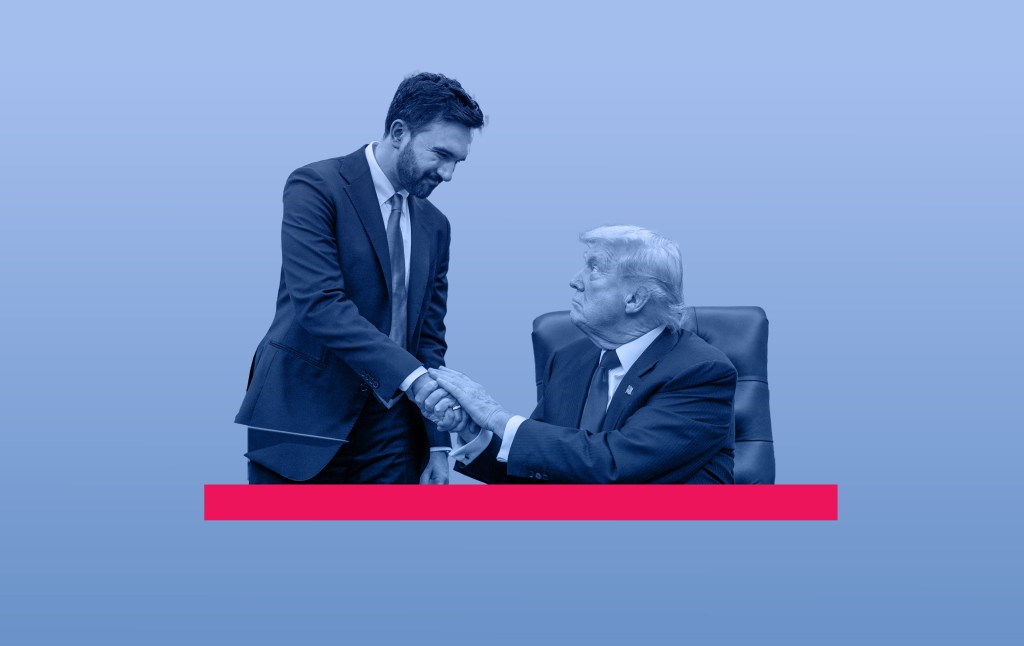
But other veteran Republican operatives are skeptical the strategy will work, at least in part because Mamdani is not a member of Congress and not on track to be elected House speaker should Democrats recapture the majority (that would be the House minority leader, Rep. Hakeem Jeffries of New York). Another crucial complication, however, is the cordial relationship Trump and Mamdani struck up late last year, after the mayor’s election. The president, a native New Yorker, has been rather complimentary of the mayor, and, so far, they’re getting along.
“Had Trump not met Mamdani in the Oval Office, the answer would have been: Absolutely they can tie [Mamdani] to the Democrats. And I think we would have been quite successful,” said a Republican insider based in New York City, who requested anonymity to speak candidly and criticize the president. “Trump’s meeting with him certainly compromised that.”
It’s standard practice for the majority party in Congress to use the bogeyman strategy in midterm elections. In 2006, Republicans tried to scare voters with Rep. Nancy Pelosi of California, warning she would govern with “San Francisco values.” The message failed: Democrats won control of both the House and the Senate. In the 2018 midterm elections, during Trump’s first presidency, he tried to turn Democrats into “radical socialists who want to model America’s economy after Venezuela.” The message failed; Democrats flipped 41 House seats.
This year promises yet another failure for the bogeyman strategy, some Republicans say.
The president’s party is typically on its heels in midterm elections: Not since 2002 has the party in control of the White House picked up seats in the House. This year’s campaign could be an exception if voters have a change of heart about Trump. But absent that, he simply dominates national media coverage and the country’s political discourse too much to make room for Republicans to turn Mamdani into the commanding figure of 2026. That’s especially likely to be the case as long as voters’ top priority is reducing the cost of living.
Just look at what happened in the 2024 election. In that campaign, Democrats rehashed Trump’s attempt to overturn President Joe Biden’s election four years earlier. They rang alarm bells about Trump’s open vows to govern with expansive, constitutionally questionable executive authority. But voters, feeling the weight of higher prices—for groceries, gasoline, and housing—opted for Trump because of their fond recollections of his handling of the economy during his first term.
“I’m very skeptical that trying to turn the mayor of New York into a bogeyman that resonates in swing districts in the Midwest is the most effective strategy,” said Alex Conant, a Republican operative and cofounder of Firehouse Strategies, a public affairs firm in Washington, D.C. He added: “The mayor of New York doesn’t have a lot to do with voters in suburbia.”