Instead, the administration has pursued a dual-track approach, continuing to weigh military options while testing whether diplomatic pressure can extract concessions from an embattled regime. Reports attribute Trump’s hesitation to several factors: that the president wasn’t satisfied with the military options presented; that the Iranians were making promises in backchannels; and that various allies were strenuously campaigning against the strikes.
Officials from Saudi Arabia, Qatar, and Oman reportedly led an effort by Gulf countries and Egypt to convince Trump not to order strikes, concerned that such an attack could spark a regional war. Michael Rubin, a senior fellow at the American Enterprise Institute and researcher on Middle Eastern politics, told TMD that he believed Arab nations did not want the U.S. to start something it wasn’t prepared to finish. “If they don’t see that the United States is serious about getting rid of something, then they are going to tell us not to touch it,” he said.
Multiple outlets also reported that Israeli Prime Minister Benjamin Netanyahu contacted Trump on Wednesday to counsel against a strike, fearing that Israel would be unprepared to defend against an Iranian response. As the protests have raged in recent weeks, Israel reportedly communicated to Iran—using Russian President Vladimir Putin as a go-between—that it is not looking to attack in the immediate future.
Nate Swanson, director of the Iran Strategy Project at the Atlantic Council, told TMD that, following Trump’s pronouncements, expectations of an immediate U.S. strike were bound to be unrealistic. “No one knows what’s going to happen, if and when strikes happen,” he said. “The U.S. military, the Gulf countries, the Israelis, even to have the option to attack, need to have their ducks in a row.” That means evacuating personnel, gathering enough planes for follow-up strikes, and moving destroyers and ground-based systems into position to defend against missiles. The USS Abraham Lincoln—previously deployed in the South China Sea—only began sailing west toward the Persian Gulf on Thursday, bringing with it a strike group of guided missile destroyers, fighter jets, and at least one submarine.
“I do not think we are postured to do meaningful attacks on Iran until the carrier strike group gets there,” Swanson said.
Operation Midnight Hammer—the June 2025 attack that damaged many of Iran’s nuclear facilities—reportedly involved more than 125 U.S. planes and, according to expert estimates, expended roughly a quarter of the United States’ valuable Terminal High Altitude Area Defense (THAAD) missile interceptors. There simply are not enough U.S. forces currently in the region to carry out a significant attack, Swanson said, adding that, by claiming he could credibly protect protesters, Trump “set a red line he could not enforce.”
So, the president pulled back from a strike—at least for now—and claimed victory from the diplomatic channels. White House special envoy Steve Witkoff has been in regular communication with the Iranians—namely, Iranian Foreign Minister Abbas Araghchi—and told the president Wednesday morning that the Iranians had committed to suspending executions of arrested protesters. That afternoon, Trump would relay that to the world. “We’ve been told that the killing in Iran is stopping,” the president said. “And there’s no plan for executions, or an execution, or execution—so I’ve been told that on good authority.”
In the days since, with the strike force continuing to move into position, the administration has pivoted to diplomacy, seeking to leverage the regime’s vulnerability to extract concessions on security. On Thursday, Witkoff said he hoped for a diplomatic solution in which Iran scaled back its nuclear and missile programs, along with reducing support for regional militias and terror groups. Alex Vatanka, the director of the Iran Program at the Middle East Institute, told TMD that he believed Iran’s leaders might be inclined to cut a deal for sanctions relief. “If somebody comes with a message of a potential deal, they’re not in a position to quickly dismiss it,” he said.
Meanwhile, protests in Iran have largely subsided, though demonstrations continue, particularly at funerals for slain protesters. In Iran, funerals and mourning rituals—particularly the end of the traditional 40-day mourning period observed in Shia Islam—have served as flashpoints for protest in the past. Likely with this in mind, the government announced last week that internet access would remain cut off at least through Nowruz, the Persian New Year, on March 20.
Though the regime has thus far managed to survive the demonstrations, it has not made progress on the issues that initially brought Iranians to the streets—particularly the deep economic crisis, which has only worsened amid the protests and the internet shutdown.
“I don’t think the regime is going to succeed in terrorizing the population to stay silent forever,” Suzanne Maloney, an Iran expert and the director of the foreign policy program at the Brookings Institution, told TMD. “It’s going to be very, very hard to imagine that this regime is going to be able to develop a sort of stable future, or a set of responses to the grievances of the Iranian people.”
And a regime willing to kill thousands of its own people in a matter of days has given no indication it won’t do so again.
Julian Waller, a George Washington University political scientist who studies authoritarian regimes, told TMD that the level of violence shown by the regime is highly unusual among modern governments, even dictatorships. “We don’t normally see this in, for lack of a better word, a more civilized authoritarian regime,” absent a major conflict or civil war, he said. “Maybe this cracks things in a more fundamental way that we can predict, but what I can tell you is I can’t predict it. We don’t have good analogies for that.”
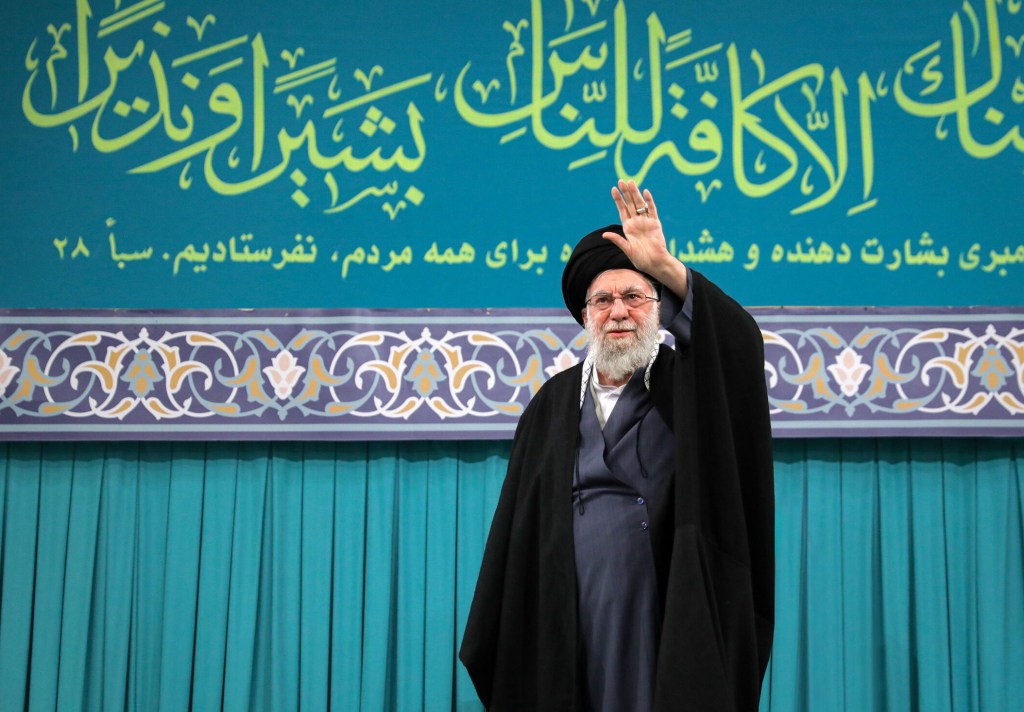
On Sunday, a spokesman for Iran’s judiciary system said that some of the crimes committed by protesters had been identified as potentially capital crimes, hinting that the regime may be breaking its assurances to the president. And in response to Khamenei’s Saturday speech and tweets blaming Trump for the deaths, the president told Politico that “it’s time to look for new leadership in Iran.”
The strike force is expected to arrive in the region by the end of this week.