
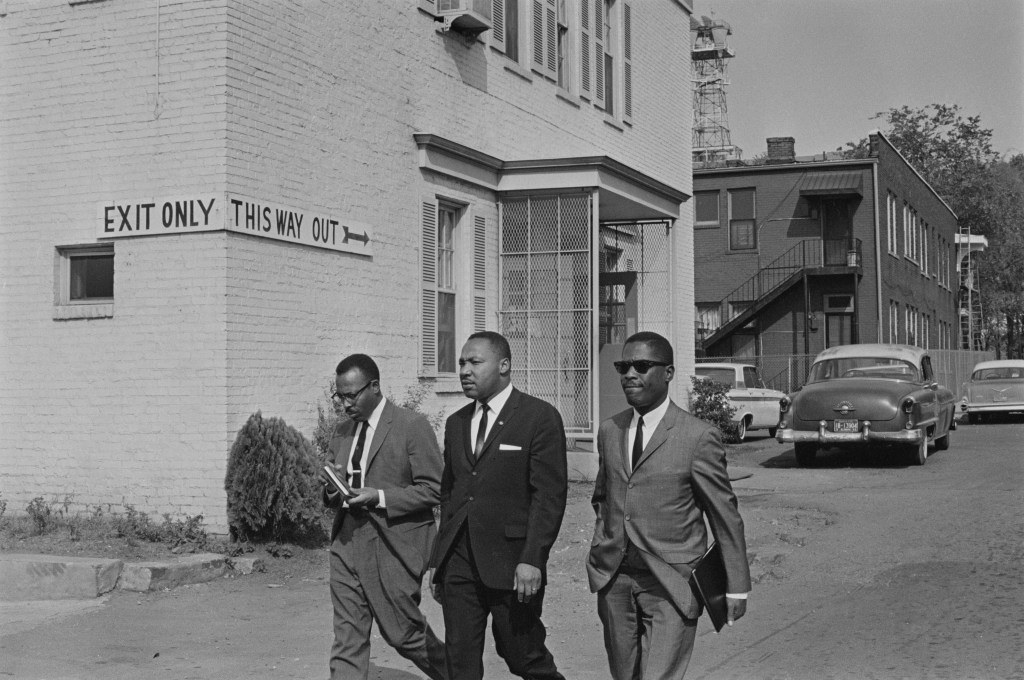
That he and others would end up in jail was one of King’s basic assumptions. He wrote:
[W]e had no alternative except that of preparing for direct action, whereby we would present our very bodies as a means of laying our case before the conscience of the local and national community. We were not unmindful of the difficulties involved. So we decided to go through a process of self-purification. We started having workshops on nonviolence and repeatedly asked ourselves the questions, “Are you able to accept blows without retaliating?” and “Are you able to endure the ordeals of jail?”
King addresses critics’ complaints that his actions were untimely, unwarranted, and excessive, that he should have pursued negotiation instead:
You may well ask, “Why direct action, why sit-ins, marches, and so forth? Isn’t negotiation a better path?” You are exactly right in your call for negotiation. Indeed, this is the purpose of direct action. Nonviolent direct action seeks to create such a crisis and establish such creative tension that a community that has consistently refused to negotiate is forced to confront the issue. It seeks so to dramatize the issue that it can no longer be ignored. I just referred to the creation of tension as a part of the work of the nonviolent resister. This may sound rather shocking. But I must confess that I am not afraid of the word “tension.” I have earnestly worked and preached against violent tension, but there is a type of constructive nonviolent tension that is necessary for growth. Just as Socrates felt that it was necessary to create a tension in the mind so that individuals could rise from the bondage of myths and half-truths to the unfettered realm of creative analysis and objective appraisal, we must see the need of having nonviolent gadflies to create the kind of tension in society that will help men to rise from the dark depths of prejudice and racism to the majestic heights of understanding and brotherhood. So, the purpose of direct action is to create a situation so crisis-packed that it will inevitably open the door to negotiation. We therefore concur with you in your call for negotiation. Too long has our beloved Southland been bogged down in the tragic attempt to live in monologue rather than dialogue.
Gandhi exploited the contradictions in the British Empire—the English sense of decency and fair play was at odds with imperial domination. King did something similar, having the great example of Abraham Lincoln and the unfinished work of the abolitionists before him: The letter and spirit of the Declaration of Independence had been at odds with the Constitution’s compromise with the slave power from the very beginning—William Lloyd Garrison had famously described our revered Constitution as “a pact with the devil” for that reason. After the shock and convulsion of the Civil War, improvements in the de jure and de facto conditions of black Americans came only sporadically and gradually. But the principles laid down in the Declaration of Independence were no less incompatible with the post-Civil War settlement that came to be known as the Jim Crow era.
The American ruling class’ commitment to civil-rights reform in the post-Civil War era was broad but shallow.
That breadth was remarkable: Sen. Barry Goldwater is remembered for his opposition to the 1964 Civil Rights Act, but less well-remembered in our time is the fact that he had supported, sometimes zealously, practically every piece of civil rights legislation prior to the 1964 law, including the 1957 and 1960 civil rights acts, that he had ensured that the Arizona Air National Guard (which he helped to organize) was racially integrated from the time of its founding (years before racial integration became policy for the rest of the military), racially integrated his family business, etc. Goldwater was an active member of both the NAACP and the Urban League. He personally funded—out of his own pocket—anti-segregation litigation in Phoenix as part of a campaign organized by his friend Lincoln Ragsdale, a local businessman and veteran of the Tuskegee Airmen whose legal campaign helped set the stage for Brown v. Board of Education.
Broad, to repeat, but shallow. The very same Sen. Goldwater could campaign against the 1964 law on principled constitutional grounds while opportunistically using that opposition to “go hunting where the ducks are,” as he put it, to court the votes and political allegiance of those whose opposition to such reform was, let us say, less principled, or, rather, based on the wrong principle, that of white supremacy. Figures such as Dwight Eisenhower and Richard Nixon were, as a moral matter and often as a matter of practical effective politics, on the side of civil rights and desegregation, but they were content with a glacial pace of reform. (The conservative sensibility does not always produce positions that look good in retrospect, but, then, the understanding that we live in the messy present rather than in an improved future is fundamental to conservatism. William F. Buckley Jr., for example, eventually came around to the view that he and his allies had been wrong about civil rights, and about racial issues more generally, but his views evolved slowly, a fact that caused him subsequent regret and embarrassment.)
Eisenhower made the right decision to send the 101st Airborne to Little Rock in 1957 when Orval Faubus, the Democratic governor of Arkansas, used the National Guard to block the integration of Central High School after the Brown decision, but Eisenhower also thought that Brown was an erroneous and ill-considered decision, that the schools were the wrong place to start, and that integration should come more gradually and more slowly, that public opinion should be more liberally accommodated. It is worth appreciating how much things have changed since then: Eisenhower took a great political risk and went to great lengths to enforce a Supreme Court decision he disagreed with and did not want—because he understood that it was his constitutional duty to see to the faithful execution of the laws.
(It is interesting to know that Eisenhower’s non-imperial style impressed many Americans, including many in the South: In the 1956 election, Eisenhower became the first Republican to win the total popular vote in the South—albeit by a plurality and not a majority—and the first presidential nominee of his party to win a Deep South state—Louisiana—since Reconstruction. Granted, that happened before Little Rock. Perhaps even more significant is the fact that Eisenhower in the post-Brown election of 1956 did a bit better in the total popular vote in the South than Sen. Goldwater would do running there as practically a single-issue candidate opposing deeper civil-rights reform in the 1964 election. Moreover, Goldwater lost the overall popular vote in the South to Lyndon Johnson by a few percentage points. It’s a complicated story.)
The Rev. Martin Luther King Jr. and his allies were able to advance their cause in the United States in part by means of civil disobedience because—even with the billy-clubs and the dogs and the firehoses, and even in the face of private violence of the sort that ultimately would claim King’s life—there were limits to what the state would do to them.
Texas Gov. Greg Abbott has engaged in a good deal of social-media tough talk about arresting protesters and activists who interfere with ICE activities in Texas. Even if we assume that Abbott, being a Republican in Anno Domini 2026, is a cynically amoral political calculator, he is right to talk about arresting those who break the law—and right to follow through. Going to jail is part of the deal when one engages in civil disobedience—if the gun thugs in Minneapolis had simply arrested Renee Good, they only would have been doing their duty, and Good could have joined a proud American tradition—Martin Luther King Jr., Henry David Thoreau, Eugene V. Debs—of sitting in jail for a cherished cause.
One need not celebrate every such cause or canonize every champion of such causes to understand the underlying political dynamic and its place in a free society. Debs was a socialist and hence an advocate of what is ultimately a profoundly anti-humanistic philosophy, but he was not imprisoned for being a socialist—he was imprisoned, under the Espionage and Sedition Acts, for criticizing the policies of the Woodrow Wilson administration. (Warren G. Harding, no friend of socialist radicals, pardoned Debs in 1921.) King—like Gandhi—was wrong about a great many things and was not entirely admirable in the conduct of his personal life, but—also like Gandhi—he was right about the one big thing at the center of his public life, and his position as a prisoner was a prouder one than that of his jailers. I am not sure what I think about Thoreau’s opposition to the Mexican War, but his refusal to pay his legally due taxes in support of that war was at least as serious a crime as anything Renee Good might have been guilty of—but President James Polk (owner of one the great glorious mullets in American life) did not flood Massachusetts with trigger-happy mall commandos in order to try to punish and intimidate his political opponents. (And, rather than being gunned down by agents of the state, Thoreau died instead in a way befitting of a man of his times: in his mid-40s of tuberculosis.) Jail was part of the cursus honorum for the civil disobedient.
Donald Trump does not aspire to be the sort of man Dwight Eisenhower was. (This is not limited to Trump’s personal cowardice in the matter of military service—far from it!—but his draft-dodging is illustrative.) Donald Trump aspires to be the sort of man Xi Jinping is, the sort of man Vladimir Putin is, the sort of man Li Peng was when he ruthlessly suppressed the Tiananmen Square demonstrations—a vicious act of repression that Trump has spoken of admiringly. The acts of unjustifiable violence and extralegal threats carried out by his agents are, manifestly, to Trump’s taste. Trump is more a man of Reginald Dyer’s type than Lord Mountbatten’s. He is an Iranian ayatollah at heart—fundamentally totalitarian. And he seems to desire violence. Why wouldn’t he? He has the guns and the gun thugs. (And, no, I don’t give a single squirt of piss what it says on your pension paperwork—if you’re wearing a mask, then you’re not a lawman, you’re a gun thug. And you’ve watched too many Batman movies.) Where there are genuine acts of violence being perpetrated against federal agents, those carrying out such acts are giving the Trump administration what it desires: a pretext for escalation.
(I say that Trump and his toadies desire a pretext, not that they need one.)
I used to be more friendly to civil disobedience in the American context than I am today. That is because I trust Americans less than I used to. There is a lot more Timothy McVeigh in our national character than I had thought. And I believe—ultimately, at a level of generality far removed from today’s on-the-ground facts in Minneapolis and elsewhere—that enforcing U.S. immigration laws and securing the border are necessary. That being said, it is easy to sympathize with the desire to push back against ICE and against the Trump administration in provocative and even illegal ways. There are better and worse ways to do that. The Rev. Martin Luther King Jr. was a man of God, but he also was a canny political operator. His career provides many useful insights for our time.
So, unhappily, does the way it ended.
Economics for English Majors
Very interesting from Andrew Left, writing in the Wall Street Journal.
The crime of insider trading consists in taking advantage of other investors by buying or selling stock based on material, nonpublic information that could affect its value. I’m being prosecuted for doing the opposite of that. I publicly expressed a sincerely held opinion and later traded on it. Under the Justice Department’s theory, that’s a crime because I made so many people aware of my opinion.
Call it the influencer penalty. Prosecutors are advancing a legal theory that creates two classes of Americans: those who can speak freely and trade freely, and those who have built an audience and therefore can’t.
The individual acts aren’t disputed. I can buy a stock. Legal. I can publicly share my opinion about that stock—constitutionally protected speech. I can sell that stock. Also legal. But do all three with a large social media following? Securities fraud.
The right of credit-rating agencies to offer poorly considered and at times destructive opinions about a security is generally protected under the First Amendment. But influencers influencing? In speech involving publicly traded securities? Seems to me pretty close to core free-speech stuff.
Words About Words
We call the program of systematic repression of black Americans in the years between the Civil War and the successes of the civil-rights era the time of “Jim Crow.” Whence that term?
Short answer: Nobody knows. But we do know a little. We know, for example, that “Jim Crow” was the name of a minstrel-show character associated with the actor (need I write white actor?) Thomas D. Rice. (“Rice,” as in, “white as.”) Rice had a song-and-dance number called “Jump Jim Crow” which included him doing a little bird-type hop, hence (one assumes) “crow.” From Britannica:
Rice was not the first performer to don rags and use burnt cork to blacken his face to present a mocking exaggerated imitation of an African American, but he was the most famous, and his success helped establish minstrelsy as a popular theatrical form that thrived from about 1850 to 1870.
Rice must have been a very compelling performer: Though the term never became as prevalent as that infamous epithet we try to avoid writing or saying these days, “Jim Crow” came to be used in a similar way as early as the 1830s. It was not, however, until several decades later that it came to be used to describe laws that encoded racial discrimination and racial subordination. It may be as simple as the fact that, conversationally, it was less shocking to say “Jim Crow laws” than to use the more familiar and presumably more offensive racial epithet in that usage.
As a friend of all corvids (and most people), I regret the attachment of the name of such a noble bird to such an ignoble enterprise.
And Furthermore
Memo to Sheriff Keith Swank: Police do not get to engage in civil disobedience or to threaten it.
Elsewhere
My Competitive Enterprise Institute colleagues and I have book recommendations. You can watch the video here.
You can see me getting uncharacteristically personal on the Fifth Column podcast here.
I’ll be on Andrew Sullivan’s Dishcast this week, if all goes according to plan. I’ll be the bald guy in the checked shirt.
You can check out “How the World Works,” a series of interviews on work I’m doing for CEI, here.
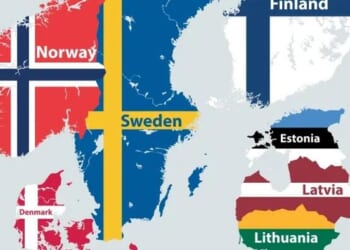
Remember when Ted Cruz joked—we thought he was joking—about Donald Trump nuking Denmark? Those were the days.









_(2).jpg)