Authored by Hanna Bechtel via The College Fix,
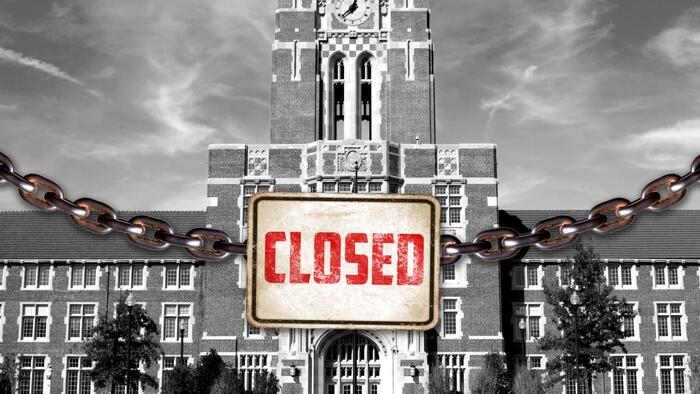
Higher education is approaching a period of profound disruption, and many colleges may not survive, Arthur Levine, the newly appointed president of Brandeis University, said during a recent event.

Levine estimated that between 20 and 25 percent of colleges will close in the coming years, while community colleges and regional universities move increasingly online.
He made these remarks during a recent American Enterprise Institute event titled “Tackling Higher Education’s Challenges: A Conversation with Frederick M. Hess and Brandeis University President Arthur Levine.”
Wealthier institutions may have the resources to withstand the transition, but many others do not. Levine said that elite schools, such as Harvard, can afford to wait out disruptions, while smaller institutions face immediate pressure to adapt.
“Higher education is undergoing a transformation. Our whole society is undergoing a transformation,” Levine said, pointing to the shift from a national, industrial economy to a global, digital, knowledge-based one.
That shift, he said, is driving demographic, economic, technological, and political change that universities have been slow to address.
The challenges facing higher education, Levine said, are not new. He pointed to three longstanding criticisms that date back to the early 19th century, including that colleges change slowly, resist change, and cost too much.
“Outcomes better be worth the price paid,” he said, adding that when society changes, higher education often lags behind and scrambles to catch up.
Levine also criticized the traditional model of higher education as a product of the Industrial Revolution, resembling an assembly line that advances students based on time rather than mastery.
“It doesn’t matter what was taught to you … We should care about what you learn,” he said.
Levine said he is attempting to respond to these issues through his “Brandeis Plan to Reinvent the Liberal Arts.”
The initiative seeks to overhaul the university’s general education curriculum, expand access to internships and apprenticeships, and provide students with micro-credentials tied to skills valued by employers.
“The liberal arts have always been practical,” he said, noting that early American higher education was designed to prepare students for professional and civic leadership.
Under the new plan, Brandeis aims to redesign general education to better align with the demands of a global digital economy.
The university’s website describes the initiative as one integrating “the values of a rigorous liberal arts education with career readiness, ethical grounding and lifelong learning.”
It features a redesigned course curriculum, as well as the development of a career-competency transcript “capturing the skills, experiences and competencies that students gain inside and beyond the classroom.”
A key component of the proposal is a shift toward competency-based education that measures students’ skills and knowledge instead of relying solely on grades.
Levine acknowledged the difficulty of the transition, saying that universities will not immediately agree on what constitutes competency, or even how it should be evaluated.
“We’re going to make mistakes. We’re going to get some things wrong,” he said.
The university president also addressed concerns about grade inflation and maintaining academic rigor, saying that grades have lost much of their meaning.
“Grades don’t mean much anymore, if everyone gets an A.” He emphasized the need for clearer standards and better assessment tools.
Levine also addressed the rise of antisemitism on college campuses, saying the university has been working with local school districts to understand better how this discrimination affects students. He has seen an increase in applications from students who no longer feel safe at other institutions.
Further, he said “diversity, equity, and inclusion” efforts are necessary, but criticized how they have been implemented and understood by higher education institutions.
Levine argued the term has become increasingly broad and unclear, limiting its effectiveness and failing to protect Jewish students and faculty. He said universities often address issues piecemeal, rather than through a comprehensive strategy, calling for clearer goals focused on access, support, and equal opportunity.
When asked about research effectiveness and institutional transparency, Levine cautioned against using research funding as a “political” tool.
He said that cutting federal support ultimately harms the country rather than just penalizing individual universities.
“Cutting research funding is not a fit penalty. It’s a penalty to the country,” he said.
He said that universities are increasingly targeted over political grievances rather than the quality of their research, calling such actions the “wrong remedy.”
Finally, Levine stressed the importance of protecting academic freedom, which he defined as the right to pursue and speak the truth, while noting it does not give faculty the license to say anything without accountability.
Loading recommendations…