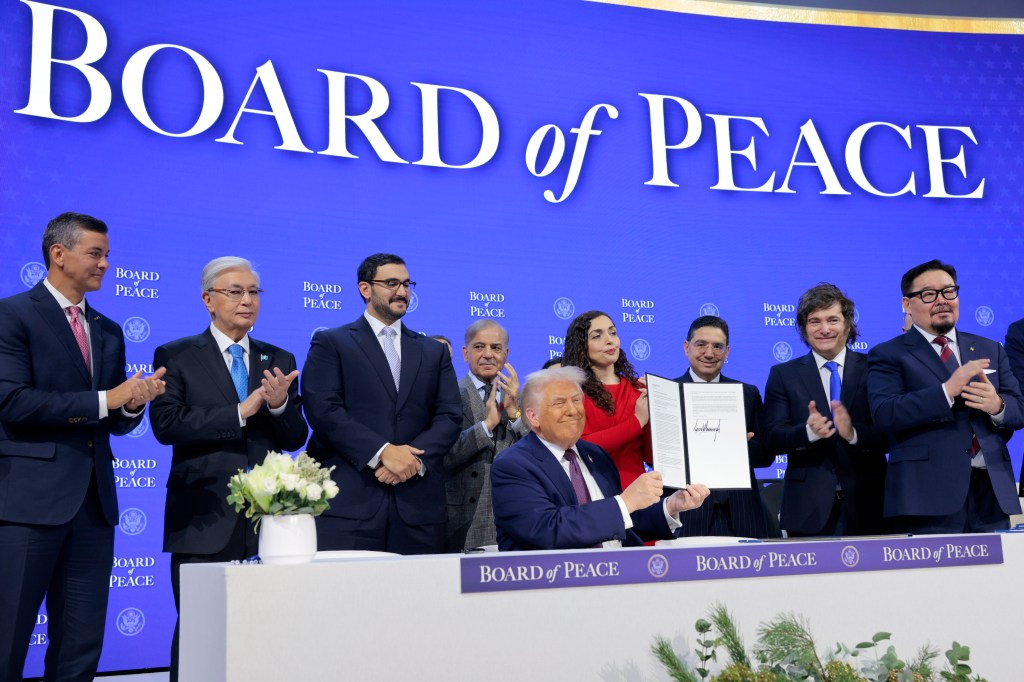
The board originated in the Gaza peace plan, and in November, 13 of the 15 nations on the U.N. Security Council voted to approve it as a “transitional administration” in Gaza through 2027. It was only after this vote that the board’s charter was released, which provided more details about the structure. Trump will serve as the organization’s inaugural chairman,”—but his term has no set end date, and the chairman designates his own successor, holds complete veto power, and casts tie-breaking votes.
The board has two tiers: an executive board of global leaders, including Secretary of State Marco Rubio, Kushner, former U.K. Prime Minister Tony Blair, and World Bank President Ajay Banga; and a Gaza executive board featuring U.S. officials, along with Turkish Foreign Minister Hakan Fidan, Qatari diplomat Ali Al-Thawadi, Egyptian intelligence chief Maj. Gen. Hassan Rashad, and others.
To become a permanent member nation, countries need to pay a $1 billion contribution within the first year; otherwise, their country will serve a three-year term. The White House claims that roughly 50 countries were invited and that 35 or so have accepted—but neither list is public, and it has been changing. Canada’s Mark Carney was invited, and said he had accepted “in principle,” only for Trump to rescind the invitation on Truth Social Thursday night. Denmark—steward of Greenland—seemingly was not invited, and many European nations, including Germany, have yet to respond to their invites. There are also legal complications: The Italian government said it’s not sure it can join, because the board, as it’s currently formulated, appears to be incompatible with the Italian constitution.
Brett Schaefer, a senior fellow at the American Enterprise Institute who focuses on multilateral treaties, peacekeeping, and the U.N. and international organizations, explained that Trump aspires for the board to serve as a global peacemaking mechanism. “The president has touted that he solved eight wars in different conflicts,” he told TMD. And, while Schaefer noted that some of those conflicts have reignited, he said, “I think the president sees this as a more flexible tool to address those situations than the United Nations, which he has dismissed as not helping him resolve those conflicts in the past.”
Khaled Elgindy, a senior research fellow at the Quincy Institute’s Middle East program, explained that the Trump administration initially led the U.N. Security Council members to believe that the board’s influence would be limited to Gaza. “There’s a kind of bait and switch that happened,” he told TMD. “The Board of Peace was sold to the international community—to the Arab states, to the Europeans—as this entity that is going to oversee Gaza’s transition, and then, lo and behold, it really doesn’t have anything to do with Gaza, except Gaza is the launching pad.”
This has been a core contention of the countries that haven’t joined. The French government announced publicly declined its invitation to the Board of Peace on Monday, with President Emmanuel Macron’s office citing “serious questions” raised by the founding charter, including concerns that the panel’s peacekeeping actions may extend beyond Gaza and conflict with the United Nations’ authority.
France had voted to approve the Board of Peace in November, but as Ian Johnstone—a law professor at Tufts University who specializes in international organizations—told TMD, “You have to sort of separate the original vision of a sort of transitional governance arrangement for Gaza from the sort of broader international organization. Nobody, until these [invitation] letters went out, ever imagined that this would become a new international organization.”
John Bolton—who served as national security adviser in Trump’s first term and U.S. ambassador to the U.N. under George W. Bush—told TMD that France likely views the board “as a direct threat to the [U.N.] Security Council,” on which France holds one of five permanent seats. The French government likely doesn’t “want to see anything that undercuts” the influence or veto power that comes with the seat, Bolton explained.
Trump responded to France’s rejection by threatening a new 200 percent tariff on wine and champagne imports and claiming the French leader will be “out of office in a few months.”
The pivot away from a narrowly Gaza-focused body has drawn a wider range of countries, many with little stake in Palestinian affairs. The office of Israeli Prime Minister Benjamin Netanyahu initially criticized the White House’s picks, stating the board’s composition was “not coordinated with Israel” and “contrary to its policy”— though it would go on to announce on Wednesday that Netanyahu had accepted the invitation to join the board.
“Even though Israel has joined this Board of Peace, it’s very unhappy about Qatar and Turkey being on the executive committee, and it’s not at all of the view that Hamas is ready to do this next necessary step,” Bolton said. “So, I think on Gaza itself, this [board] remains purely aspirational at this point.”
Bolton also emphasized that any progress in Gaza would require Hamas to follow through with the phase two agreement and voluntarily demilitarize. Axios reported last week that the Trump administration believes demilitarization is on the horizon, with one U.S. official telling the outlet that “Hamas is indicating that it will happen.” However, earlier this month, the Wall Street Journal, citing Arab and Israeli officials, reported that Hamas had been restructuring its command leadership, reconstructing its underground tunnel network, and collecting funds with which to pay fighters. Bolton said, “The board can issue all kinds of pronouncements, but if conditions on the ground don’t change, it won’t make any difference.”
The other issue with the “Board of Peace” has been the potential inclusion of Russian leader Vladimir Putin. Ukraine has been invited, but hasn’t said whether it will join. Yesterday, British Foreign Secretary Yvette Cooper said the U.K. won’t be joining the board—at least for the time being—citing “concerns about President Putin being part of something which is talking about peace, when we have still not seen any signs from Putin that there will be a commitment to peace in Ukraine.” Trump said on Wednesday that Putin had accepted his invitation to join the Board of Peace, but the Russian president later clarified that he had not yet decided and was still considering the offer.
Speaking to reporters on Wednesday, Trump acknowledged that some “controversial people” would be on the board, but he emphasized that he wanted a team that could “get the job done,” including world leaders with significant “control and power.” “If I put all babies on the board, there wouldn’t be very much,” Trump said. “So [Putin] was invited.” Putin’s close ally, Belarusian dictator President Alexander Lukashenko, also received and accepted a proposal to join. The White House also invited Chinese leader Xi Jinping, and while he has yet to provide an official response, a Chinese Foreign Ministry official said on Wednesday that China “will stay firmly committed to safeguarding the international system with the U.N. at its core.”
Though these nations could have some involvement in rebuilding Gaza, their membership seems more connected to the board’s broader, international aims.
“The Russians have never been stakeholders [in Gaza], they’ve never been involved,” Ghaith al-Omari, a senior fellow in the Washington Institute’s Irwin Levy Family Program on the U.S.-Israel Strategic Relationship who served in various senior positions within the Palestinian Authority, told TMD. “They don’t have the resources to contribute.” However, al-Omari noted that Putin and Xi “perceive this as an opportunity to basically bargain with Trump away from the constraints of the U.N. and other traditional bodies.”
Ian Hurd—a political science professor at Northwestern University, where he directs the school’s international studies program—told TMD that he doesn’t expect the board to gain international legitimacy, predicting, “Don’t expect people to be talking about it much three months from now.”
While organizations like the United Nations and World Economic Forum receive criticism as being ineffectual bureaucracies, they have a record of being places where leaders can meet to discuss and address ongoing problems. Hurd argued that the Board of Peace doesn’t have that, and that foreign leaders view “it as a vanity project of Donald Trump, and his brand carries very little trust or legitimacy around the world these days.”
They “may see it instrumentally as a vehicle for currying favor with Donald Trump, and that, I think, is explains why it’s getting the attention that it’s getting, but I don’t think it will last.”