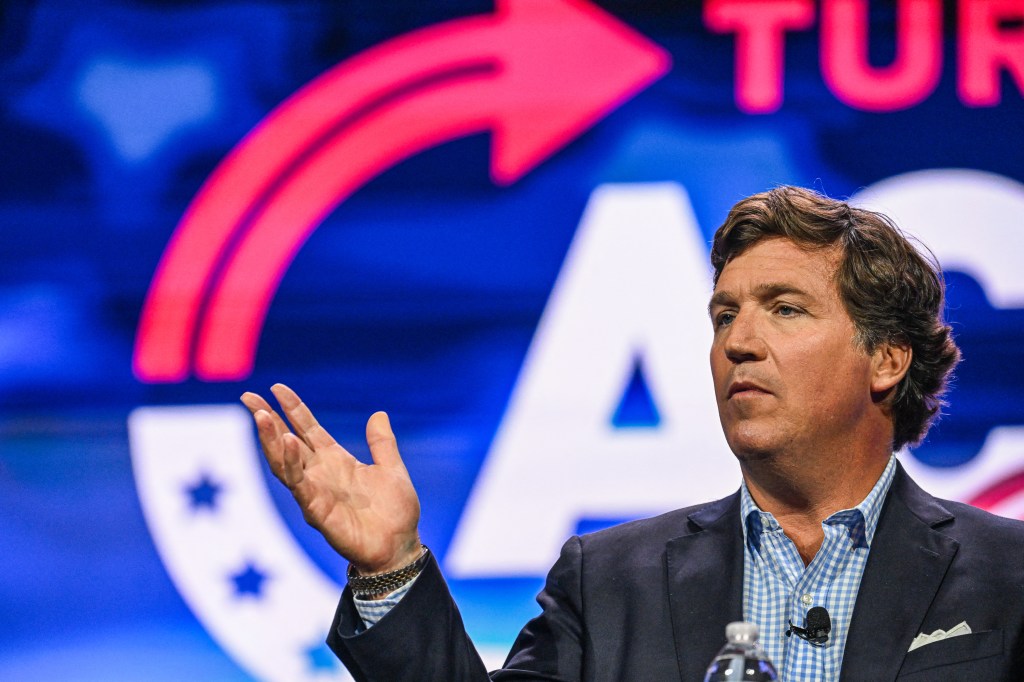
For most of the last decade, over the course of Tucker Carlson’s long slide from charismatic contrarian to kooky conspiracist, those who knew him best pondered the same questions many casual observers were asking: What happened? Why is Tucker doing what he’s doing?
His longtime friends and onetime colleagues now mostly shrug their shoulders. There is no simple explanation. And if the informed speculation once offered got us partway there—he’s an inveterate attention whore, he’s chasing dollars, he’s running from his own privilege, he’s always had an anti-establishment streak—ask them today and they’re truly nonplussed. Carlson has spiraled so far he’s no longer recognizable. It’s one thing to author puckish profiles of controversial figures in American politics, portraying Ron Paul as a visionary or Al Sharpton as a statesman. It’s quite another to shill for Vladimir Putin or minimize Bashar al-Assad’s crimes against humanity, to serve as a character witness for Alex Jones, to praise white nationalists and amplify racists. If Carlson was once entertaining and relatively harmless, he’s now self-serious and dangerous.
Carlson’s bizarre journey has spawned a cottage industry of Tucker profilers, some better than others. The latest entry is the most exhaustive, and it comes from Jason Zengerle, late of the New York Times Magazine and recently announced as a New Yorker staff writer. Zengerle spent much of the last five years reporting on Carlson, talking to many of those former friends and erstwhile colleagues (including me), and the result is an authoritative look at both Carlson and the chaotic information environment that has made him very wealthy and very powerful.
In many respects, the strength of Zengerle’s effort—Hated By All the Right People: Tucker Carlson and the Unraveling of the Conservative Mind, out Tuesday from Crooked Media Reads, an imprint of Zando—is its restraint. In chronicling the rise of Carlson as a radical but influential voice, whose persuasive power comes in part from his mastery of demagogic oversimplification, Zengerle lets his reporting speak for itself, resisting the temptation to offer his readers easy answers where reality is complicated.
That reporting tells two intermingled stories—one about Carlson himself and another about journalism on the right, the former concerning the moral corruption of a talented narcissist and the latter about the incentives and inducements that made the debasement of the conservative media all too easy and all too rewarding. The first one is tragically fascinating: According to Zengerle, Carlson used to tell friends, “I want to have an interesting life … that’s my goal.” And on that, at least, he has succeeded, and Zengerle’s story about Carlson is entertaining in a grim, we-know-where-this-is-headed kind of way.
But the far more important story is the one he tells about the failure of conservative media—a story where attention matters more than accuracy, where affirmation matters more than information, and where party loyalty trumps telling the truth.
It begins with Carlson’s now-famous cri de coeur—a speech well-known to Tuckerologists, anyway—at the Conservative Political Action Conference in 2009.
Conservative journalism is broken, Carlson argued, and badly in need of fixing. “If you create a news organization whose primary objective is not to deliver accurate news, you will fail. You will fail.” Conservatives, he went on, need a New York Times. “The New York Times is a liberal paper, but it’s also a paper that cares about whether they spell people’s names right, by and large. It’s a paper that cares about accuracy. Conservatives need to build institutions that mirror those institutions.”
The crowd was hostile—scattered boos, shouting, heckling. Zengerle recounts the back-and-forth. When a woman shouted, “The New York Times is twisted,” Carlson agreed and responded: “I’m merely saying that at the core of their news-gathering process is gathering the news.” He went on, undeterred. “You can believe it or not! But conservatives need to mimic that in their own news organizations. They need to go out there and find what is happening, find actually what is going on, not just interpret things they hear in the mainstream media but gather the news themselves. It’s expensive. It’s difficult. And it is worth doing.”
His message wasn’t theoretical. In January 2010, Carlson would launch The Daily Caller to do this important work. The late Foster Friess, a key funder of the venture, described the outlet to the Washington Post as “a huge opportunity to re-introduce civility to our political discourse” with founders who “want to make a contribution to the dialogue that occurs in our country that has become too antagonistic, nasty and hostile.”
The launch generated some initial interest. Former Daily Caller writer Mike Riggs described it to Zengerle as a “curiosity spike about ‘what does Tucker Carlson’s website look like’”—but it didn’t last. “And then within a week it f—ing flatlined. And we weren’t writing enough, and we weren’t fast enough, and our copy wasn’t engaging enough.”
In its very early days, the Daily Caller was heavy on the kind of earnest and often unsexy fact-based reporting that Carlson had promised, alongside the occasional audience-pleasers with potential for virality. That mix would eventually flip. It didn’t take long for Carlson to discover what so many in the conservative media ecosystem would learn: Outrage and partisanship generated attention, that attention meant clicks, those clicks made money. And, according to Zengerle, the stories that performed best were stories that “in addition to appealing to conservatives, actively antagonized liberals.”
It wasn’t long before the outlet was publishing more side-boob slide shows and headlines like the one suggesting then-Senate Majority Leader Harry Reid was a child molester. A profile of Carlson published by Washingtonian magazine in late 2012 reported that the Daily Caller was averaging 8 million unique visitors a month and had begun to make a profit. (Tom Bartlett, the author of that profile, reported that Carlson’s journalistic models had evolved to include tabloids like the Daily Mail and the New York Post; Bartlett called the Harry Reid article, which was based on an anonymous entry someone had submitted to Urban Dictionary and eventually acknowledged the claim was false, “one of the worst stories published by the Caller—or, honestly, by any news organization ever.”)
Zengerle reports that Carlson became consumed with the website’s traffic and obsessively followed web analytics provided by a company called Chartbeat. “Chartbeat’s constantly updating statistics were displayed on a giant television in the Caller’s newsroom that was strategically placed so that Carlson had a direct view of it from his office,” Zengerle writes. “If his view was ever blocked, or if he wasn’t in the office, he’d look at Chartbeat’s dashboard on his laptop.”
Soon, Carlson began pushing his reporters to produce stories that would generate buzz and, more specifically, catch the eye of Matt Drudge. A link from Drudge could be the difference between, say, 5,000 readers and, depending on its placement on the Drudge Report, a million. Carlson struggled at first to get organic links from Drudge, leading him to propose a pay-to-play strategy to one of Drudge’s top editors, Joe Curl, who rejected the offer.
If the thirst for clicks led Carlson to move away from his pre-launch aspirations for The Daily Caller, competition with a site that had actually succeeded in monetizing Drudge links would accelerate the spiral. Andrew Breitbart spent years as Matt Drudge’s right-hand man, controlling the content on the Drudge Report site for big chunks of most days every week. Breitbart launched his own media company, a series of sites where he would post the wire service articles he linked on Drudge and earn money on all of those clicks.
Breitbart died in 2012. He had sometimes described himself as a “happy radical” and set out to disrupt the establishment media. Still, he had understood the basic rules of journalism and usually weighed them as he made decisions about what to publish.
But then a former investment banker named Steve Bannon took over.
Bannon brought something darker to the Breitbart empire. If Andrew Breitbart’s ambitions centered on disruption of the left-leaning media establishment, Bannon wanted to replace it by creating a home for the kind of race-baiting, anti-immigrant conspiracies and provocations that would become a signature of the alt-right. Former Republican operative Tim Miller memorably described the strategy in his book We We Did It as “centering the comment section.” If mainstream conservative publications often ignored the conspiracy theorists and cranks in their comment sections, Bannon’s Breitbart sought to celebrate their participation and elevate their ideas.
In 2012, Bannon hired Matthew Boyle away from the Daily Caller and launched what would become a highly consequential clickbait cold war between his site and Carlson’s. Boyle came to the Caller a young, indefatigable reporter, and he soon cranked out a series of buzzy stories, including several that his editors, including Carlson, found thin. No matter. “Carlson loved Boyle’s stories, and the traffic they brought,” Zengerle writes. When one reporter worried aloud to Carlson that Boyle was hurting the Daily Caller’s credibility, Carlson responded: “The story he filed yesterday got a million views. When was the last time you wrote a story that a million people read?” And when a second colleague told Carlson a sloppy Boyle story had “crossed the line,” Carlson told him: “There is no line. The line is fake. …They impose the line to put you in place. The sooner you stop believing in the line, the better off you’ll be.”
In less than four years, Carlson had gone from his bold CPAC speech predicting failure for any conservative media outlet that didn’t prioritize accuracy to the kind of anything-for-eyeballs content machine that would change how many conservatives would receive their news in the years to come. (And Carlson’s use of the demagogue’s favorite trick—assigning blame to an all-powerful “they”—would preview his prodigious use of the populists’ preferred pronoun.)
Other Daily Caller reporters followed Boyle to Breitbart, and Bannon’s outlet soon overtook Carlson’s as the go-to information source for the growing anti-establishment, populist wing of the Republican Party. So Carlson doubled down. “The heedless pursuit of clicks soon took the Caller in a new and even more extreme direction,” Zengerle reports. “To the extent that Carlson thought he understood Breitbart News’ success, he attributed it to the fact that Bannon, after raiding the Caller’s staff and then amping up their inflammatory takes on immigration, race and gender, had positioned Breitbart News to the Caller’s right.”
So, according to Zengerle, Carlson sought to outflank the competition. He brought to the Caller a collection of more provocative writers, including several who had contributed pseudonymously to the growing number of racist and white-nationalist-adjacent blogs and listservs. Scott Greer had written for Radix Journal, founded by Richard Spencer, a leading white nationalist. Jonah Bennett contributed to an email listserv called “Morning Hate.” Another staffer, Kate McHugh, a self-described white nationalist who later repudiated her views, dated prominent white nationalist Kevin DeAnna who, according to Zengerle, regularly attended Daily Caller happy hours and holiday parties with his white nationalist buddies.
Carlson denied any knowledge of these views, but Zengerle reports that they were something close to an open secret in the newsroom. (Zengerle notes that one former colleague of Scott Greer’s said he used to call his desk “the Eagle’s Nest, which was the name of Hitler’s mountain lair.”) And if Carlson reportedly sought a comfortable distance from racist cranks back in his Daily Caller days, he would come to openly associate with them and promote their work in the years to come.
As Carlson chased clicks and clout at his online outlet, he sought to restart his stalled television career. Carlson had stints at both MSNBC and CNN, the latter of which ended after Carlson, then a co-host of Crossfire, was famously confronted on-air by comedian Jon Stewart. Stewart chastised Carlson and his co-host, Democratic operative Paul Begala, for cheapening political debate on the show. “You’re doing theater when you should be doing debate,” Stewart said. “What you do is not honest. What you do is partisan hackery.” After initially trying to de-escalate the situation, Carlson took a shot at Stewart. “I think you’re a good comedian. I think your lectures are boring. I do think you’re more fun on your show.” Stewart clapped back. “You know what’s interesting, though? You’re as big a d–k on your show as you are on any show.”
With a gaggle of soon to be college-bound children in private schools, Carlson was hoping to boost his public speaking career. He understood from experience that there’s no better way to make money speaking than being a fixture on television, but having burned bridges at both CNN and MSNBC, his options were limited. Carlson’s public criticism of Fox News and its leader Roger Ailes complicated matters further.
Zengerle reports that Ailes, who had never been fond of Carlson, nonetheless reached out to him with an insult and an offer. “You’re a loser, and you screwed up your whole life,” Ailes told Carlson, according to Carlon’s business partner, Neil Patel. Ailes nonetheless offered him a low-dollar contributor contract on the country’s leading cable news network. But Ailes, determined to make Carlson work for his airtime, put Carlson as far away from primetime as possible, making him a weekend host of Fox & Friends.
Carlson quickly resurrected his career at Fox News, rising from weekend morning personality to host of the most popular show on cable television. It’s no accident that his rebirth took place at a time of extraordinary disruption in both media and politics. Carlson had learned at the Daily Caller that outrage and partisanship bring an audience and that media outlets most likely to thrive in the new, chaotic information environment were the ones run by people who understand “there is no line.”
(A brief aside about Zengerle’s reporting. I’d heard a detailed version of the Carlson-Ailes conversation and had long been under the impression that it was a closely held secret. When Zengerle called me to see if I’d talk to him for the book, he shared those details and it was immediately clear that he’d done extensive reporting. I told him that I didn’t have real personal insight into Carlson—we were not friends and I’d long held Jon Stewart’s view of him—but agreed to talk about my experience in conservative media. In that subsequent conversation, I was impressed at the depth of his reporting and the seriousness of his purpose. I’m mentioned a few times in the book. Zengerle introduces me as a Dick Cheney fanboy and dismisses my Cheney biography as a hagiography. I disagree with his assessment of my book, obviously, but he’s entitled to his opinion and no doubt others share it. (It’s worth noting that Cheney wasn’t one of them.) But Zengerle’s claim that Cheney “tapped Hayes to write his authorized biography” is categorically false and it’s a pretty sloppy mistake. I worked for almost a year to get a very reluctant Cheney to give me access for the book, something I discussed in many interviews. And in the book itself, I described it as a “reported biography,” making clear all of the editorial choices were mine alone. Cheney had zero input on what I wrote and didn’t see a word of the book until after it was published. I will admit that this kind of careless error, even if minor, seems to have been based on faulty, ideologically-driven assumptions and made me wonder if Zengerle made similar mistakes elsewhere in the book. I didn’t see them if he did and my overall sense of the book is that it’s very well-reported.)
It’s also no coincidence that Carlson’s resurgence coincided with the rise of Donald Trump, a populist demagogue whose nihilistic approach to politics reflected the same understanding—”there is no line”—that the GOP base was seeing on websites like Breitbart and the Daily Caller. Trump had fans scattered throughout conservative media, including two of its most popular talk radio hosts, Sean Hannity and Rush Limbaugh. But Carlson’s value to Trump wasn’t that he made the case for nationalism over conservatism, as Limbaugh did, or could offer rote repetition of Trumpy talking points, as Hannity did. It was that he often went beyond Trump —making an edgier, more aggressive case for the kind of supercharged MAGA world that Trump was trying to create. And Trump was almost always watching. Carlson was initially surprised by Trump’s attention to his show but over time came to understand the power he had and programmed his hour accordingly.
“Each night on Fox, [Carlson] was articulating a populist-national ideology that was far more coherent than anything being offered by Trump himself,” Zengerle writes. Alyssa Farah Griffin, who served as White House communications director in the first Trump term, described attending a senior staff meeting where Trump’s top aides were talking about a segment from the previous day’s Tucker Carlson Tonight. When Griffin said she hadn’t watched the show, Jared Kushner, Trump’s son-in-law, scolded: “You can’t work in this White House and not watch Tucker Carlson.”
If the role of televised political coverage in the pre-cable days was to inform the public and hold politicians accountable, political coverage in the cable-era prioritized partisanship, outrage, and entertainment. (Lawyers for Fox News made that last point explicitly as they successfully defended Carlson in a 2020 defamation case. The Trump-appointed judge summarized their argument this way: The “‘general tenor’ of the show should then inform a viewer that [Carlson] is not ‘stating actual facts’…Fox persuasively argues, that given Mr. Carlson’s reputation, any reasonable viewer ‘arrive[s] with an appropriate amount of skepticism’ about the statement he makes.”)
Carlson’s nonliteral commentary frustrated his colleagues on the news side, who sometimes took to correcting claims from Carlson and his guests in their on-air reporting in the days after one misleading segment or another. This happened several times in October and November 2021.
On Tucker Carlson Tonight on October 27, 2021, Carlson played the trailer for Patriot Purge, an upcoming three-part documentary special scheduled to run on Fox Nation, the network’s much-ballyhooed streaming service. Over graphics reading “The True Story Behind 1/6 – The War on Terror 2.0,” a disembodied voice declares: “The domestic war on terror is here. It’s coming after half of the country.” The voice belonged to Darren Beattie, a fringe conspiracy theorist and white nationalist who’d spent months claiming that the January 6 attacks were an inside job.
Over footage of choppers above the U.S. Capitol, Carlson intones: “The helicopters have left Afghanistan and they’ve landed here at home.” A prominent J6 defense lawyer claims, over footage of orange jump-suited detainees being waterboarded: “The left is hunting the right. Sticking them in Guantanamo Bay for American citizens. Leaving them there to rot.”
It got worse from there. The tease on primetime set off a wave of panic among the serious, news-side journalists at Fox News, who began calling and texting one another to learn more about this latest Carlson project. They’d grown accustomed to the irresponsible and misleading dreck that had come to dominate Carlson’s 8 p.m. hour, but this seemed different. Carlson seemed to be attempting an ambitious rewriting of the history of January 6—one of the most videoed events in human history. And if Carlson had sought distance from the bigots he employed at the Daily Caller, he was elevating and amplifying them in this new project. Beattie, who had been dismissed from the first Trump administration for his white nationalist sympathies, tweeted racist taunts at prominent black conservatives as the attack unfolded. “Kay Cole James of Heritage Foundation needs to learn her natural place and take a knee to MAGA,” he tweeted at 2:24 p.m. “Tim Scott needs to learn his place and take a knee to MAGA,” he tweeted one minute later.
The trailer set off several days of intense discussion at the highest levels of Fox about whether the series should be allowed to air. Just as conscientious reporters at the Daily Caller had come to Carlson worried that Matt Boyle’s work was damaging the reputation of their journalistic home, several of Fox’s top on-air personalities took their case to Fox executives. “Privately, Chris Wallace and Bret Baier both protested to [Fox News CEO Suzanne] Scott that Patriot Purge was damaging Fox’s credibility,” Zengerle writes.
Jonah Goldberg and I had each been Fox News contributors for more than a decade. Over the years, we’d raised concerns internally about programming we saw as misleading, particularly after standards seemed to erode following Roger Ailes’ departure and Donald Trump’s election. This was a new low.
On the night the trailer aired, Jonah had texted me: “I’m tempted just to quit Fox over this.” I replied: “I’m game. Totally outrageous. It will lead to violence. Not sure how we can stay.”
I received similar messages from several Fox colleagues—including prominent on-air anchors and reporters. The subsequent 48 hours were filled with back-and-forth over email, text, and telephone as the responsible voices inside Fox compared notes on whether the series would be released.
There was near-universal revulsion at the trailer inside Fox, and two colleagues told me that none of the senior executives at Fox had even known about Patriot Purge, much less seen it. Colleagues who had spoken to Jay Wallace, Fox’s president and executive editor, told me that he was angry and was considering killing the project. The problem, they said, was that in killing the series after the trailer had aired, Fox would be accused of censoring its most popular host. When Lachlan Murdoch joined the Fox News exec call the day after the trailer aired, he dispensed with small talk and bellowed: “How the f–k does something like this happen?”
As a Fox contributor who’d been largely sidelined in the Trump era, I was under no illusion about my ability to influence that debate. But we thought it worth registering our strong objections. And having launched The Dispatch in 2019 as an alternative to the kinds of conspiratorial nonsense that the Patriot Purge trailer was promising, it was clear that we couldn’t stick around if it ran. I’d gotten to know Jay Wallace over the years through my participation in Fox’s “big nights” —special coverage of things like State of the Union addresses, Supreme Court confirmations, presidential debate and primary coverage and election nights–which Wallace helped produce. So I wrote to him directly about the documentary. I didn’t get a response.
The series, which was somehow worse than the trailer, ran as scheduled. Jonah sent word to Fox that he was leaving. I wrote Wallace again and resigned. This time, Wallace sent a brief reply, thanking me for my input. “Respect your decision,” he added.
Patriot Purge badly damaged morale at Fox, particularly because many hard-working and conscientious journalists at Fox were aware that top Fox executives knew how misleading it was —and decided to air it anyway. There was no denying that Fox leadership had decided—as Carlson had a decade earlier—that there is no line.
This reality was made even clearer two years later, when the private internal communications of top Fox News personalities and executives were shared with the world as part of Dominion Voting System’s $1.6 billion lawsuit over allegedly defamatory statements related to the 2020 election. Fox personalities who praised Trump in public often trashed him in private, and network executives appeared more concerned with audience fan service than telling the truth. In an email to the executive responsible for primetime programming, Fox CEO Suzanne Scott objected to a fact-check of Trump’s voter fraud claims conducted by Fox reporter Eric Shawn. “This has to stop now,” Scott wrote. “The audience is furious and we are just feeding them material. Bad for business.”
Except—maybe there was a line at Fox News, if a smudged one. Fox took Carlson off the air four days after settling the Dominion lawsuit for $787 million. He wasn’t given a reason. Zengerle reports that speculation at the network focused on profane messages he’d sent about Fox executives, a hostile-work-environment lawsuit filed by his show’s former booker, and further fallout from Patriot Purge, including a potential lawsuit from Ray Epps, a January 6 protester at the center of some of the conspiracies given airtime in the series. According to Zengerle, Carlson believes he may have been let go as a quiet part of the Dominion settlement.
In the time since his Fox departure, Carlson set up the Tucker Carlson Network, a media outlet that features Carlson conducting extended interviews with all sorts of unsavory characters. He has welcomed Holocaust-revisionist Darryl Cooper, who Carlson praises as “the best and most honest popular historian in the United States.” He visited Russian butcher Vladimir Putin in Moscow, touting the cleanliness of the city and the shopping carts in its grocery stores. He amplifies InfoWars’ Alex Jones, who lost a $1.4 billion settlement for propagating conspiracies about the Sandy Hook elementary school shooting. He released a four-part series suggesting the attacks on 9/11 were a false flag. And most famously, Carlson hosted Nick Fuentes, a white nationalist and Holocaust denier who is unapologetic about his open bigotry, for a friendly conversation. It’s Carlson’s common cause with these odious figures that has his longtime friends abandoning any attempts to understand him.
By all accounts, Carlson’s long slide from bold truth teller to conspiracy theorist has been lucrative, calling into question the central claim of his CPAC speech all those years ago. “If you create a news organization whose primary objective is not to deliver accurate news, you will fail. You will fail.”
Actually, you might just thrive.