Submitted by Thomas Kolbe
Ursula von der Leyen survived her fourth vote of no confidence in the European Parliament on Thursday. In the process, the EPP Group has increasingly resorted to drastic measures to enforce internal discipline and ensure a uniform voting outcome within its ranks.
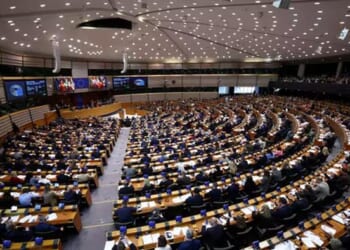
EU Commission President Ursula von der Leyen once again survived a no-confidence vote in the European Parliament on Thursday at noon. In Strasbourg, 165 members voted in favor of the motion, 390 voted against it, and 10 abstained.
The latest initiative from within the Parliament was introduced by Patriots for Europe (PfE), the right-conservative parliamentary group. The main point of criticism that led to the motion of no confidence was the free trade agreement between the EU and the Mercosur states of South America. More broadly, the group expressed dissatisfaction with the Commission’s trade policy, which it claims systematically ignores national interests—particularly those of European agriculture.
This marks the fourth no-confidence motion against von der Leyen within six months. The initiators have alternated between the right-wing groups Patriots for Europe and the European Conservatives and Reformists (ECR), as well as the left-wing parliamentary group “The Left.”
Von der Leyen continues to face accusations of a lack of transparency during the COVID period. She has also repeatedly been criticized for the absence of democratic legitimacy in conducting trade negotiations with the United States on behalf of EU member states, as well as for her strong focus on supporting Ukraine—an emphasis that critics argue comes at the expense of the interests of EU member countries.
Parliamentary Discipline in the European Parliament
In light of the steadily growing conservative right in Parliament, von der Leyen has increasingly become a projection surface for criticism of the centralization of political power in Brussels. The core factions supporting the Commission President—primarily the EPP (European People’s Party) under the leadership of CSU politician Manfred Weber, along with the Progressive Alliance of Socialists and Democrats (S&D), Renew Europe, and parts of the liberal and Green groups—are finding it increasingly difficult to shield her from public criticism.
With each publicly staged no-confidence motion, another piece of Ursula von der Leyen’s political substance erodes. She has been weakened since the scandal surrounding her deleted text messages in the Pfizer affair.
For this reason, EPP Group leader Manfred Weber resorted in advance of the no-confidence vote to “disciplinary” measures, significantly restricting the rights of members of his parliamentary group in the event of dissenting votes (as previously reported by Tichy’s Einblick).
In addition to explicit threats of sanctions against dissenters, reports from Brussels indicate that an internal communications strategy was deployed to reinforce group discipline. Weber repeatedly made clear that he expects “closed majorities” and branded dissenting votes as “destructive to the political center.”
Weber also once again emphasized that dissenters were doing the business of Vladimir Putin—a familiar political talking point that has by now largely lost its effectiveness.
With his leadership style, the Union politician has positioned himself as one of the standard-bearers of an increasingly unrestrained party bloc, one that appears unable to counter the growing competition from the national-conservative camp with substantive arguments. Whether in the case of Schleswig-Holstein’s Minister President Daniel Günther and the associated threats of censorship, or—as now with Weber—in the Union’s handling of a political credibility crisis and economic recession, opposition voices are increasingly suppressed. Step by step, the party is conforming to a repressive system of political control.
The catalogue of sanctions established by Weber to enforce group discipline included, among other measures, the withdrawal of rapporteur positions. In addition, members were internally threatened with disadvantages such as the loss of group support in committee work and reduced influence over delegation decisions, in order to eliminate any incentive for dissenting votes.
Absence from votes—or even support for the no-confidence motion against von der Leyen—was also set to result in exclusion from delegation trips and internal working groups. Absenteeism was viewed as particularly critical by the EPP leadership, as it can be interpreted as a political statement—an implicit rejection of the group leadership and its strategic line.
Ostracizing Freedom of Conscience
Through this approach, Weber promotes the political ostracization of dissenters—freely elected representatives who vote according to their conscience. Critics see this practice not merely as an instrumental push toward party conformity, but as a structural undermining of the principle of the free mandate in the European Parliament, especially given that Parliament already possesses few independent legislative initiative rights.
Formally, the mandate remains free; in practice, however, Weber’s actions significantly devalue it. Members deemed “undesirable” risk not only political isolation, but also the loss of real opportunities to shape policy within the EU legislature. This weakens their mandate far beyond symbolic sanctions.
This approach follows a pattern that Weber has progressively intensified in past votes. Even during earlier no-confidence motions, he threatened dissenters with post-hoc sanctions in a disciplinary tone. Previous votes—such as those in October or July—already showed that EPP members who adopted more cautious or critical positions toward key Commission decisions were placed under scrutiny. In line with his strategy, Weber moved aggressively against any deviation in order to preserve a unified political image of the EPP.
This behavior is not only unethical and, from a parliamentary perspective, dishonest; it also inflicts significant damage on the European Parliament itself. The Parliament—already a representative body without its own right of legislative initiative—loses further prestige as a result of Weber’s measures. It increasingly appears as a democratic fig leaf for a technocratically operating Commission, drifting ever further away from democratic principles under the banner of internal party discipline.
* * *
About the author: Thomas Kolbe, a German graduate economist, has worked for 25 years as a journalist and media producer for clients from various industries and business associations. As a publicist, he focuses on economic processes and observes geopolitical events from the perspective of the capital markets. His publications follow a philosophy that focuses on the individual and their right to self-determination.
Loading recommendations…