Authored by Ryan Morgan via The Epoch Times (emphasis ours),
The Pentagon released its new National Defense Strategy late on Jan. 23, placing the homeland and a surrounding sphere of influence as the top priority for the U.S. military.

Nearly two months after the White House released President Donald Trump’s National Security Strategy, the new 34-page Pentagon document provides specifics regarding how the U.S. military will support the president’s strategy. In particular, it describes four specific lines of effort for military planners going forward.
“No longer will the Department be distracted by interventionism, endless wars, regime change, and nation building. Instead, we will put our people’s practical, concrete interests first,” Secretary of War Pete Hegseth wrote in a memorandum accompanying the new strategy document.
Here are the four key lines of effort outlined in the new National Defense Strategy and how they fit into Trump’s security and foreign policy framework.
1. Sphere of Influence
The Pentagon describes defending the U.S. homeland as the “foremost priority” Trump has given the military.
“The Department will therefore prioritize doing just that, including by defending America’s interests throughout the Western Hemisphere,” the document states.
As part of this first priority, the Pentagon noted U.S. military efforts to secure the United States’ borders and to combat drug trafficking throughout the Western Hemisphere.
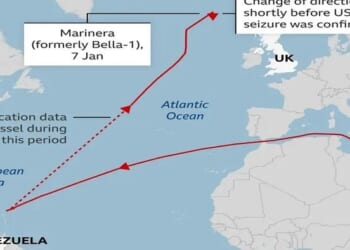
U.S. forces began amassing near Latin America in August 2025 and carried out strikes on drug boats in the Caribbean Sea and eastern Pacific for months. They also seized sanctioned oil tankers sailing to and from Venezuela.
Those moves preceded an operation into Venezuela, during which U.S. forces apprehended the country’s wanted leader, Nicolás Maduro, to face federal charges for an alleged drug trafficking conspiracy.
President James Monroe articulated a U.S. pledge to oppose European colonial efforts in the Western Hemisphere in an address to Congress in December 1823 that later came to be known as the Monroe Doctrine.
In the weeks leading up to Maduro’s capture, the Trump administration began increasingly referring to a “Trump Corollary” to the Monroe Doctrine.
In a press conference following Maduro’s capture, Trump explicitly referenced Monroe’s 1823 doctrine and said, “Under our new national security strategy, American dominance in the Western Hemisphere will never be questioned again.”
Since ordering Maduro’s capture, Trump has also ramped up talk of a U.S. acquisition of Greenland, which is currently a semiautonomous territory of Denmark. Trump has said the island territory is key to U.S. national security.

The new strategy document states that the Pentagon will “provide the President with credible options to guarantee U.S. military and commercial access to key terrain from the Arctic to South America, especially Greenland, the Gulf of America, and the Panama Canal.”
The document further declared the Pentagon’s intent to support Trump’s Golden Dome missile defense initiative.
U.S. nuclear force modernization and cybersecurity are also listed under the first line of effort, as is countering Islamic terrorism.
“The Department will maintain a resource-sustainable approach to countering Islamic terrorists, focused on organizations that possess the capability and intent to strike the U.S. Homeland,” the document states.
2. China and Indo-Pacific Deterrence
As the U.S. military adjusts its global strategy, the Pentagon is charged with finding ways to deter China while seeking to avoid confrontation with the nuclear-armed power.
The Pentagon said it will follow Trump’s lead in engaging with Chinese counterparts and supporting deconfliction efforts.
The strategy document does not mention any intent to be in direct conflict with China, but it states that the responsibility of the military is “to ensure that President Trump is always able to negotiate from a position of strength in order to sustain peace in the Indo-Pacific.”
Under this priority, the U.S. military “will build, posture, and sustain a strong denial defense” along what’s known as the first island chain.
The first island chain includes mainland Japan, the Ryukyu Islands, Taiwan, the Philippines, and Borneo.
“We will also work closely with our allies and partners in the region to incentivize and enable them to do more for our collective defense, especially in ways that are relevant to an effective denial defense,” the new National Defense Strategy states.

One effort to bolster regional allies involves a trilateral security partnership among Australia, the UK, and the United States, known as AUKUS. The partnership began in 2021 during President Joe Biden’s administration.
In June 2025, the Pentagon placed the AUKUS partnership under review. In October, Trump suggested the partnership might be unnecessary.
The Trump administration has since expressed support for the group, and in December 2025, Hegseth said, “We are strengthening AUKUS so that it works for America, for Australia, and for the UK.”
3. Burden-Sharing
As with the alliance-building in the Indo-Pacific, the new National Defense Strategy emphasizes a need for allies and partners across the globe.
The strategy document describes a “simultaneity problem” wherein multiple adversaries of the United States might act in concert to stretch U.S. military resources.
“Such a scenario would be less of a concern if our allies and partners had spent recent decades investing adequately in their defenses. But they did not,” the document states.
“Instead, with rare exceptions, they were too often content to allow the United States to defend them, while they cut defense spending and invested instead in things like public welfare and other domestic programs.”
The document states that the United States will push for partners in Europe, the Middle East, and the Korean Peninsula to take primary responsibility for their defenses, “with critical but limited support from U.S. forces.”
According to the strategy document, Mexico and Canada will have a role to play in the Western Hemisphere, helping prevent drug trafficking and illegal immigration into the United States.

“Canada also has a vital role to play in helping to defend North America against other threats, including by strengthening defenses against air, missile, and undersea threats,” the document adds.
In Europe, North Atlantic Treaty Organization (NATO) members are expected to “take primary responsibility for Europe’s conventional defense.”
Trump has already championed a pledge for the NATO members to each commit 5 percent of their annual gross domestic product to defense and national security spending, up from a goal of 2 percent in 2014.
4. Arms Manufacturing
The fourth area of focus detailed in the Pentagon’s new strategy document is to bolster the United States’ arms industry.
The document states that this reindustrialization effort “is vital to ensuring that U.S. forces have the weapons, equipment, and transportation and distribution capability needed” to implement the strategy.
“It is also critical to ensuring that the United States can help arm allies and partners as they take on a greater share of the burden of our collective defense, including by leading efforts to deter or defend against other, lesser threats,” it reads.
This month, Hegseth began touring U.S. arms manufacturing facilities in what he’s dubbed the “Arsenal of Freedom” tour.

Hegseth and Trump have taken other recent steps to reform the military’s arms acquisition process.
“We’re leaving the old failed process behind, and we’ll instead embrace a new agile and results-oriented approach,” Hegseth said in a speech to industry leaders at the National War College in Washington on Nov. 7, 2025.
In a series of social media posts on Jan. 7, Trump criticized Raytheon and other arms manufacturers for the compensation packages they are giving to corporate executives and for offering stock buybacks and paying out dividends to shareholders.
Along with working with established traditional vendors, the National Defense Strategy states that the Pentagon will also seek to bolster organic manufacturing capabilities and grow nontraditional vendors to grow the U.S. arms industry.
Loading recommendations…