Gaza’s reconstruction is not an apolitical project. It is, in many ways, a contest of political power between those who want to continue the Israeli-Palestinian conflict and those who wish to end it.
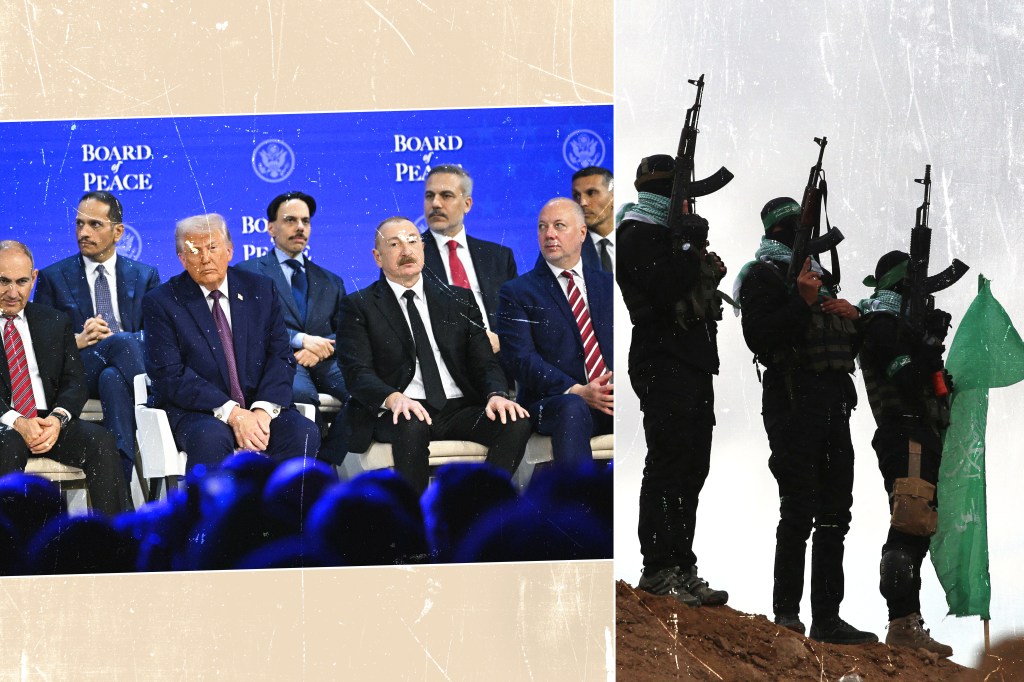
President Donald Trump’s recently announced Board of Peace is a new attempt to answer a question the world has asked—and failed to answer—for years: how to rebuild Gaza in a way that produces a better future for its people, rather than producing another round of fighting, death, suffering, and rubble.
Under Hamas, Gaza was transformed into an enclave geared toward armed resistance to Israel. Tunnels became the signature public works program. Launching rockets at Israel was Hamas’ chief form of foreign policy.
Civilian life existed, too—and many Palestinians in Gaza had nothing whatsoever to do with Hamas and don’t support its ideology. Indeed, many in Gaza did not like Hamas at all because it ruled over Gaza with authoritarianism and cruelty. But Hamas built a military system on top of the society. This arm absorbed resources and dictated politics.
Hamas is built on an anti-Zionist ideology that rejects the existence of Israel, claiming all of the land between the Jordan River and the sea for an Islamic state. Hamas’’ major patron, the Islamic Republic of Iran, did not invest in Gaza under Hamas because it wanted Palestinians to live normal lives in a sovereign state next to Israel—Iran invested because Gaza was useful.
The Islamic Republic’s leaders treated the Gaza Strip as a place to stockpile weapons, train men, launder money, and keep the conflict with Israel burning. And Hamas is far from their only project of this nature. The Iranian regime has developed a network of political parties and jihadists across the Middle East. This so-called “Axis of Resistance” includes Hezbollah in Lebanon, Kata’ib Hezbollah in Iraq, Liwa Fatemiyoun in Afghanistan, Ansar Allah in Yemen, and a multitude of groups involved in the Syrian civil war. The aim is to destroy Israel, not to bring about any form of peace or prosperity for people on the ground.
So after every conflict between Hamas and Israel—for instance, nearly two months of hostilities that Israel dubbed Operation Protective Edge in 2014 and more than 10 days of fighting in 2021—there is a phase of rebuilding. Every time, Hamas then takes the rebuilt city and uses it as a platform to prepare for the next war. Not every bag of cement becomes a tunnel, but enough do. Not every school becomes a recruitment site, but the ideology remains.
Any future rebuilding attempt needs to break that pattern. Palestinians need to be freed from Hamas. Decades before the group existed, Hamas’ ideologies of Islamism and jihadism sowed the seeds for the conflict during the 1930s. This is why Hamas named its armed wing after Izz ad-Din al-Qassam.
Al-Qassam was a Syrian jihadist preacher who moved to Palestine in the 1930s with the intent to fight both Zionism and the British Mandate. He recruited small clandestine cells using religious networks in and around Haifa and in what today is the West Bank near Nablus, Jenin, and Tulkarem. His group, known as the Black Hand (Al-Kaff al-Aswad) engaged in sabotage against British infrastructure, including the railways, and attacks on Jewish communities. His ideology was focused on a revival of Islamic rule, both in the British Mandate of Palestine and more widely. Hamas was founded as a continuation of Al-Qassam’s movement. He is recognized (in Article 7) of the group’s founding charter as being its ideological inspiration.
Let’s be clear: The goal here in the long run (for both Palestinians, Israelis, and everybody else involved who wishes to see a humane outcome to the Israel-Hamas war) should not be a momentary fix. The goal should be a permanent system of peace. Peace is the only sustainable basis for future prosperity, both for Israelis and Palestinians, and across the wider region.
We already have a foundation. The key is that as a condition of the ceasefire that came into effect on October 10 last year, Hamas’ leadership accepted—at least on paper—the principle of disarmament. If Gaza is to become a land of peace and coexistence in the future, this is a crucial change.
The question now is whether this becomes reality and whether it works in practice. Firm action is required—to demilitarize Hamas and prevent it from gaining a new foothold for jihad.
The ceasefire was structured as a phased transition. Phase 1 focused on an immediate halt in fighting. It also specified increased humanitarian deliveries into Gaza and the exchange of hostages, prisoners, and remains. Phase 2 was meant to begin the transition toward peace: expanded Israeli withdrawals, Hamas’ disarmament, and the first practical steps toward a new governing arrangement in Gaza. With the reported recovery on Monday of the body of the final Israeli hostage, Phase 1 is drawing to completion.
Hamas’ leadership agreed to the terror group’s own disarmament as part of the ceasefire. But even so, senior figures in the movement, such as Khalil al-Hayya, say they are not willing to relinquish weapons until Israel fully withdraws from Gaza. After Israel targeted al-Hayya and other Hamas leaders in a September airstrike in Qatar, they want international guarantees against any future Israeli military action against them.
A board designed to force a transition away from Hamas rule now includes states that have had a long investment in Hamas surviving that transition. In other words, the project can be hijacked from the inside.
Such a process risks dragging us back into another ugly quagmire. Imagine: Hamas holds onto power, Gaza is rebuilt, and Hamas rearms. Hamas decides the time is ripe for a new wave of jihad, and repeats October 7 or a similar kind of attack—as one of its leaders, Ghazi Hamad, promised to do in the early days of the war. And then, what? The region gets sucked into another war?
This is the eventuality that the Middle East needs to avoid.
Long before October 7, the world treated Gaza as a permanent emergency, but such an approach has not resolved the problem. Ultimately, it sustains a political stalemate in which armed groups retain control. This allows external patrons to keep supplying and resupplying them with weapons of war. Each round of rebuilding lays the groundwork for the next armed conflict. It’s a never-ending cycle of disaster.
Could the Board of Peace break the cycle? Could it make a difference where the United Nations has failed to improve the lives of Palestinians?
The U.N., in practice, is two different things. On the ground, it is a logistics-and-services machine. Its agencies feed people, run clinics, staff schools, and coordinate shipments. But in the political arena, it has become a stage—one where ideological blocs fight symbolic battles, and where Gaza is discussed endlessly without actually fixing the underlying conflict. Living under a U.N. refugee system is supposed to be temporary. Crises are supposed to be resolved, not kicked down the road.
What makes the Board of Peace different—at least in theory—is that it appears to sit alongside, rather than inside, the dysfunctional United Nations system. It looks like a parallel mechanism, or perhaps even the start of an alternative system altogether.
The new model concentrates authority in a smaller coalition—Washington, regional funders, and whatever local governing mechanism replaces Hamas. The trouble with this arrangement is that unless the board draws hard lines, it risks importing many of the same contradictions that paralyze the U.N.
Here’s an example: Trump has invited Qatar and Turkey to join the Board of Peace. Both have, in different ways, kept Hamas politically afloat. Qatar hosted Hamas leaders and acted as a financial conduit into Gaza for years. Turkey gave Hamas political cover and continues to allow it to use Turkish soil as an operational platform. The involvement of Turkey and Qatar does not read like neutral mediation.
That creates a basic problem. A board designed to force a transition away from Hamas rule now includes states that have had a long investment in Hamas surviving that transition. In other words, the project can be hijacked from the inside.
At the risk of stating the obvious, what Trump needs to secure from any future member of the Board of Peace is an actual commitment to peace. The Board of Peace cannot function without a basic commitment to that principle. You can’t build peace if your long-term goal is to tear down the people on the other side.
If Trump’s Board of Peace is to be more than a rebrand of the old international machinery, it has to do what the U.N. system has not: disarm Hamas, facilitate credible governance for Gaza, and end Gaza’s use as an Iranian or Qatari or Turkish forward base for jihad against Israel. If it cannot draw those lines, then it will simply inherit the same contradictions as the U.N.: humanitarian management without political resolution, rebuilding without peace, and setting the stage for another cycle of destruction waiting to happen.