As we end the first month of 2026, the governing spirit of the United States is not populism; it is neither right-wing nor left-wing ideology, and it is most certainly not the political order spelled out in the Constitution. It is chaos.
The Trump administration has had an extraordinary few weeks, dragging the American people along for the ride. Federal agents have, as of this writing, shot dead two American citizens—within weeks of each other, in the same city—while clad in masks and military gear and carrying out a campaign of paramilitary-style immigration enforcement that appears far more interested in theatrics than deportations. In both cases, the secretary of the Department of Homeland Security has rushed to label these shooting victims—and by extension other ordinary Americans protesting Immigration and Customs Enforcement tactics—“terrorists.” In recent days, we’ve seen high-ranking administration officials try to retroactively justify the agents’ actions by advancing arguments that infringe upon Americans’ First and Second Amendment rights.
Elsewhere in the world, NATO countries dispatched troops to Greenland in response to fears—far from unreasonable—that the United States was weighing an act of war against Denmark as part of a campaign of old-fashioned imperial expansion. The Canadian prime minister announced the end of his country’s longstanding partnership with the United States—“we are in the midst of a rupture, not a transition”—and has taken steps to strengthen ties with China. India and the European Union, both harmed by U.S. tariffs, announced the “mother of all” trade deals as a defensive measure against the United States and China, now regarded in Delhi and Brussels as twin predators.
Gold and silver prices are regularly hitting record highs, and the financing costs of the U.S. government’s ever-expanding national debt are continuing to rise. The United States has now entered its sixth consecutive year of persistently high inflation, and while pandemic-related economic forces and excessive federal spending first signed into law by his Democratic predecessor can account for much of that, President Donald Trump’s stubborn clinging to misguided tariff policies is not helping matters. Neither is his administration’s transparently pretextual criminal investigation of Federal Reserve Chairman Jerome Powell as part of the president’s efforts to bully the Fed into lowering interest rates in the runup to the midterms.
One of the ironies repeated throughout world political history is that autocrats rarely bring the order they are elected—or installed—to deliver, even the servile kind that can be imposed through state terror. No, more reliably, autocrats bring disorder. The disorder under which Americans are now suffering, the ramifications of which have only just begun to be realized, is what inevitably happens when an American president disregards the rule of law, insisting that he is limited only by his own sense of morality—a sense of morality that in this case does not quite seem to exist.
The president’s defenders—the true believers and those who, for some reason, feel obliged to play the role—will point out that the worst possible version of the events outlined above has generally failed to materialize. Canada remains a sovereign nation despite continued musings to the contrary; the administration is shaking up leadership and rethinking enforcement tactics in Minneapolis; the United States military has not been ordered to invade Greenland, and the associated tariff threats on European allies have been called off; Jerome Powell is still a free man. Indeed, Trump’s brinksmanship has been mocked with the acronym TACO: “Trump Always Chickens Out.”
But this brinksmanship is not cost-free, as the families of Renée Good and Alex Pretti can attest. Canada’s turn away from the United States and toward whatever opportunities present themselves—including a closer relationship with China—could very well be permanent. American leadership of NATO remains on paper, but it is a de facto dead letter, and the alliance itself may soon be, too. Countries such as Ukraine that once trusted the United States no longer believe Washington to be a credible friend; enemies such as Iran and Russia may still fear the United States but have learned that it is not always a credible enemy. American leadership of a market-oriented international economic order has been forfeited and may never be recovered. Far-flung allies such as Taiwan are starting to understand that if anything is going to save them from oppression, it is not going to be American fidelity—nuclear weapons might be a better bet.
We are aware that Dispatch readers have read and heard us repeat these points a thousand times in articles and on podcasts, and we are equally aware that a Dispatch editorial, while rare, is not going to be the “J’accuse!” that forces the powers that be to rethink where they are and what has brought them there. But we will repeat ourselves nonetheless: Donald Trump is uniquely unqualified for the office of the presidency, himself a man with no sense of integrity or administrative acumen, and one who is lazy, vain, ignorant, and vulnerable to flattery—all of which make him easy to manipulate for figures such as Stephen Miller, whose ethnonationalist obsessions and sophomoric Nietzschean posturing have dominated the administration’s agenda for months and who is emblematic of the types of advisers with whom the president has surrounded himself this second go-round.
But Trump is far from the only one at fault for the mess in which we find ourselves.
There is, of course, the Biden administration—and former President Joe Biden himself—whose own incompetence, disregard for the rule of law, and dishonesty with the American people did irreparable damage to the country and paved the way for Trump’s return to power. And when the history of our time is written, congressional leaders—particularly Republican congressional leaders—will be remembered as more important, and much more culpable, than it seems at this moment. Describing their careers as inaction would be too charitable; they have been enablers not only of the particular crimes of the Trump administration but of the more general aggrandizement of the presidency and the subordination of the entire legislative branch—the branch created by Article I of our Constitution to make laws and exercise oversight of federal agencies. They are, in a very real sense, in gross violation of their oaths of office, and so too are the representatives and senators of both parties who have contributed over the years to the reduction of Congress to its current miserable state. It was inevitable that the void left by Congress’ abandonment of its constitutional duties would be filled by the energies—and fantasies, and fundamental incompetence—of a man once accurately described by J.D. Vance as plainly unfit for the office to which he has twice been elected by the American people.
There are other aggravating factors as well, including the emergence of a digital culture that has degraded political journalism from an important check on those in power into clickbait fan service and conspiracy theory nonsense. Our two main political parties, which have been supplanted as financial actors by small-dollar donors driven by social media outrage, no longer serve their traditional function as gatekeepers, enforcers of standards, or negotiators of broad consensus and compromise. Vital institutions and activist groups—on both the right and the left—have fallen prey to audience capture and now serve purely partisan interests rather than the missions upon which they were founded. We must ultimately note, however, that while Trump did try to steal the 2020 election, he did not steal the 2024 election—he was put into the position he holds by the votes of the American people.
The catalog of the administration’s wrongdoings is so substantial as to feel endless—not impossible to keep track of, but not many people are in a position to dedicate their lives to the project. American citizens illegally detained by ICE agents. The gross corruption on the part of the president and his circle. Launching a war on Venezuela without congressional authorization, after carrying out a likely illegal campaign of extrajudicial massacres at sea. Refusing for months to enforce the law banning TikTok. The pace of outrages and abuses is part of the White House’s strategy—you’ll have forgotten about Trump’s promise to end the Russia-Ukraine war on his first day in office by the time you’ve journeyed through Minneapolis and Caracas and Tehran and Nuuk.
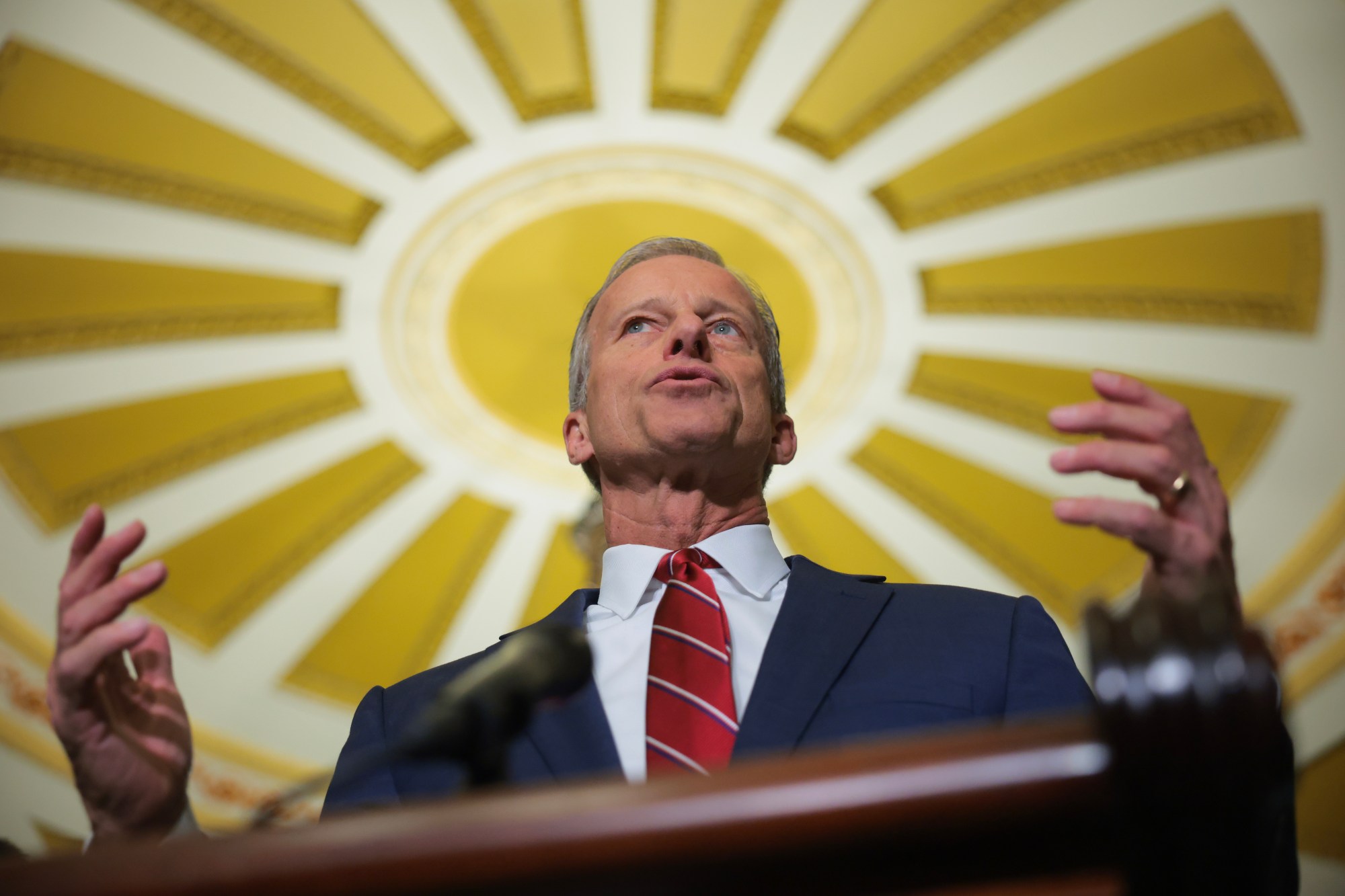
Here we will take the unusual step of directly addressing Sen. John Thune, the majority leader in the Senate, who, we believe, understands the difference between merely being the Senate majority leader and acting like the Senate majority leader. Whatever his admirable personal qualities, Thune has thus far failed to perform the role he is supposed to play in our constitutional order. If Trump is to be constrained—and the need only grows more dire by the day—it is Congress that will constrain him. Senate Republicans, having a majority that is at the moment expected to survive the midterms, have a special role to play in that. And Thune, as their leader, has an opportunity to begin charting the long path toward the kind of politics and governance that so many elected Republicans privately wish for when the cameras are off.
And so we ask Sen. Thune: If you cannot act in the face of this—all this—why do you choose to remain in the Senate at all? Now 250 years into this great experiment in self-government, we firmly believe there is still a much greater appetite for sanity, civility, and decency in this country than social media and cable news would indicate. But even if we’re wrong, we return to The Dispatch’s founding document: “Failure in a good cause is better than triumph in a bad one.”
Dante put his cowards and opportunists—those who refused to take a stand in life—in the vestibule of his inferno: It isn’t Hell proper, but you can see the rest of the underworld from there. The cowards and opportunists in the United States in 2026 stand at a precipice, too, and have brought our country to the verge of something awful and unspeakable. We got here one step at a time—let us hope that we remember the way back.