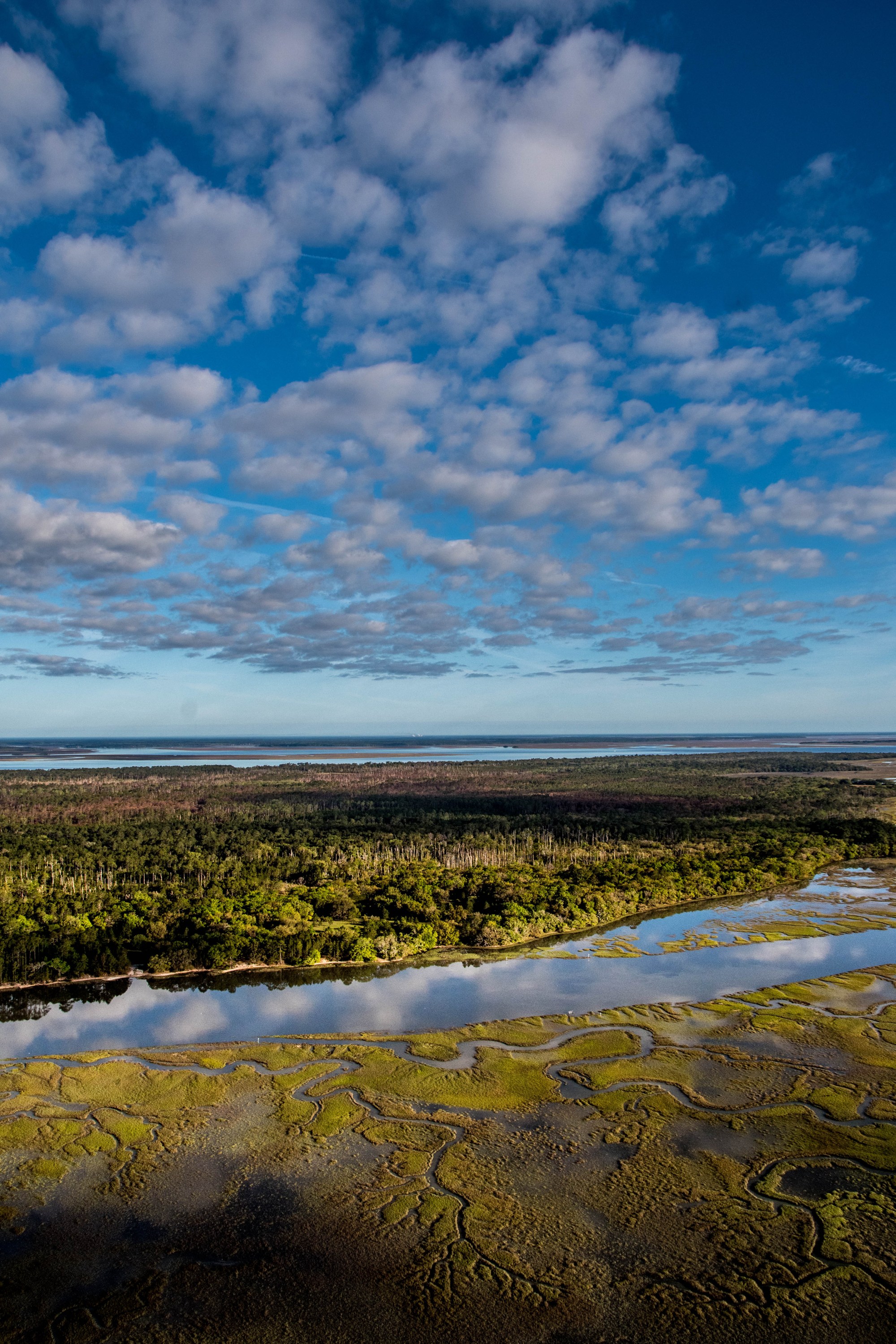
SEA ISLAND, Georgia—Just past the upscale shops, architecturally integrated fast-food restaurants, and aging movie theater in the charming beach town of St. Simons Island, the signs of development rapidly fall away. The two lanes of Sea Island Road here are lined with magnificent live oaks, their boughs arching over the roadway and garlands of Spanish moss dipping downward, as if a series of stage curtains has just been raised. Then the oaks thin out into planted palms and that’s when the marshes, with their winding brackish creeks and swaying grasses, are revealed.
This is what the 19th century poet Sidney Lanier, in perhaps his most celebrated work, described as “the length and the breadth and the sweep of the marshes of Glynn.” It is the grand, captivating view that the Sea Island Company works to maintain for the benefit of visitors to its luxe resort on the namesake barrier island the company owns, which sits just across from St. Simons. It’s an entrance to a coastal retreat that for 100 years has drawn U.S. presidents, foreign leaders, and titans of business. It’s the first taste of the natural beauty that draws in the wealthy homeowners and summer renters.
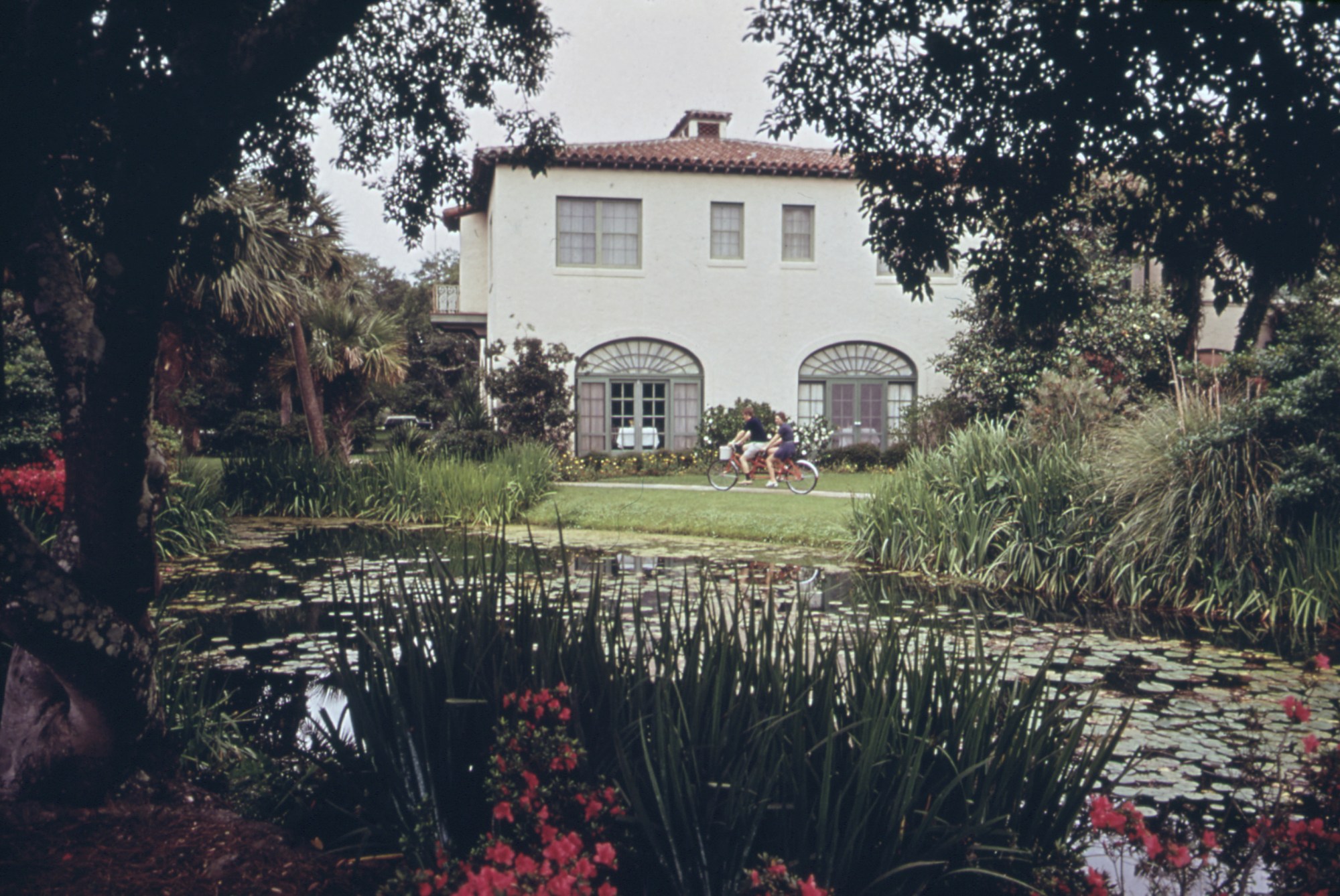
Past the gatehouse at the end of this spit of marshland and across the short causeway spanning the Black Bank River lies Sea Island itself, another world of luxury and elegance. Northeast of the bridge, the distinctive tiled roof of the island’s five-star hotel, the Cloister, pokes out among the palms. The sight recalls the Roaring ’20s, when architect Addison Mizner drew on Mediterranean styles to define the look of much of South Florida and, yes, Sea Island, too. (The current Cloister building is a recreation of Mizner’s original 1928 construction.) If the goal is to project ornamental exclusivity rising up from the marsh, then mission accomplished.
The road curves northeast to run parallel to the beach, spreading out slightly into a grand avenue that is briefly interrupted by a roundabout. Take a right to head to the Sea Island Beach Club, or go left to the Cloister. Straight through begins the journey through one of the most exclusive neighborhoods in the Southeast.
All along the main drag, as well as off the regular streets that shoot off toward both the Atlantic, on the right, and the marsh, on the left, are impressive multimillion-dollar homes. Some are understated but grand ranches. Yet plenty are extravagant and luxurious mansions, hilariously described on the matching address signs dotting every pristine lawn as “cottages.”
One of these beachfront cottages sold late last year for $30 million, the highest recorded residential sale ever in the state of Georgia. Known as Entelechy II, it was designed and owned by the neofuturist architect John Portman, who died in 2017. The house’s experimental design includes seven bedrooms, a multistory atrium, multiple exterior spiral staircases and bridges connecting interior rooms, two ocean-view terraces, large load-bearing columns secretly housing features like an elevator and a wet bar, a pool and postmodern sculpture garden, and cantilevered steel beams protruding from an open-air gridded roof. (The new owners are Jeffrey Sprecher, the chairman of the New York Stock Exchange, and his wife, Kelly Loeffler, the former U.S. senator and current head of the Small Business Administration.)
About a mile past the Cloister, a left turn toward the marsh-side takes you past a few impressive-looking homes before the street dead ends next to a relatively quaint rambler. Instead of a manicured lawn of Bermuda grass, this house is partially obscured by the spindly pines and squat palmettos growing naturally all around it. Its comparative ordinariness amid the surrounding opulence seems intentional.
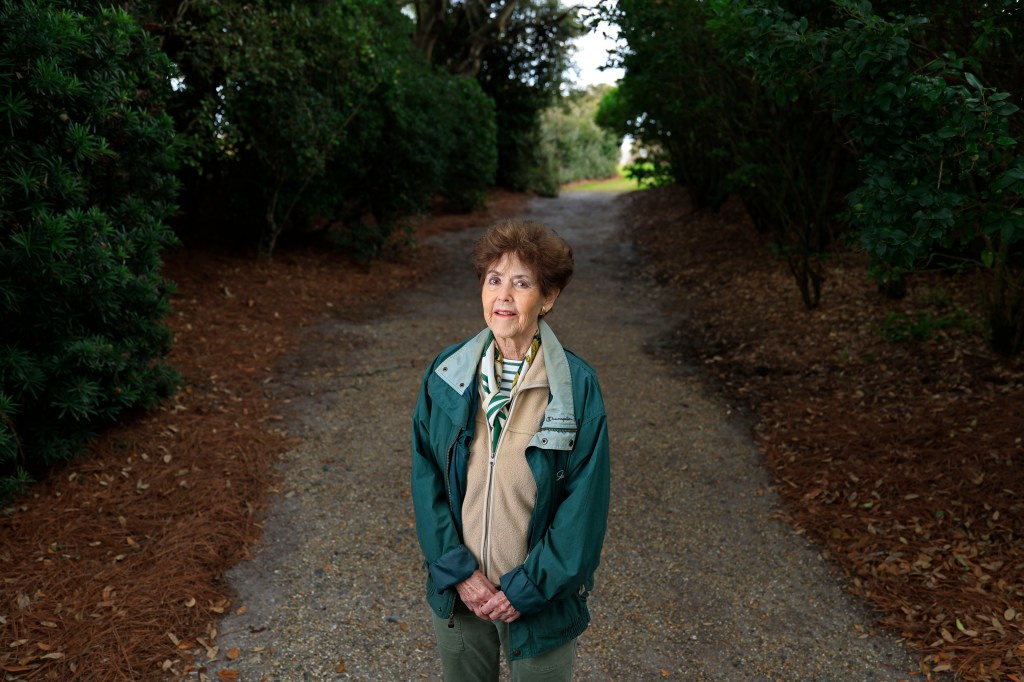
This is the home of Jane Fraser, an environmentalist, philanthropist, and Sea Island’s unofficial gadfly. At first glance, this spry 83-year-old Southerner looks like any other well-off Sea Island denizen you might spot at the clubhouse or going for an early-morning stroll along the beach. But talk to almost anyone here or on St. Simons, and they will have an opinion about Fraser—mostly negative ones.
Over the past two decades, Fraser or organizations she’s connected to have filed nearly a dozen lawsuits against everyone from the Sea Island Company to local residents and even a historic and beloved church. Many involve environmental or development complaints, and taken together they have cost Fraser (and the various defendants) a considerable amount of money but with very few victories to show for it. For Fraser, the magnificent portal I have just driven through to arrive on Sea Island is her latest and, perhaps, most ambitious target.
That would be the aforementioned gatehouse, which guards the only land access to the island. Passing through the gate requires a word with one of the security officers employed by the Sea Island Company. To proceed, guests of the resort and guests of homeowners must be on the list. Homeowners, members of the private beach club, and commercial contractors must purchase a pass for an annual fee to get onto the island. Otherwise, the island is inaccessible to the general public.
In Fraser’s mind, that inaccessibility is a wrong she is set on righting. She has separately sued both Glynn County and the Sea Island Company to remove the gatehouse and reopen the bridge, and thus Sea Island, to the public.
Fraser’s current lawsuits all rest on a remarkable claim: The land on which the road and causeway connecting St. Simons to Sea Island sit is being misused in violation of an agreement, signed during the Calvin Coolidge administration, between the county and a local businessman named T.L. Cain. In her telling, the Sea Island Company and Glynn County conspired more than 20 years ago to limit the only public road access to the island, something that violates that contract, the public trust, and Cain’s intent.
“I visualize the right thing being done and the people who lied to the citizens being held accountable, and I don’t think they have been,” Fraser told me last month as we sat in her living room. “I just think the truth should come out.”
Fraser remembers a different time, when Sea Island wasn’t just another gated community. Long before she began coming to Sea Island in the early 1970s, then moved here permanently in 1994, the bridge was a spot for those on St. Simons and broader Glynn County to fish, or to watch fireworks on the Fourth of July, or to simply take in natural beauty. Artists once set up their easels and camera tripods on the bridge to capture the sun rising and setting on the salt marsh. Families would cross onto Sea Island for day trips to the beach, reclining on the same sand enjoyed by the titans of business who were members of the island’s expensive beach club or the wealthy vacationers staying at the Cloister.
That’s the past Fraser and her co-plaintiff, a man from nearby Brunswick, Georgia, named Jeff Kilgore who had previously traveled regularly to Sea Island before the gatehouse was erected, would like to return to. “It means that people can stop there for their bait again. It means that they can come watch the fireworks, it means they can come do the open-air paintings,” Fraser said. “It’s public land.”
Fraser wants to project an image of herself as a defender of the common man of Glynn County, looking to break down the divide between the haves and the have-mores. “There’s no words for her tireless work that she has done to advocate for St. Simons Island,” says Darion Williams, a descendant of Cain who lives in Arizona but has been a vocal supporter of Fraser’s fight to open up the island.
Yet it’s unclear how much of the local public in the rest of Glynn County is on Fraser’s side. In fact, Fraser’s crusade has earned her the informal title of “troublemaker” among several people in the community I spoke with. The lawsuits over public access to Sea Island are only the latest example of her two decades of litigiousness that vexes almost everyone else, especially the local business community. For them, Fraser is not a populist hero but an annoyance who refuses to bend to appeals to reason, compromise, or neighborliness. “She’s just an antagonizer,” said Clement Cullins, a real estate lawyer in St. Simons. “She’s bad for community. She’s bad for this community.”
Reverting to the past.
Fraser’s house is smartly but sparsely furnished, fitting for an elderly woman living on her own. (Her husband, Joe Fulcher, died in 2017.) A few cats mill around, with Fraser occasionally letting them out of the sliding glass doors. The view from her backyard is a little step back in time to the way things might have looked here 40 years ago. The natural beauty of the island itself crowds out most of the signs of material wealth that linger across the inlet and behind the trees. Looking north from Fraser’s yard, the trees of the undeveloped Little St. Simons Island (currently owned and protected from development by former Treasury Secretary Hank Paulson) are arrayed against the horizon.
A smaller building on her property houses a home office, where she stores documents and conducts part of her work as president of the Stuttering Foundation of America, a nonprofit providing educational resources for stutterers and their families as well as supporting research into causes and treatment. Fraser took over the job from her father, Malcolm Fraser, the cofounder with his brother Carlyle of the auto parts distributor Genuine Parts Company, the parent company of NAPA Auto Parts. Malcolm was a stutterer from an early age, back during a time when the disorder was poorly understood. His business success led him to start and provide the initial funds to the foundation in 1947.
Fraser, who became president of the nonprofit in 1981, says her father’s legacy is the foundation. But his business success helped provide her with an impressive fortune with which she has supported other philanthropic causes, from speech therapy to civics education to conservation. It’s also helped finance her many adventures in litigation, the latest of which is the current fight over the causeway and gatehouse.
One afternoon last month, Fraser sat with casual poise, speaking softly in a genteel Southern accent but with the energy and passion of someone decades younger. “I guess we could start with 2004 and the abandonment of the roads,” Fraser said when I asked about how she got to this point. That key moment when Glynn County abandoned its ownership of the approach to Sea Island to the company, she argues, is when all the trouble started.
But we should go further back, because the story really begins in 1924, when a St. Simons landowner named T.L. Cain deeded two adjacent plots of his land to Glynn County.
Cain conveyed both of these tracts to the county, provided they were to be used for specific purposes in perpetuity. The 2-acre wedge off Frederica Road was to be used for a park, which to this day is known as Twitty Park. The long narrow strip stretching from the wedge all the way to the Black Bank River, meanwhile, was given to the county “for the purpose of a right of way for a road from St. Simons to Long Island,” as Sea Island was still sometimes called in 1924.
The contract went on: “It is understood and agreed that if the lands should ever cease to be used for such purposes then the title to the same shall revert to the first party.”
Here is where Fraser thinks she has Glynn County and the Sea Island Company dead to rights. In her view, Cain intended this strip of land to be used by the public to access Sea Island, and the fact that it is no longer publicly accessible past the gatehouse is a violation of the terms of his agreement. Legally, she argues, the land should revert to Cain’s heirs—and it just so happens that Fraser has purchased those reverter rights from several (but not all) of Cain’s living heirs.
“He meant this area to be open,” Fraser said of Cain, who died in 1939. “Donor intent has always been a big thing for me.”
Was that Cain’s intent? Neither the Sea Island Company nor the Glynn County government appears to see things that way.
“We believe the lawsuits are without merit,” said Scott Steiler, the president of the Sea Island Company, in a statement he first provided to the Brunswick News in 2024 when Fraser filed her suits. “While it’s unfortunate that the plaintiffs have decided to file these complaints, we nonetheless will vigorously defend ourselves and we are committed to do what we have always done: be good stewards of not only Sea Island but for all of Glynn County as well.” The company declined to comment further for this story, and the county did not respond to multiple requests for comment.
The transfer of the roads and utilities approaching and on Sea Island by the county to the company was all done in a public and transparent process, following the procedures laid out by state law. The gate itself certainly makes the island exclusive, but the right of way for authorized vehicles—homeowners, guests, commercial, service—isn’t impeded. And despite Fraser’s claim, there’s nothing in the letter of the contract that specifies that the road be publicly accessible, unlike the language governing the other tract, which expressly declares the land be used as a park “for the use and benefit of the public.”
It’s an important distinction, because this is not the first lawsuit Fraser has filed involving Cain’s contract, the Sea Island Company, and Glynn County. Back in 2016, Fraser and the Glynn Environmental Coalition (a group that Fraser has been deeply involved with) sued both the county and the company over the 1982 land swap in which the county conveyed Twitty Park to the company. Basing their arguments on Cain’s stipulation that the land be used for a public park, Fraser and the plaintiffs sought a declaration that the land swap was void and that the park’s ownership revert back to either the county or to the Cain heirs and other parties (in this case, Fraser herself) who owned the reverter interest.
In 2019, a superior court judge delivered Fraser a rare win by voiding the land swap and returning ownership of Twitty Park to Glynn County, which has a population of under 85,000 and is anchored by Brunswick, home to one of the country’s busiest seaports. The decision suggested to Fraser that she was onto something.
“We all knew that the causeway also belonged to T.L. Cain and it was also part of the gift to the citizens, right, not to the county,” she told me, recalling how she began to think about her next project: getting rid of the gatehouse.
Legal abandonment.
Despite the shared provenance from Cain’s deed, the Sea Island causeway case has not simply followed the logical conclusion from Fraser’s Twitty Park win. Fraser has had to, in fact, file three different suits: one against the Sea Island Company, one against Glynn County, and one seeking clarity about the ownership of the title under Georgia’s land registration act. So far, she has struggled to overcome the procedural but important hurdles involving standing and justiciability.
We can pause here to consider some of the factual history regarding how the Sea Island Company came to own the land on which the gatehouse and causeway sit. In 2004, the company requested the county abandon both the relevant portion of Sea Island Road along with the utility easements on the island itself. The triggering event was a break-in and assault of two Sea Island residents in September of that year by three young men from Brunswick.
There was no mystery about why the company wanted to take ownership of the land and utilities. As the Brunswick News reported on November 9, 2024, “preliminary plans” from the company included a gate to limit entry to “residents and their guests, Sea Island Club members, hotel guests, employees and service personnel only.”
What happened next was apparently a legal and open process, despite Fraser insisting in her legal filings that the process was a conspiracy and that the road was not “lawfully abandoned.” The Glynn County board of commissioners held a public hearing on the abandonment issue on November 18, with comments from both supporters and opponents. Afterward, the board approved the abandonment, which legally transferred the land and the road to the Sea Island Company. By 2009, the gatehouse was up, and access to the island became restricted.
All of these facts have complicated Fraser’s effort to even get a hearing on the suits’ substance. In the suit against the county, for instance, she has been unable to convince either the superior court or the state court of appeals panel to waive Glynn County’s sovereign immunity from civil suits. Simply put, the courts have held, Fraser has not demonstrated she can seek relief from a party that has no ownership interest in the disputed land. The same court of appeals panel also dismissed in part Fraser’s appeal on the land registration act petition, thanks to the fact that Fraser does not own all the reversionary rights to Cain’s property and there remain other heirs who retain those rights but are not party to her suit.
Finally, her lawsuit against the Sea Island Company is stayed in trial court until the other two suits are fully resolved. But all indications from the courts so far are that the issue is likely impossible to adjudicate. Fraser, meanwhile, says she’s going to keep fighting.
Always fighting.
Fighting, even when the law and the arguments are stacked against her, is something Fraser has done a lot of with members of her community over the past 20-plus years.
In 2006, Fraser caught wind that two separate neighbors on Sea Island had sought approval from the U.S. Army Corps of Engineers to fill in some of the marshland on their respective properties. Citing the federal Clean Water Act, she sued the homeowners and the Corps, claiming the permits were improperly awarded because the marshes had been incorrectly identified as freshwater and not tidal, the latter of which could not be filled in. Court filings show that despite two separate evaluations that the marshes were indeed freshwater, Fraser continued to insist otherwise. The next year, the Corps’ Savannah office updated the regional guidelines to allow filling tidal marshes, too, rendering the legal question moot. A judge quickly dismissed the case.
Another lawsuit, first filed in 2021, involved the historic Christ Church on St. Simons, a local tourist destination and a favorite spot for weddings and funerals. Decades of growth and development on the island meant increased traffic on a road that ran fairly close to the church grounds, forcing guests and parishioners to park along the road or in a lot across from it. In a plan with the county, Christ Church sought to move this portion of the road via a land swap.
But some of Fraser’s frequent allies, including Kilgore and the Center for a Sustainable Coast, a regional nonprofit, sued both the church and the county to halt the project, citing environmental concerns. Though Fraser was not a plaintiff, she backed the suit both publicly and financially— via her support for the Center. The suit ultimately failed, and a judge even ordered Kilgore and the Center to pay more than $100,000 in legal fees to the church and the county.
The Sea Island Company itself is often in Fraser’s crosshairs. Outside of the Cain-related lawsuits, she has challenged the company’s efforts to fill marshland on one of its other properties on St. Simons, again citing the Clean Water Act. The case was dismissed in a federal district court in 2024, a decision reaffirmed by the 11th Circuit Court of Appeals in 2025. Just this week, Fraser and the Glynn Environmental Coalition filed an appeal to the U.S. Supreme Court.
Fraser has also tried her hand in local politics, losing two Republican primary battles for a seat on the Glynn County Commission in 2018 and 2022.
“She was kind of the outsider, and she could be fairly brash, yes,” said Bob Potokar, a former St. Simons resident who supported Fraser’s political campaigns. “The people that supported her really supported her. The people that didn’t really didn’t.”
“She’s an advocate for trying to slow growth on the island,” said Bill Brunson, a former commissioner for Glynn County. “I’ve thought a lot about her motivation, but I just don’t know.”
‘More and more annoying.’
Fraser insists she’s motivated by a profound sense of right and wrong. In her telling, the Sea Island Company is a powerful and totalitarian force restricting the freedom of Sea Island residents and others in the community, all with the backing of the local government. Every change to the way things had been is part of what she calls the “noose” tightening around the residents of Sea Island: higher fees for contractors like landscapers who want to access the island; the removal of the Sea Island post office from near the Cloister hotel to a shopping center across the bridge on St. Simons; even restrictions on accessing the island after hurricane damage.
“It’s loss of freedom. My friends can’t just pop out and visit me. As the noose closed with the gate, it became more and more annoying,” Fraser told me. “All of it became clearer and just became kind of more suffocating.”
Perhaps it’s too easy to dismiss Fraser’s rabble-rousing as a form of weaponized (and well-funded) nostalgia. It’s not just the gatehouse. Things aren’t how they used to be on and around Sea Island. After the death of Sea Island Company co-founder Howard Coffin in 1937, the family of his cousin and the company’s co-founder, A.W. Jones, took control. But after more than 70 years of the Jones family running the place, ownership passed in 2010 to a partnership of investors. In 2016, one of those investors, billionaire Philip Anschutz, bought out the other partners and now has sole ownership of Sea Island and the Sea Island Company. In the last couple of decades, the expansion of the company’s real estate holdings and resort ambitions has coincided with more growth and development in St. Simons, too. That’s brought more traffic and more crowds, in ways that might make a longtime resident like Fraser feel that the character of the place is being swept away.
Fraser herself says she doesn’t quite understand why more of the local members of the community aren’t outraged about how the gatehouse reinforces the exclusivity of Sea Island and supposedly sharpens a class divide. “It’s interesting to me what sheep they are, that they’re not standing up more,” she told me. And as for her fellow residents of Sea Island, there seems to be little appetite for opening up the island. When I asked her if her neighbors have expressed either support or opposition to her efforts, she shrugged her shoulders.
“No one has done that,” she said. “But again, they’re the sheep. No one has done that.”
But in spite of her reasonable frustration that others don’t see things the way she does, there’s plenty of evidence that Fraser and her community are not so far apart. The selectiveness of Sea Island is hardly an engine of class warfare but a point of local pride—the 2004 Group of 8 international summit held on Sea Island remains a big deal—and of economic prosperity for the surrounding communities. It’s not lost on many here that the county’s largest private employer is the Sea Island Company.
Meanwhile, the company has long been well regarded as a steward of the environment and history of this part of the Georgia coast. Sea Island has won a string of environmental planning awards from conservation nonprofits and development trade groups going back to the 1970s, and the company cofounded and has since supported the St. Simons Land Trust, which seeks to preserve much of the natural beauty of the area by acquiring properties for use as public parks and walking trails or simply for protecting ancient live oaks.
The list of historical sites on St. Simons that have been protected from development by the efforts of the Sea Island Company is long. During the development of the St. Simons airport in the 1930s, for example, the company intervened to buy and preserve a former slave cabin called the Tabby House. The company also purchased the site of a former plantation, known as Cannon’s Point, that has been used for archaeological studies by researchers at the University of Florida and the National Science Foundation of human artifacts dating back thousands of years. And one of the area’s biggest tourist attractions is Fort Frederica, built by Georgia colony founder James Oglethorpe to protect the young colony from Spanish attacks from nearby Florida in the mid-18th century. Thanks in large part to lobbying by the Sea Island company, the fort was declared a national monument by the federal government in 1936.
Conservation here is a critical investment for the Sea Island Company, whose business model requires maintaining a swanky retreat amid the natural beauty of the salt marsh. But good business also makes for good relationships within the community.
That was especially true when it comes to the specific issue of what the public has lost without access to the Sea Island bridge. When the Sea Island Company was lobbying the Glynn County government to abandon the road to the company in November 2004, one of the promises it made in a public meeting was to provide to the Georgia Department of Natural Resources a new pier on St. Simons. “The proposed pier,” the minutes note, “includes a 6-foot wide boardwalk with rail out to a 100-foot platform for fishing and crabbing.”
It’s an easy promise to make for a company looking to sway the local government—and just as easy to walk away from the commitment. But the Sea Island Company fulfilled the plans, completely funding a public fishing pier in a park on St. Simons that was completed and opened in 2006. A 2007 article in Game & Fish magazine on Georgia’s fishing getaways mentioned the new pier and the Sea Island Company’s support for it. And there was no hiding what the purpose of the company’s generosity was: “The pier was funded by the Sea Island Company following the closing of the Sea Island Causeway to public fishing.”
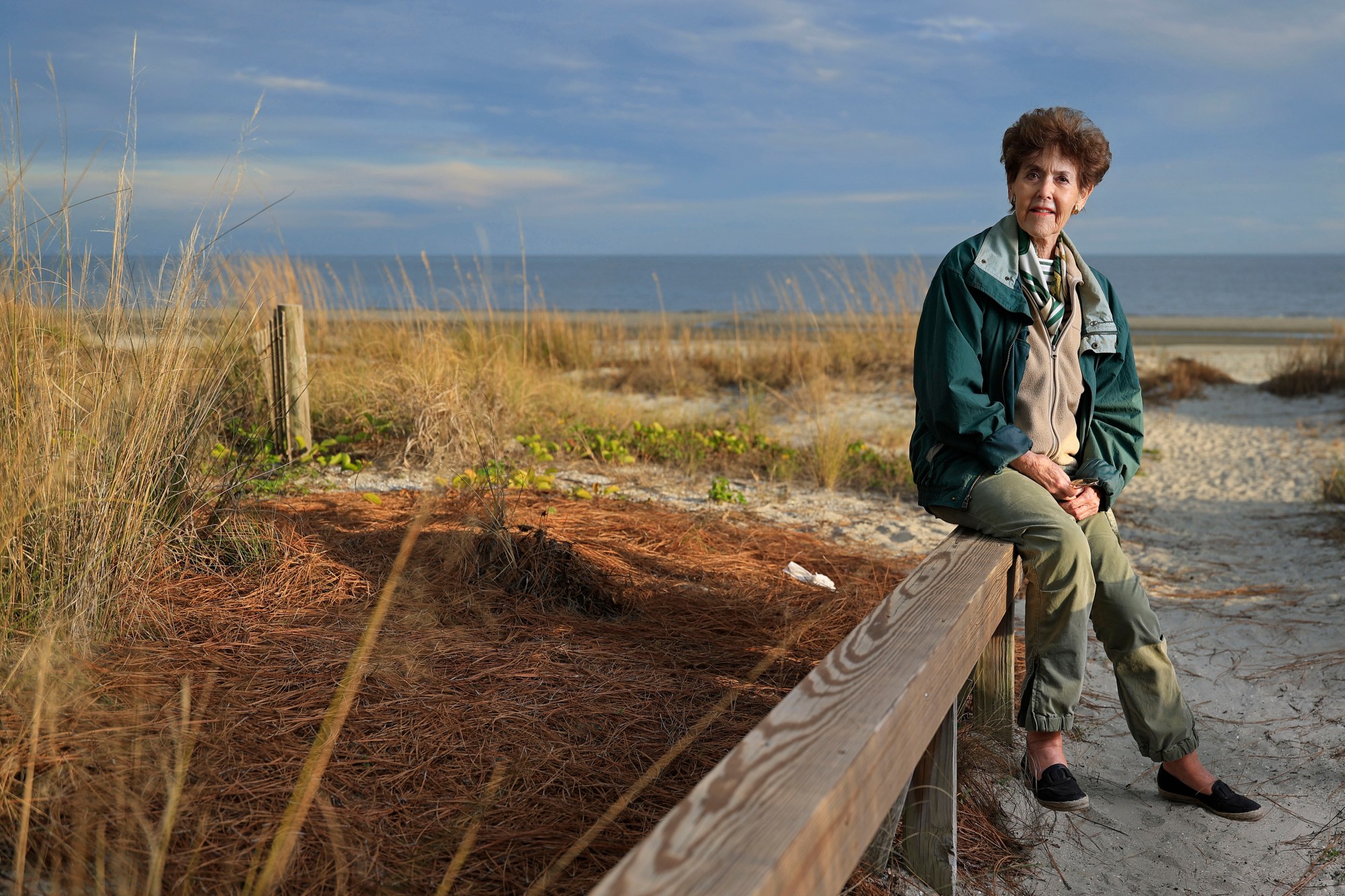
Back on Sea Island itself, once you leave Fraser’s house, you can walk down the street and across the main road toward the Atlantic. Her street dead-ends into a boardwalk that stretches over the dunes and ends on the beach itself. In “The Marshes of Glynn,” Lanier captured the scene here:
Thus—with your favor—soft, with a reverent hand,
(Not lightly touching your person, Lord of the land!)
Bending your beauty aside, with a step I stand
On the firm-packed sand,
Free
By a world of marsh that borders a world of sea.
This symbol of the “greatness of God,” these “marvellous marshes of Glynn,” are what Jane Fraser has been willing to spend a small fortune and her twilight years fighting for in court. It’s also what the Sea Island Company, which directly lobbied the state assembly decades ago to protect the marshes of Glynn County between Brunswick and St. Simons from development and billboards, wants to preserve. It may be hard to see that from Sea Island itself, where the changes over the years—old friends dying, new homes being built, new gates erected—appear monumental and seem unconscionable.
So it is even at the roadside Marshes of Glynn Overlook Park, which sits off U.S. 17 in Brunswick. The so-called Lanier’s Oak, which a historical marker claims was one such live oak the poet sat under as he gathered inspiration, is now separated from the rest of the park. It sits in the median across the highway, the golden arches of a McDonald’s just a few hundred feet away, as cars and trucks zoom unknowingly past it on their way between Savannah and Jacksonville.
But back in the park, there’s a panorama of Lanier’s beloved marshes, with the trees of St. Simons in the background and Sea Island barely visible on the horizon. From here, the view is perfect.