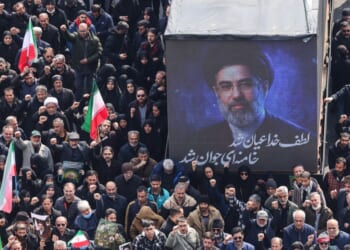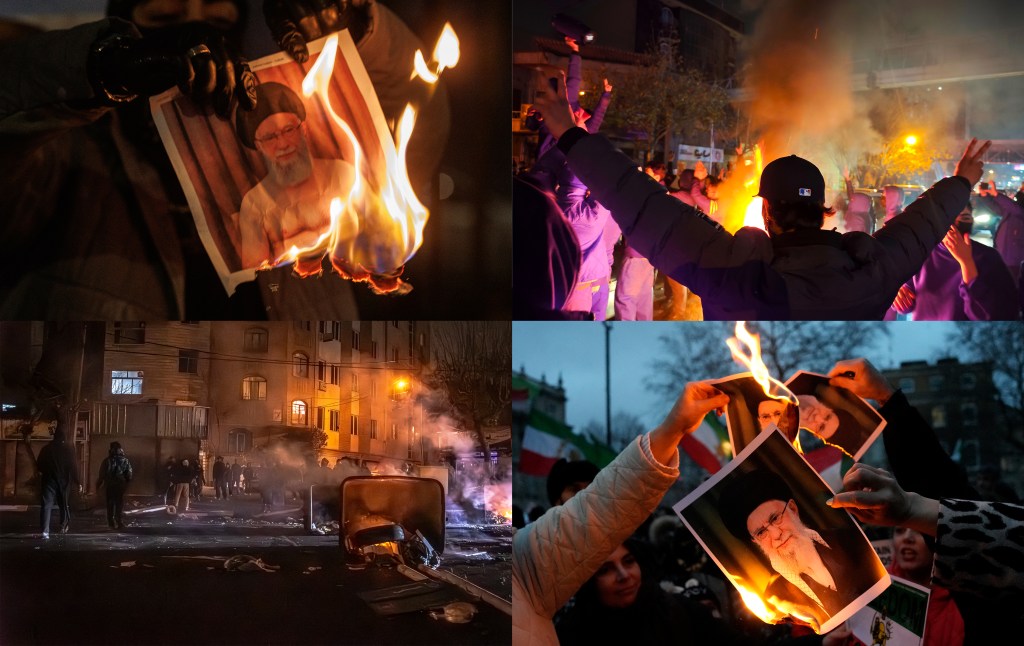
In early January this year, nationwide protests in Iran reached a fever pitch. Students spilled out of universities and technical schools. Workers came straight from shifts, still in uniform. Shopkeepers pulled down shutters and walked toward the noise. In smaller towns where everyone knows everyone, faces were fully visible; participation came with the knowledge that anonymity wasn’t an option.
Some of the protest chants were complaints about daily life under the regime: prices, wages, corruption. Others were challenges to the legitimacy of the regime itself: “Death to Khamenei.” “Death to the dictator.” And then there was the chant that carried a lot of voltage in an Islamic Republic founded on the overthrow of a king: “Javid Shah.” Long live the king. It represented the feeling that the entire clerical system has run out of time.
Iranian security forces responded with repression at a speed that exceeded anything seen since the Rwandan genocide in the 1990s. Hospitals overflowed, body bags ran out, and an internet blackout cloaked the events in uncertainty. Internal estimates compiled from hospitals and reports from Iranian officials speaking to Time magazine suggest that as many as 30,000 may have been killed in just two days—on January 8 and 9.
The following week, President Donald Trump offered words of support for the protesters that carried the promise of something more: “Help is on its way,” he said, urging Iranians to “keep protesting,” without specifying what that help would actually look like.
In 2009, during Iran’s Green Movement protests against the regime, you might remember that leaders in Washington, D.C., took the opposite posture. President Barack Obama’s tone was steeped in caution. Obama later claimed that he was worried that overt U.S. support for protesters would allow Tehran to reframe the uprising as some kind of Western plot, that speaking out as president of the United States of America might make it easier for the regime to portray protesters as “foreign agents” in the public imagination. Obama also prioritized “engagement” with the regime and tried to treat it as a rational negotiating partner.
Obama himself recognized in 2022 that not speaking out at the time was a mistake, saying:
In retrospect, I think that was a mistake. Every time we see a flash, a glimmer of hope, of people longing for freedom, I think we have to point it out. We have to shine a spotlight on it. We have to express some solidarity about it.
I see it the same way—the Iranian regime was always going to blame the protests on America, anyway.
It should now be clear that the regime in Iran is nothing like the rational partner that Obama envisioned. This is a government that, when challenged, turns off the internet and starts shooting its own citizenry. What do you think its leaders would be willing to do if they gained nuclear weapons capacity?
But Trump’s verbal support for the protesters is meaningless if it is not backed by something real. And it is worse than meaningless if it implies something real while delivering nothing.
Trump has always tried to define himself as the anti-Obama. He has tried to be the president who carries himself with the rugged grit of a businessman and the power posture of a strongman, and eschews the prevarication of a professor. But he’s in danger of putting himself into a credibility trap similar to the one Obama fell into during Syria’s civil war.
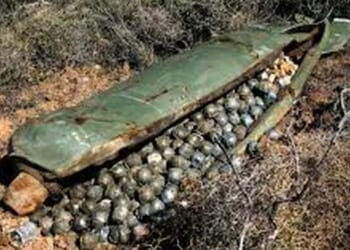
When Obama said that the use of chemical weapons by Syrian President Bashar al-Assad was a red line that could not be crossed, he thought he was drawing a boundary in the sand. Sharp. Tough. What he actually did was tank his own credibility. Why? When the U.S. took no action after Assad used chemical weapons, the question was always: Did you enforce your red line? No? Well, why should I take anything else you say seriously?
Drawing a red line can work. It can, under some circumstances, convince adversaries to back off. But it can resemble an extremely high-stakes game of poker. Your foes have to believe that you mean it. They have to believe that you are willing to enforce it. If you squander your credibility, you get walked over. And setting a red line invites everyone—friends, foes, cable news pundits, podcasters, your own opposition party—to watch for the moment you blink.
That is the ghost hovering over Trump’s Iran rhetoric. “Help is on its way” functions like a red line. By speaking like a man who will act decisively, the president creates a standard that he will be expected to meet. Not only by Americans, but by adversaries abroad.
“Help” could imply steps that aim to prevent the regime from killing its people in the dark. It could mean targeted sanctions on Islamic Revolutionary Guard Corps commanders, interrogators, judges, and prison chiefs. It could mean support for keeping internet access alive when Tehran pulls the plug (e.g., by supplying satellite internet equipment or software for mesh networking). It could mean providing resources like secure tools and training for documenting atrocities or expediting refugee and emergency immigration pathways for those most at risk. But none of these measures will bring down the Iranian regime, which is armed to the teeth and quite experienced in getting around sanctions.
What the Iranian protesters were crying out for again and again during the protests was regime change. Trump himself talked of regime change in Iran last year when he wrote on Truth Social: “It’s not politically correct to use the term, ‘Regime Change,’ but if the current Iranian Regime is unable to MAKE IRAN GREAT AGAIN, why wouldn’t there be a Regime change??? MIGA!!!”
In Senate testimony this week, Secretary of State Marco Rubio said regime change in Iran is “far more complex” than the midnight helicopter raid into Venezuela that led to the arrest of dictator Nicolás Maduro, precisely because Iran’s system of government is so entrenched; in his words, it would require “a lot of careful thinking.”
The Islamic Republic is an interlocking structure involving the Islamic Revolutionary Guard Corps and Basij paramilitary forces. But there are also intelligence services, powerful clerics, courts, prisons, and patronage networks. To topple it, we would essentially be talking about a U.S. military intervention on a scale not seen since the Iraq war. And Iran is a vastly larger country than Iraq. This would come with huge costs and risks—beyond the obvious cost in blood (including both the risk to American troops and the risk to innocent Iranians unconnected with the regime) and treasure.
Start with the most immediate risk: Iran’s whole deterrent posture is built around widening the battlefield—with missiles, drones, proxies, and pressure on Persian Gulf oil and shipping infrastructure. A campaign aimed at toppling the regime would likely lead to proxy retaliation against U.S. forces and partners across the region. Rubio himself underscored how exposed America’s defense posture is—tens of thousands of U.S. troops at multiple facilities within range of Iranian drones and short-range missiles
Then there’s energy and the global economy. Iran could certainly try to close the Strait of Hormuz to cause an economic shock; but it could also attack shipping more widely in the region. Insurance rates would jump. Tankers would have to reroute. Oil prices would spike.
Next comes the internal Iranian effect. A foreign attack can strengthen the regime’s story and shore up elements of internal support. The Islamic Republic’s most useful domestic narrative is that dissent is foreign-directed. Military action by the U.S. gives that narrative oxygen. America can decisively win a war with Iran, just as it won militarily in Iraq and Afghanistan. But winning the war is no guarantee of winning the peace. Air power can destroy runways, radars, depots, and command centers. It cannot, by itself, produce a smooth transition to a new government.
In both Iraq and Afghanistan, the U.S. succeeded in removing a ruling order. The trouble began when the question changed from who is in charge to what holds the country together. When the center of a state cracks, the immediate winners are the men with weapons, the men with networks, the men who can move fast. If the U.S. is not prepared to occupy Iran, then it is betting that some internal actor will consolidate force quickly enough to prevent a slide into factional violence.
Administration is another problem. A state facilitates salaries, fuel distribution, ports, hospitals, banks, and courts. In Iraq, the hollowing-out of institutions following the U.S. invasion turned life into a daily hunt for basic necessities and empowered the most ruthless actors. When ministries stop working, people experience blackouts and shortages, resulting in panic.
A third problem is establishing a legitimate new government. The chant “Javid Shah” carries power because it offers an alternative symbol to the regime. Reza Pahlavi, the exiled son of the previous ruler deposed in the 1979 revolution, is promising to act as a temporary steward of a transition. In interviews and statements over the last few weeks, he has described his role as leading (or helping to lead) a transitional arrangement toward a secular, democratic system in which the final form of government is decided by Iranians themselves, via a referendum.
One recent transition framework circulating in Pahlavi’s orbit focuses on preventing the classic post-revolutionary disasters: retaliatory purges, institutional collapse, and security fragmentation. It emphasises maintaining public order and territorial integrity, keeping the state functioning, and moving quickly toward an organized democratic transition rather than a vacuum. This is the right idea. But with all these factors in mind, a U.S. intervention has substantial risks. Of course, there are risks to allowing the regime to continue, too.
If Supreme Leader Ayatollah Ali Khamenei retains power in Iran, then the regime is left free to treat massacres as proof of concept. It can keep killing, keep disappearing people, keep throttling the internet, and do so with confidence that the world doesn’t care enough to do anything to stop it.
After Trump promised that “help is on its way,” for the U.S. to do little or nothing creates the impression of a weak president talking tough and then shrinking from the consequences. For a White House that trades so heavily on the aesthetics of strength, it becomes a credibility problem—noticed, no doubt, by other adversaries including Russia, China, Hamas, and anti-American forces worldwide.
Trump finds himself between a rock and two hard places. He rose, in part, by mocking the Bush-era vision of Middle Eastern nation-building—by describing Iraq as a disaster and the foreign policy establishment as foolish. It was also a theme Trump previewed last year when he praised the region’s turn toward “commerce, not chaos” and claimed to offer Tehran “a new path” if it gave up its export of violence.
If he now takes the U.S. into another Middle Eastern war, he risks betraying a foundational piece of his political support base.
How his administration navigates this crisis will shape both the Middle East for decades to come and Trump’s place in history. Either he becomes the president who takes the plunge—accepting the costs, the potential escalation, and the unforeseeable aftermath—or he becomes another president who issued a promise and then stepped away.