IN THIS ISSUE:
- Climate Change Front and Center at Heartland’s World Prosperity Forum
- Solar Power Problems Keep Increasing
Climate Change Front and Center at Heartland’s World Prosperity Forum
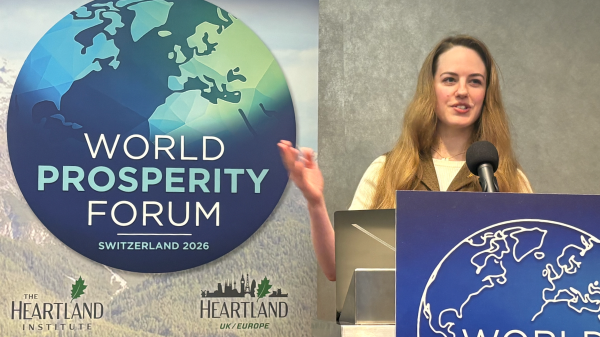
HSB Note: I had planned for this week’s issue to cover The Heartland Institute’s World Prosperity Forum (WPF), held in Zurich, Switzerland last week as a counterpoint to the World Economic Forum (WEF) in Davos. For five days, Heartland brought world leaders and international researchers together to discuss a range of issues, including climate change, energy, agriculture, global trade, the economy, artificial intelligence, ESG, and other topics of global concern, from a point of view—advancing freedom and individual choice—too often ignored or directly undermined by the power brokers at the annual Davos retreat. President Donald Trump was almost the only voice for economic sanity and national and international geopolitical security at an event dominated by elitist globalists who support a pan-national world order.
Rather than describe this event from afar, I am privileged to take advantage of the fact that we had people on our team who participated in and experienced the WPF and (to a lesser extent) the WEF first-hand. I asked Heartland Research Fellow Linnea Lueken to provide a brief overview of some of the climate-related events. I hope that the taste of the event she provides will encourage you to watch the videos online at Heartland’s YouTube page, linked at the end of this item.
What I Saw at the WPF and WEF
I recently had the opportunity to be in Davos, Switzerland on the day President Trump spoke at the World Economic Forum conference. Although I was not allowed inside the main event space, as it was restricted, I was able to walk around and look at the other offerings at Davos.
It took us a little time to find the “Climate Hub,” a small area dedicated to climate-focused breakout sessions and gatherings. It was a ghost town, and I am certain that it was not always like that. There were “green” posters and signs scattered about the pavilion, with statements like “The Earth does not belong to us, we belong to the Earth” and “Your actions count,” but very few people to look at them.
The busiest the area got was around meal times, when people lined up to enjoy veal or chicken bratwurst and beer at one of the more popular food stands within the pavilion. Of course, veal probably is not the most “climate friendly” choice, but climate friendliness has never been a major value among Western elites, unless it’s being forced on the rest of us.
Inside the main building was a theater room where the breakout sessions took place. I sat in to watch one of them. The panel discussed something called an “Ecosystem Integrity Index” (EII). The speakers were a handful of finance types and representatives from the United Nations. Most interesting was a comment made by the CEO of the Taskforce on Nature-related Financial Disclosures: “no one wants to be shouting from the rooftops about what they are doing for sustainability right now, for various reasons,” those reasons almost certainly being an unfriendly Trump administration and general public backlash against anything that smells of environment, social, and governance (ESG) scores or “woke.” At present, energy affordability is trumping climate concern around the globe.
It is both disturbing and heartening that these green-obsessed financiers are not abandoning their attempts to take control over our lives and, with the EII, probably privately owned land as well, but are now trying to do so more quietly. It is disturbing because the fact that they are sneaking around indicates they know they are doing things the public would not support. It is heartening because it indicates the public can easily see what these people are doing, the tide has turned, there is very little support from government or the public for these overbearing green initiatives, and these financiers feel they will be punished if they’re found out. Risk aversion is a trait we can leverage to make these banks and investors think twice about supporting so-called “sustainable development.”
The supporters and funders of overbearing green policy are being worn down, even if they insist they aren’t. However, climate realists can’t let up on the pressure, or the green power brokers will almost certainly regroup and rise again the moment international political landscapes (particularly in the United States) are more favorable.
That is why The Heartland Institute is working with allies across the Western world on sustained counter measures against the likes of the World Economic Forum, countering their bad ideas with good ones, emphasizing individual rights and national sovereignty. As part of that effort, this year we hosted the very first World Prosperity Forum (WPF), right in Davos’ backyard.
Several panels at the WPF focused on the climate issue, because it is one of the main vehicles globalists have used to try to break down our ability to self-govern, through the promotion of global carbon credits, ESG, and other schemes.
Václav Klaus, a former prime minister and later president of the Czech Republic, spoke about the similarities between the people at the modern WEF Davos conference, with their green priorities, and the old Communist regimes that he lived under in Eastern Europe. Klaus, a longtime friend of The Heartland Institute, said although we lost the initial battle to keep climate alarmists from gaining major footholds in our institutions, the fight is not lost and is ongoing. Klaus said green ideology found its “best and most promising weapon in the promoting of the hypothesis of dangerous global warming, allegedly caused by irresponsible human behavior.”
The carbon credit system these globalists have tried to set up is another kind of “state-controlled, administrative rationing system which only pretends to be market-friendly,” Klaus explained.
Day three of the WPF featured several presentations from international speakers and focused on food security and the ways the green agenda has threatened agriculture and farmers. Marcel Crok, co-founder of the Climate Intelligence Foundation, spoke about the dire situation in Europe caused by EU leaders’ obsession with net zero. This is particularly the case for Germany and the Netherlands. Rolling blackouts have become more common in Europe as electricity delivery has been destabilized by the penetration of renewables such as wind and solar, driven by the most ambitious green plans in the world.
Net zero targets, Crok explained, are leading to the destruction of European industries by greatly increasing the cost of both primary energy and electricity. Crok showed a very interesting chart demonstrating how, despite Germany’s multibillion-dollar “transition” to renewables, the country has not had a single day in which its carbon dioxide emissions were less than those of France. This is due to Germany shunning nuclear energy, whereas France relies on it as a stable electricity source. Germany has actually shuttered nuclear plants, which their leadership now admits was a big mistake, Crok noted. Petrochemical industries are leaving the Netherlands and other European countries, destroying local economies.
Dr. Calum T. M. Nicholson of the Danube Institute of Hungary presented on “How to think about Climate Change,” comparing the way climate change affects different people around the world to the maladaptive architectural design in earthquake-prone parts of Peru. Buildings that cannot flex to the movement of the Earth in these areas are prone to collapse and injure people. “Earthquakes don’t kill people; what kills people is buildings collapsing on people,” Nicholson said. A similar-sized earthquake somewhere like Japan might have fewer casualties, because Japan’s infrastructure was designed better and there is less political corruption getting in the way of rescue efforts. This is why a globalist or overly scientific approach to climate change cannot work: each country or region on Earth might assess risk differently and has different types of institutions and infrastructure which are impacted differently by any changing conditions. The key to thriving in the face of climate change is adaptability and flexibility, which wealth enhances, not centralized, one-size-fits-all for all time mandates.
One of the most powerful presentations on the rot at the center of the climate scam came from Anika Sweetland, who has a degree in climate science. Sweetland talked about her journey away from being convinced by the climate establishment in her school years that the world was coming to an end due to global warming. Sweetland said she used to lose sleep wondering when climate-induced food shortages would start, worrying about whether it was ethical to bring a child into a doomed world, and other fears brought on by the way her teachers and curricula presented climate change as an existential threat caused by human actions.
Sweetland spoke passionately about the increase in “climate anxiety” in children, caused by the alarmism in schools and the media. Sweetland pointed to the decades of failed predictions by the climate alarmist establishment and the trillions of dollars that have been poured into green initiatives, all intended to “brainwash” children and university students to “blindly perform and enact their [globalist, climate alarmists] agenda.”
Sweetland then explained how she came to climate realism, discussing the failure of myriad predictions of climate-caused doom. “I want my money back at this point,” Sweetland told the audience.
My own presentation on that day focused on the twisting and lying the mainstream media does when it comes to extreme weather, focusing on their reliance on single-event attribution studies. Hundreds of media stories every year lean on studies which assume climate change makes weather more severe, with those assumptions built into the climate models these so-called scientists use in conducting the study, making it impossible for those studies to get to the truth. Attribution studies assume what they are purporting to prove.
Earlier in the week, I spoke about how the green agenda is the Chinese agenda, and how catastrophic it could be if we relied on Chinese-made solar panels and electric vehicles, given China’s hostility and proven record of withholding essential manufacturing feedstocks from countries that stand against them in any way.
The entire event was a great success, with impressive international speakers who, like us at The Heartland Institute, oppose the architects of the global net zero push and the climate alarmist establishment. It was a great contrast to the weakened climate hub at the World Economic Forum. If we can keep up the pressure on green globalists, I think we have a great chance of liberating the world, even Europe, from the machinations of the WEF’s globalist cabal.
—Guest Post by Linnea Lueken
Sources: World Prosperity Forum: Day One; Day Two; Day Three; Day Four; Day Five
Solar Power Problems Keep Increasing
Longstanding concerns about the rapid expansion of solar power include the amount of space solar industrial facilities require, disrupting wildlife habitat; the relatively short lifespan of solar panels before performance begins to decline; the limited ability and high cost of recycling solar panels and the subsequent solid waste problem and potential pollution; and of course their intermittency, which adds significant management problems to the grid.
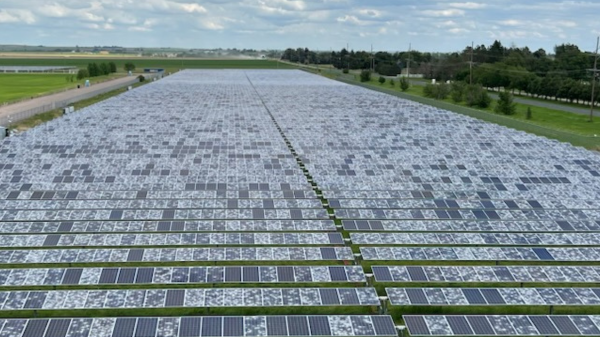
New research indicates solar power has even more problems than previously understood. Recent articles published in PV Magazine, a trade journal dedicated to and a booster of the solar industry, report cracks or breaks often form in even newly installed solar panels. In an article titled “Solar Modules Under Pressure: The Growing Risk of Spontaneous Glass Breakage,” the magazine reports, “Cases of cracked or broken modules, sometimes just weeks after installation, occur without any external shock or exceptional weather event being implicated.”
In the quest to make panels thinner and lighter, to use less material and reduce costs, breakage has become an increasing problem, PV Magazine reports:
With the rapid growth of solar photovoltaics, module reliability has become a central issue for the industry. Among the quality problems that have emerged recently, spontaneous glass breakage is attracting increasing attention. Long considered isolated incidents, glass breakages are now becoming more frequent, revealing the limitations of certain industrial choices and the need for heightened vigilance. …
Independent quality tests, such as those conducted by RETC or Kiwa PVEL, indicate increased fragility in the modules (Kiwa PVEL’s 2025 scorecard indicates that 83% of manufacturers failed at least one module reliability test, compared to 66% in 2024). This trend is also supported by feedback from the field. Cases of cracked or broken modules, sometimes just weeks after installation, occur without any external shock or exceptional weather event being implicated.
Commenting on the implications of this finding, J. W. Thompson writes on his Substack,
No hail. No tractors. No tornadoes. Just … crack.
But wait—it’s not just “spontaneous” breakage.
Also, in PV Magazine USA’s “Long-term issues found in warehoused solar panels” (March 27, 2025), they describe how warehouse storage and handling can create damage that only shows up later—meaning the potential for breakage and failure can begin before panels are even installed.
And then comes the part we’re all apparently supposed to ignore (again, from PV-Magazine’s Jan. 15, 2026 article):
“Delayed identification can lead to water infiltration, resulting in insulation defects, reduced availability and efficiency, and even fire hazards.”
According to PV Magazine, cracks are forming in an increasing number of panels shortly after they are installed, with the problems beginning as the panels pile up in warehouses.
Another concern: panels contain small amounts of many chemicals listed as toxic by various environmental agencies around the world, including the U.S. Environmental Protection Agency. This is no problem if the chemicals stay in the panels and don’t leach out, but research shows they do.
A 2019 study published in the Journal of Natural Resources and Development found toxins were leaching from solar panels—the older, thicker solar panels, which were not identified by the authors as having noticeable cracks or breaks. Simple wear from the weather and sunlight at the solar facility they sampled at the University of Buffalo resulted in higher concentrations of selenium, strontium, lithium, nickel, and barium (all chemicals contained in solar panels) in the soil beneath and near the solar facility. The authors go to great pains to state, “Despite concentration differences for some elements near vs. far from the panel systems, no elements were, on average, present in concentrations that would pose a risk to nearby ecosystems.”
This claim might be reassuring except that people—especially but not only rural landowners and farmers—are regularly assured that such leaching does not take place and the panels will not pollute their land. Also troubling is the fact that the soil was sampled just five years after the facility began operating. The University of Buffalo’s panels have a planned use of 20 to 25 years. So, in less than five years the older, more-secure solar panels, those less prone to breakage and delamination, leached measurable potential toxins into the soil. How much more will they leach over the remaining years of operation? And what levels or amounts of toxins and at what rate might the newer panels, prone to cracking, allow water to seep through or into the panels and then into the underlying and nearby land?
If any other industry’s operations were found to be depositing measurable concentrations of selenium, strontium, lithium, nickel, and barium into the soil, does anyone have any doubt there would be government investigations and resulting regulations to slow or halt those operations or expansion plans? And perhaps even mandated remediation requirements, which would add appreciably to the cost of industrial solar facilities?
Also, with solar panels a growing trend on rooftops, it might be worth examining the soil around those roofs and/or gutter pipes where rain and snowmelt run off or drip. Anyone for unnecessary toxin buildups around your home, where people garden and children play?
Sources: PV Magazine; PV Magazine; Journal of Natural Resources and Development; J. W. Thompson Substack