
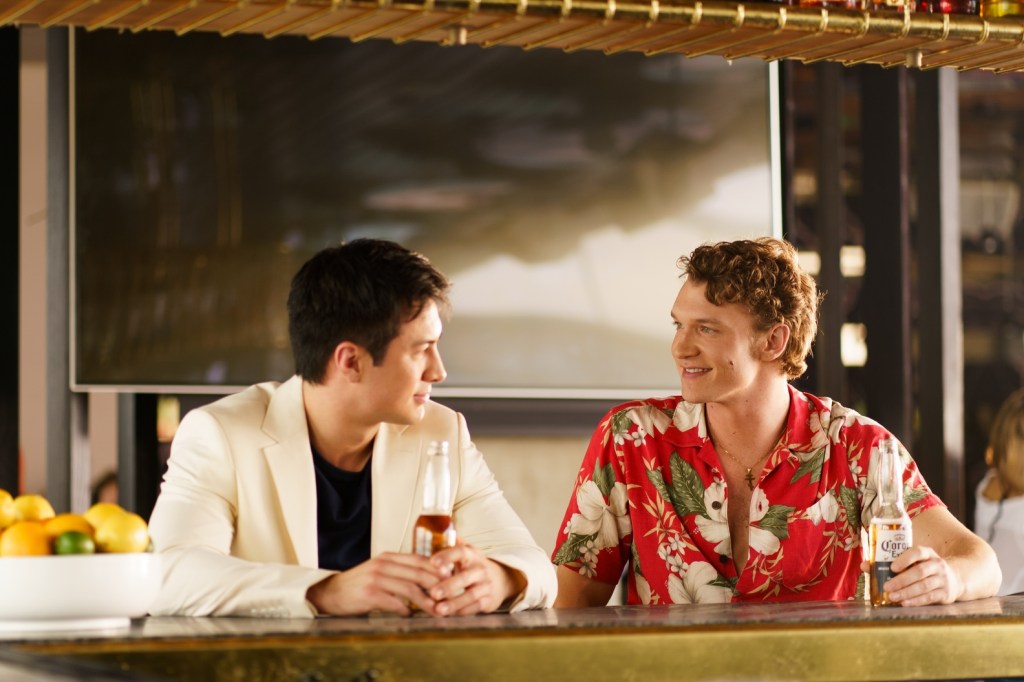
If you haven’t yet heard of Heated Rivalry—which is to say, if you are not a woman with an internet connection nor intimately associated with such a woman—allow me to introduce you to one of the more … curious … cultural phenomena of this winter.
Somewhere in Canada, a boutique production house known as Accent Aigu Entertainment spent a modest sum of 12 million Canadian dollars to bring to life a story about two closeted gay hockey players. These NHL captains enjoy sexual exploration during hotel-room assignations each time their rival teams face off in the same city, falling in love over the course of several years.
Preposterous? Decidedly so.
And yet, season 1 of this six-episode series has millions of adult women of every age overcome with a feverish consumption of all things Heated Rivalry. If the plot sounds like a rainbow rendition of a smutty paperback one might blush to read on public transportation (or, in my case, in a house packed with relatives over the holidays—I don’t recommend this, but it was for research purposes), that’s because it is. The source material is romance writer Rachel Reid’s Game Changers series, which details the sex lives of numerous fictional gay hockey players. And the fact that there are seven books in this series makes one consider just how much appetite there is for a subject which, before last month, I’d have thought must be fairly niche.
As it happens, the appetite, now whetted in the mainstream, is insatiable. “Heated Rivalry psychosis” is the official nomenclature, but I first encountered this epidemic in the wild when a friend texted me in late December: “Madeleine, I think something is wrong with me. I can’t stop obsessing about Heated Rivalry. Am I ok?” She begged me to watch, thinking that I, the therapist friend, might be able to offer some informal insight or validation regarding the tight hold with which Shane Hollander and Ilya Rozanov, the show’s gorgeous main characters, had gripped her. So, watch I did.
Romance having never been my genre of choice, and not harboring any special proclivity for gay athletes, I was prepared to be let down. Instead, I found the whole feel of Heated Rivalry to be surprisingly warm, genuine, and humane. Sublime acting by previously unknown leading men Connor Storrie and Hudson Williams alchemized a fairly crude plot into something palpably tender and emotionally honest. The show’s soundtrack also notably enhanced the experience, the blend of early 2000s indie nostalgia and arty Quebecois pop setting a coherent tone of yearning and catharsis across all six episodes. Admittedly, the pacing of the first three episodes was clunky, but the sweetness of the final two episodes more than made up for a bumpy start.
Theories abound as to why the show has so compelled women. As River Page argues in The Free Press, “a lot of liberal women want to be pursued by a dominant man but are too proud to admit it, so they project those desires onto a fictional gay guy.” While I acknowledge that this is possible, I doubt that it’s a complete enough theory to explain the overwhelming success of the series among women across ages and political persuasions.
Indeed, when I’ve discussed Heated Rivalry with friends, a few themes have come up repeatedly:
1.) Female romance protagonists are often portrayed with a grating and unrelatable neuroticism that spoils even the would-be sexiest of stories, a problem Heated Rivalry neatly circumvents by featuring two confident, evenly matched men.
2.) It’s easier to drop one’s guard and feel physically persuaded when there is no point of comparison; in other words, voyeurism is easier and more gratifying when you have no symbolic skin in the game.
3.) Male vulnerability, especially as expressed through the pristinely chiseled features of Storrie and Williams, is quite sexy. These two men affect one another deeply, and women often relish the smoldering that ensues when a man feels fragile.
But while it’s plenty of good fun to speculate on the psychological forces at play in Heated Rivalry fever, Occam’s razor should probably be applied in attempting to explain the show’s outsize success. Heated Rivalry is, in essence, a comforting return to the basics of romance: Two attractive, talented people who are somehow at odds notice each other’s massive sex appeal and consent to test the waters, risk be damned. Chemistry does its thing and feelings of true tenderness arise. The heroes and all who cheered their journey emerge nobler and purer of heart for having believed in the triumph of love. The bone structure here is sturdy and recognizable.
Compare this to another series that wrapped up earlier this month. Stranger Things, the genre-bending, megahit darling of Netflix, aired a fifth and final season over December and January. The emotional centerpiece of the show, teased for several seasons, was the coming out of 17-year-old Will Byers. In an ill-timed and fairly boring monologue, Will confesses to his friends that he is “different” because although he, like his friends, likes (insert all manner of generic 1980s-associated childhood nostalgia: “bike races and trading comics and NASA,” etc. etc.) he doesn’t like girls.
The scene fell flat, as did the entire $400-million season, because the writers broke every time-tested rule of good storytelling. In particular, cloying ruminations on self-acceptance that do nothing whatever to forward the plot tend to annoy people, especially when key questions raised earlier about said plot are still unanswered. Viewers responded mercilessly.
In contrast, there are no such indulgent meditations in Heated Rivalry: Creator Jacob Tierney must have recognized that sex still sells, because above all things, Heated Rivalry is sexy. The unrelenting focus on acceptance and identity that accompanies coming out stories in film and TV obscures the fact that being gay is, first and foremost, a sexual orientation. Heated Rivalry is successful because rather than euphemizing that fact, it dives right in.
This is not to say that Heated Rivalry is above reproach. Shane and Ilya are, in fact, ostensibly 17 when the season begins, which should make all of us at least a little uncomfortable. I also have to wonder if men would be as readily excused as women if they en masse and somewhat obsessively touted a show featuring underaged lesbians. Probably not.
But I suspect that the real reason so many of us are able to eschew too much pearl-clutching is rooted in yet another time-tested rule of storytelling: Sex may sell, but true love wins the day. If I wanted to, say, capture hearts and minds of viewers in service of greater societal embrace of gay love, Heated Rivalry would be an excellent choice—precisely because, with the exception of a handful of DEI-style notes that exist solely among secondary characters and never between Shane and Ilya, it’s not propaganda. It’s just a love story—and it’s a great one.