I love foie gras. I just don’t like to think about it too much.
My relationship with animals is deeper than most. My mother was a state- and federally-licensed wildlife rehabilitator. I was raising owls, deer, mockingbirds, and turtles before I could read. We had a coyote once. I always had a fishbowl filled with baby rabbits to bring for show and tell. I find several birds a year (or do they find me?) in need of an all-expenses-paid night at Chez Isgur. Owen the possum liked to snuggle into my hair for a nap. Luther the parakeet liked to take showers with me. Barkley the turtle liked to torture mealworms before eating them. They all have unique personalities—just like us.
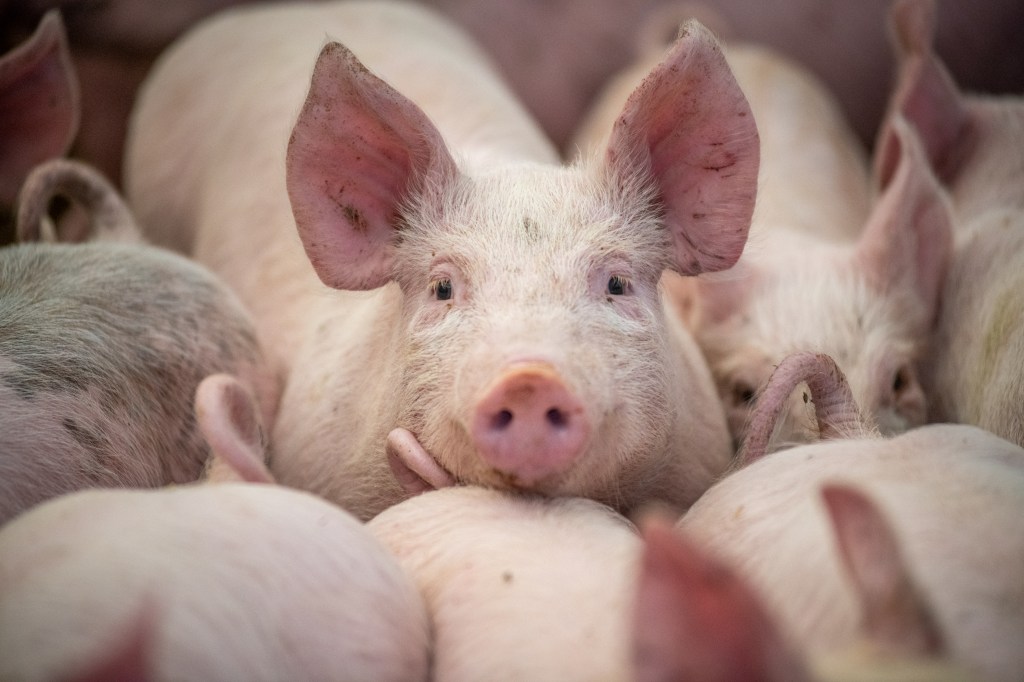
I spend quite a bit of my free time pondering what issue future generations will judge us by. What is our era’s segregation, torture, witch trials? I’m convinced it’s our treatment of animals. After all, if eating your dog is unthinkable, why is it okay to eat a pig just because I didn’t name it?
On the one hand, humans evolved to be omnivores. Food, including meat, doesn’t intrinsically have any taste; our perception of taste (and color, and smell) is directed by chemicals in our brains. But to us, it tastes incredible because we’re wired to crave protein that will fuel our giant brains and muscle mass. In other words, eating meat is as natural as it comes.
On the other hand, we’re a long way from chasing wildebeest in the Serengeti.
The sheer magnitude of the impact animal agriculture has on our lives is hard to fathom. Half of the world’s habitable land is used for agriculture, and 80 percent of that is either for the animals themselves or to grow the food that feeds those animals. Just the methane that farm animals (mostly cows) produce is roughly the equivalent of the emissions of all global air travel. Antimicrobial resistance is only a matter of time now, because something like three-quarters of 136,000 metric tons of antibiotics produced globally are fed to animals. It’s a national security risk when countries that have to import meat are rocked by supply chain issues caused by animal diseases. Japan and South Korea, for example, are both under 50 percent for food self-sufficiency.
And boy is it inefficient. For every 100 calories of chicken (by far the most efficient animal that we farm) we eat, 800 calories are wasted on keeping the animal alive or on non-edible parts of the bird (bones, for example).
And yet, none of us are going to stop eating meat. Not even to save humanity.
Bruce Friedrich, author of Meat: How the Next Agricultural Revolution Will Transform Humanity’s Favorite Food and Our Future, knows this. He’s not trying to convince you to go vegan any more than he’s trying to convince you to avoid air conditioning and stop driving your truck. As he sees it, all of those might be noble ideas. But they ain’t gonna happen.
Still, he sees a path forward. Why? “Human beings when given two options of roughly equal economic value,” he writes, “will choose the one that makes the world a better place.” So all he has to do is give people a better option at the same cost.
He’s for alternative meat. And to be clear, he’s not talking about gardenburgers or tofurkey. (In fact, he recalls bringing a friend to try the new bocaburger at Johnny Rockets in the early 2000s. The meat-loving friends’ reaction? “You don’t actually like food, do you?” Lol.) Instead, we now have the ability to take real meat cells from an animal and replicate them. The product is actually meat, but it’s not from a dead animal.
Nope, Friedrich gets it now. Alternative meat can’t compete by being healthier or better for the environment or nicer for animals. For most people, he acknowledges, food is not an ethical decision. It has to taste as good and be as cheap.
Meat should appeal to Dispatch readers: In fact, there’s even a shoutout to one of our pieces on the Florida cultivated meat ban. The writing is just relentlessly upbeat. There are no bad guys in this story—not the meat lovers, not the corporate food companies like Tyson or Cargill, not the Trump administration, not even the cattle ranchers who worked to pass a cultivated meat ban in Florida. It’s just a lot of great people trying to make the world a better place.
Still, it’s hard to imagine a world without industrial pig farms and cattle grazing fields in Texas, all switched out for actual meat grown in vats that look like beer brewing factories. Then again, it was hard to imagine a world in which people wouldn’t need a horse to visit you. Or that we could travel from San Francisco to New York City in less than six hours. Or that those phones on our walls would some day be glued to our hands.
In 1851, John Gorrie invented an artificial ice machine. It was expensive and kind of gross. According to the natural ice folks, this artificial ice was impure, unnatural, and inferior. Of course, now we don’t call it artificial ice. We call it ice. It’s the only ice most of us have ever known.
For 5,000 years people rode horses. In less than two decades, the ridiculous and unimaginable became not just unremarkable but ubiquitous. Meat, similarly, has always come from live animals. It’s easy to assume it always will.
Meat is a book about food systems, sure. But it’s also a book about innovation told from the perspective of a new technology that is just in its infancy. How does it happen? Who pays for it? Is cultivated meat more like the Oldsmobile or the Hindenburg? Or is it more like the 8-track—an evolutionary dead end that nevertheless was part of a technological revolution that nobody could have imagined?
After Meat, you’ll be convinced that we aren’t going to continue on our current trajectory. We simply cannot increase global meat production enough to keep up with a human population that is getting wealthier and hungrier. And we’re not going to be using live animals on Mars for meat. So the question isn’t whether we will replace our current animal agriculture system, but how.
In 1931, Winston Churchill predicted that by 1981 humanity would “escape the absurdity of growing a whole chicken in order to eat the breast or wing, by growing these parts separately under a suitable medium.”
So we’re a little behind schedule. But as Friedrich writes:
May I present for your consideration: A global network of friendly neighborhood meat breweries, complete with tours and tastings and other events?
My foie gras habit can’t wait.