The Hawkeye State has a plan to make college cheaper: Iowa is mulling a bill that would allow some of the state’s community colleges to begin offering a limited number of bachelor’s degrees. However, the proposal has withered under fierce pushback from the state’s private colleges, which, fearful of competition, have successfully pushed to water down the reforms. Now, only community colleges more than 50 miles away from a public or private university would be allowed to offer bachelor’s degrees.
The limitation is a shame. The cure for sky-high costs in higher education is more competition. Iowa could give students seeking bachelor’s degrees more options at the state’s community colleges, where tuition costs are reasonable. Community colleges in Iowa charge an average of $5,600 annually to in-state students—meaning tuition is often free after applying grant aid. Private institutions in the state, by contrast, charge more than $37,000 per year.
Private colleges object, on the grounds that community colleges receive subsidies from the state that allow them to defray tuition costs. This is true, but arguably more important is the fact that community colleges operate on a lower-cost model.
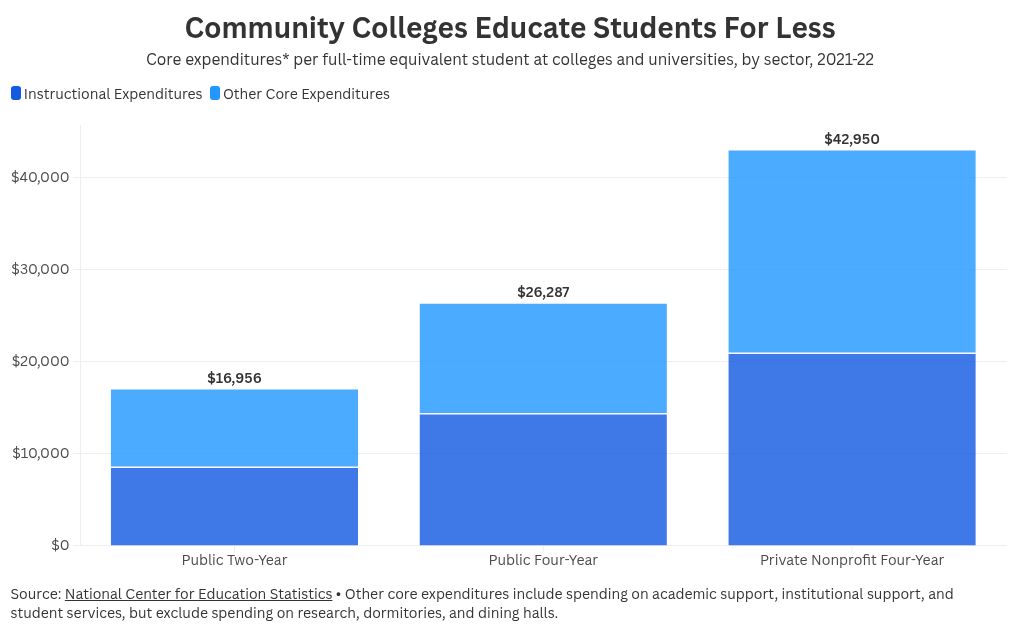
According to the National Center for Education Statistics, the typical community college spends just under $17,000 per full-time equivalent student on core expenditures (including instruction and administration). Four-year private colleges spend nearly $43,000 per student—even excluding noncore expenditures like research, dormitories, and dining halls.
Community colleges have largely beaten back the inflationary tide that has washed over higher education. The bigger problem in the community college sector is outcomes. Two-year degrees have limited labor market value, especially those in general education rather than a vocational field. Some community college students aim to transfer to a four-year school and complete a bachelor’s degree there, but four-year institutions are often hesitant to accept community college credits, meaning the success rate for this pathway is low.
The clear solution is to allow community colleges to offer higher-value credentials. Instead of waiting around for four-year institutions to lower prices, policymakers should allow community colleges to apply their low-cost model to bachelor’s degrees. This will create competition that could force the rest of the higher education system to reduce costs, too.
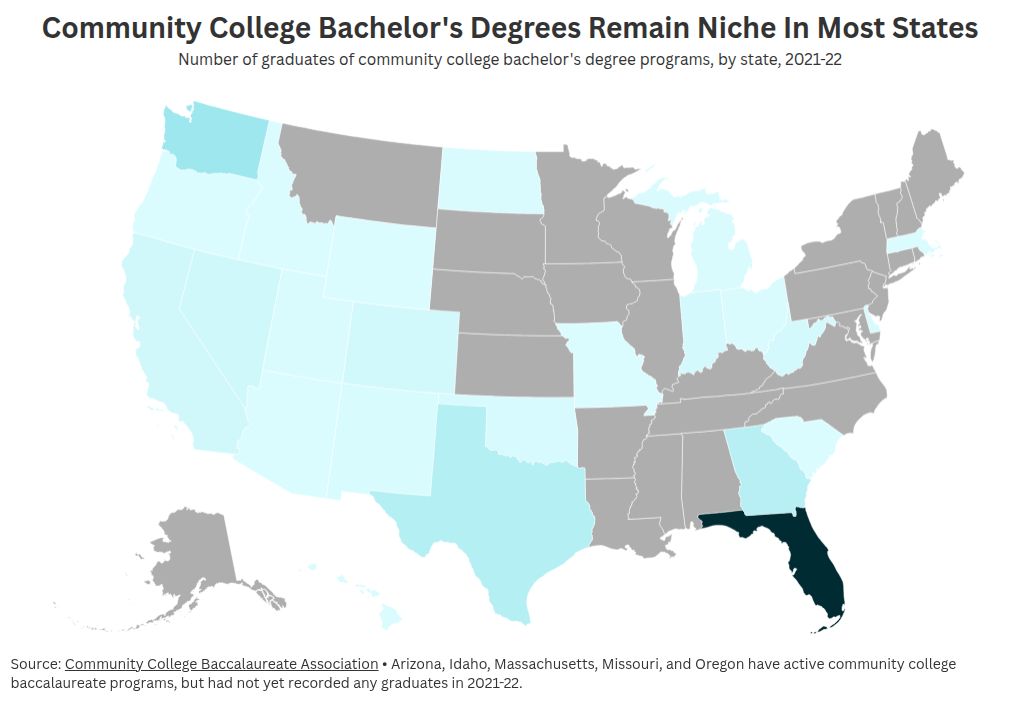
It’s not a new idea. Nearly 200 community colleges in 24 states offer at least one bachelor’s degree, according to the Community College Baccalaureate Association. But it’s still a small market overall—community colleges awarded just over 15,000 bachelor’s degrees in 2021-22, out of more than 2 million bachelor’s degrees awarded nationally. Only a handful of states, including Florida and Washington, have truly scaled up the model.
Where the model exists, its track record is impressive. Students who complete bachelor’s degree programs at community colleges earn a median salary of $61,000 after four years, per Education Department data—comparable to the outcomes for bachelor’s degree programs at four-year schools. This is partially because community colleges tend to offer bachelor’s degree programs in higher-return fields, especially nursing and business.
But community colleges could also be a great option for students who want to pursue bachelor’s degrees in fields where earnings are somewhat lower, such as education. The number of bachelor’s degrees in education awarded annually has plunged 15 percent since 2010, as students have sought higher-return majors. An education major isn’t always worth it at traditional four-year college tuition rates. But if community colleges were to offer more bachelor’s degrees in education at affordable prices, it could attract students back to this major. (Oregon’s community colleges have floated a proposal to do just that.)
Granted, bachelor’s degree programs may cost more to operate, which could raise prices. The Iowa bill accounts for this possibility by allowing community colleges to charge 150 percent of normal tuition rates for their bachelor’s degree programs. But community colleges are nonetheless starting from a foundation of low costs—and these schools will surely recognize that if they want to draw students away from four-year institutions, they’ll need to offer very competitive prices.
Nothing brings down costs like market competition. Where prices are too high, as in higher education, the culprit is often barriers to entry. Allowing more community colleges to offer bachelor’s degrees would create a whole new source of competition for higher education—delivering lower prices and more options for students.
The post Let Community Colleges Offer Bachelor’s Degrees appeared first on American Enterprise Institute – AEI.