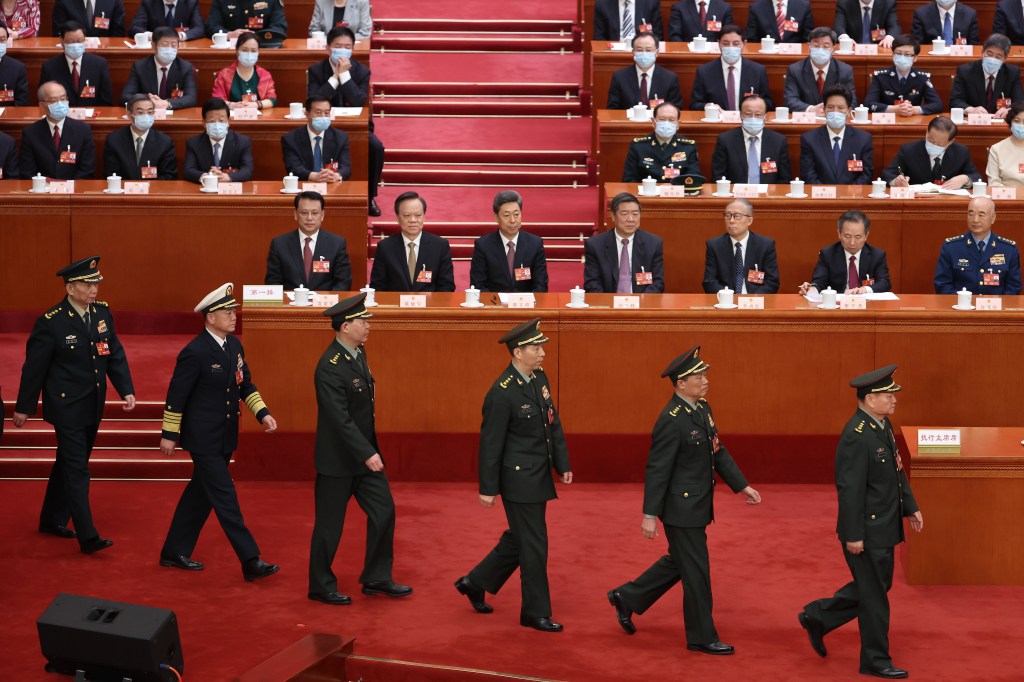
Zhang was a seemingly unlikely target for an anti-corruption investigation. Both he and Xi are “princelings”—the term for sons of the men who rose to power with Mao Zedong—and their fathers fought together in the Chinese Civil War before rising to high-ranking positions in the party.
In 2012, Zhang was promoted to the Central Military Commission, the CCP organ that directs China’s armed forces (each level of the Chinese state is supervised by a parallel party body). He rose to vice chairman in 2017—and though 68 is the informal retirement age for Politburo members, Xi allowed the now-75-year-old Zhang to keep his seat on the CCP’s top executive body. Until now.
An editorial in the CCP-run newspaper PLA Daily published shortly after the Defense Ministry’s announcement declared that Zhang had “seriously trampled upon and undermined” the Chinese military’s standards of responsibility, which Brookings Institution China analyst Jonathan A. Czin said was likely a coded reference to challenging Xi’s authority. He also told TMD that the leaks of Xi’s purge to Western media were likely intended to send a message to all CCP officials: graft, which used to be taken for granted, can now destroy you. “The fact that these rumors are floating around, it’s designed to scare people,” he said.
Miles Yu, director of the China Center at the Hudson Institute, told TMD that periodic purges are inherent to Communist dictatorships. “It’s definitely a pattern,” he said, arguing that Xi’s drive to consolidate power has also made him eager to eliminate any potential rivals to his authority. Firing and prosecuting Zhang “is not really incidental at all,” Yu said. From this viewpoint, Zhang’s seniority and experience made him more vulnerable to Xi, not less.
Making an example of Zhang also advances one of Xi’s central goals: forcing a bloated, corrupt military to become a credible fighting force. RAND Corporation researcher Timothy Heath told TMD that while accusations of high-level espionage against Zhang were implausible, the corruption charges were quite probable. “The entire military is just thoroughly corrupt, so anybody could be accused of corruption,” he said.
The PLA has long operated as a fiefdom within China, which worsened as the government poured money into the military in recent decades. Corruption is reportedly rife, from the selling of promotions to procurement fraud that has allegedly left missiles filled with water instead of fuel and ICBM silos with doors that won’t open.
“In the past, I think the top leaders tolerated the corruption” due to the military’s fundamental loyalty to the Communist Party, Heath said. “The problem is Xi Jinping wants the military to actually be competent at its job.” Czin agreed: “Whereas other previous Chinese leaders had really put economic reforms at the center of their legacy, Xi has put a much greater emphasis on making military reforms a centerpiece of his legacy.”
For Xi, anti-corruption campaigns both combat graft—which had been a key source of public discontent with the party—and eliminate potential rivals. The Central Military Commission (CMC) is usually composed of a chairman, two vice chairs, and four regular members. With Zhang’s departure, it’s down to just Xi and Zhang Shengmin, the head of the PLA’s internal disciplinary arm. “It concentrates the power of commander in chief, and really political power over the PLA, in Xi Jinping’s hands, even more than previously,” Susan Shirk, a professor and China specialist at the University of California, San Diego, told TMD.
The case of Zhang, while surprising due to the general’s seniority, fits in with a flurry of recent moves against PLA leadership. Since 2023, dozens of senior officers (including four of Zhang’s former colleagues) from the CMC, PLA, People’s Armed Police, and the defense ministry have been removed on vague corruption charges. The whereabouts of many remain unknown.
Last year, He Weidong—vice chair of the CMC and commander of the Eastern Theater Command, the military sector responsible for a potential conflict with Taiwan—was removed along with eight other officials on corruption charges. He was the first sitting CMC vice chairman from a career military background to be purged since the Cultural Revolution of 1966-1976, Mao Zedong’s infamously bloody campaign to reestablish power within the Communist Party.
The removal of Zhang and other senior leaders has sparked some speculation that Xi intends to empower officers more committed to preparing Chinese forces for an invasion of Taiwan by 2027, a date frequently cited by Western analysts as a potential deadline, inferred from PLA modernization goals. The date originated with U.S. Adm. Philip Davidson, who warned the Senate Armed Services Committee in 2021 that “the threat is manifest during this decade, in fact, in the next six years.” But Shirk told TMD that the ostensible deadline was “ginned up” by Americans looking to create a narrative of a looming crisis.
Czin largely agreed that Xi’s moves likely do not signal imminent action against Taiwan. “In the shorter term, what it demonstrates for the next year or two is that Xi actually feels really comfortable with the cross-strait dynamic,” he said, pointing out that the Trump administration has been reluctant to sound hawkish notes on Taiwan, and that the island’s pro-independence president, Lai Ching-te of the Democratic Progressive Party, is currently facing a major revolt from the comparatively pro-China Kuomintang party.
The most significant personnel move resulting from Zhang’s downfall might be in the selection of his replacement on the CMC, as non-military members of the committee are seen as potential successors to Xi. But the scale of Xi’s anti-graft mission has removed many potential heirs apparent. In 2022, the CCP said it had conducted almost 5 million corruption investigations into its members during Xi’s first decade in power (the CCP has around 100 million members). Among these were all of the members of the “Fujian Clique,” a faction within the PLA that traditionally backed Xi, until he evidently no longer needed their support.
At the next Party Congress in 2027, Xi will almost certainly be selected for a fourth presidential term, which he would begin in March 2028—breaking the previous record, also set by Xi, of three presidential terms. Not since Mao has another CCP head served for so long, or so aggressively shaped the party in his own image. But his grip on the party-state raises questions about China’s future.
Xi is 72, and will be nearly 80 by the end of his next five-year presidential term. With Xi now unchallenged within the party, the question of succession is more pressing—and more opaque—than at any point in decades. The People’s Republic has a history of succession struggles: China came close to descending into civil war after Mao died in 1976, as successors vied for power.
“The Chinese Communist Party had a couple of decades of fairly stable succession, and it’s not clear that will continue in the future,” said Heath. “Who is Xi thinking about? Who follows him? … I really haven’t the foggiest idea.”