With Trump’s return to the White House, Modi—who first came to power in 2014 and is now serving a rare third consecutive term—immediately sought closer relations with the U.S. Both men pledged during a February 13, 2025, meeting at the White House to work together on a bilateral trade agreement. “India was eager to get a trade deal from day one of the Trump administration, and preemptively jumped to the head of the line to try to negotiate a trade deal,” Daniel Markey, a senior fellow at the Stimson Center’s South Asia and China programs, told TMD. The Indian government was “hoping to skip all the [tariff and trade] drama, and instead, they got a whole lot of drama. And now, they finally get a deal.”
After that meeting, Trump twice raised tariffs on Indian exports, and the president’s claim last May that he brokered a ceasefire agreement between India and Pakistan after a conflict in Kashmir strained the U.S.-India relationship further still. The Indian government blamed Pakistan entirely for igniting the conflict, and India’s foreign secretary stated that Modi “clearly conveyed” to Trump that the ceasefire was achieved through “direct communication” between the two countries’ militaries, not U.S. mediation, and that India “does not and will never accept mediation.” Defense Minister Rajnath Singh later described Trump’s claim of ending the conflict as “baseless.”
The next point of tension came in August, when the president—blaming other countries for being insufficiently aggressive on cracking down on Russia, and overly dependent on U.S. aid—applied an additional 25 percent levy on Indian goods over India’s refusal to stop buying Russian oil. Russian oil comprised 35 percent of India’s crude oil imports in 2025 while U.S. oil accounted for just 6.6 percent, according to data analyzed by analytics firm Kpler. But this dependence is recent: In early 2022, a mere 0.2 percent of Indian crude oil imports came from Russia.
“It’s only after Russia’s invasion of Ukraine, when India could exploit the cheaper prices, that it turned to Russian oil,” Center for a New American Security senior fellow Lisa Curtis told TMD. No other country can reliably provide a steady supply of oil at prices as low and in volumes this large as Russia, but American tariffs might change India’s calculation. “It would be fairly straightforward for India to shift back to relying on other oil suppliers,” Curtis said. “I don’t think it would cause any major dislocations in the Indian economy if India were to halt all of its Russian oil imports.”
But India’s ties with Russia extend well beyond oil. Russian President Vladimir Putin visited New Delhi in December for the 23rd India-Russia Annual Summit, where both sides reaffirmed their defense partnership and pledged to expand joint military manufacturing. Russia remains India’s largest defense supplier.
Modi has also moved to warm relations with its other giant neighbor. Modi met Chinese President Xi Jinping at the BRICS summit in Kazan, Russia, in October 2024, their first formal engagement since 2019. The two met again at the SCO summit in Tianjin on August 31, 2025—Modi’s first visit to China in seven years. The two sides completed border disengagement, resumed direct flights, eased visa restrictions, and declared they should be “partners rather than rivals.” The rapprochement was driven in part by Trump’s tariffs, which pushed India to diversify its economic relationships, though China’s provision of military support to Pakistan during the May 2025 India-Pakistan conflict complicated matters.
Also—despite a diplomatic crisis over Canadian allegations that Indian government agents were involved in the 2023 assassination of Sikh activist Hardeep Singh Nijjar near Vancouver—Canadian Prime Minister Mark Carney and Modi agreed in November to restart trade discussions, driven by Ottawa’s need to reduce its U.S. dependence.
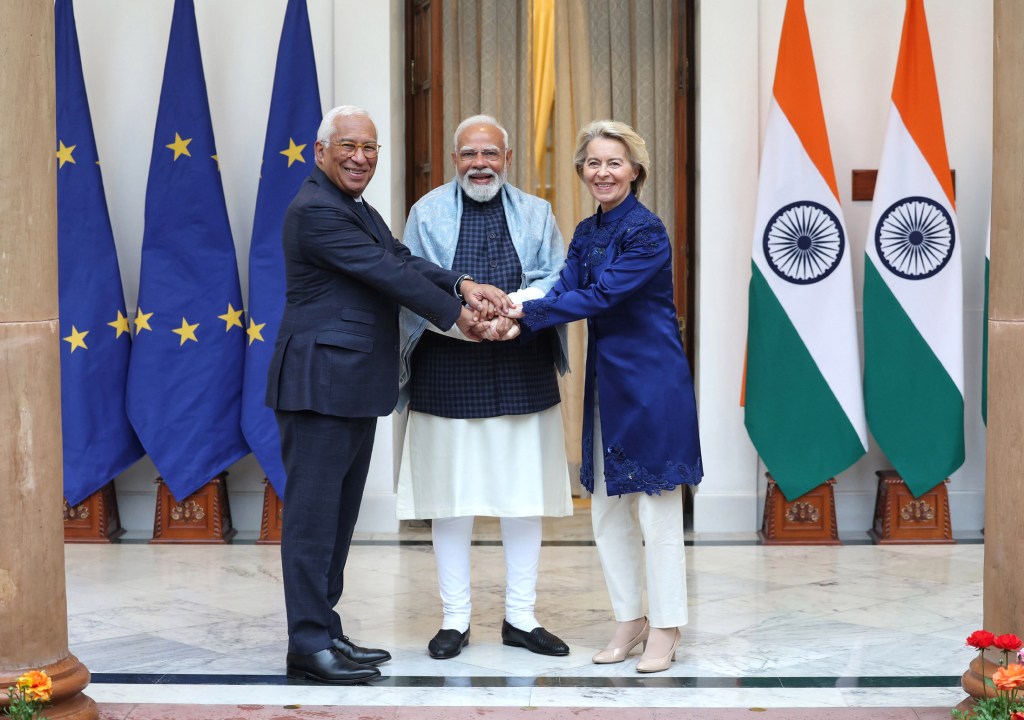
But India’s most important economic partnership is with Europe. In recent weeks, while Trump was threatening to take Greenland and the European Union was responding with tariff increases and economic countermeasures, India was finalizing an EU trade agreement that had been in negotiations for 19 years but was sealed by the greater need to counterbalance American influence. Under the terms of that arrangement, India will either eliminate or significantly reduce tariffs on 96.6 percent of European exports; in return, the EU will phase out tariffs on 99.5 percent of Indian exports. European Commission President Ursula von der Leyen praised it as the “mother of all deals,” producing a “free trade zone of two billion people, with both sides set to benefit.” The EU and India also agreed to a framework for a defense agreement to strengthen cooperation on counterterrorism, cybersecurity, and maritime security.
“It’s Trump who helped bring about the EU-India free trade agreement, because the Indians recognize they desperately needed alternative markets,” Hoover Institution senior fellow Šumit Ganguly told TMD. After the EU and India reached an agreement, “Trump and his advisers must have also concluded, ‘Oh dear, now we need to act.’”
Details of the quickly announced U.S.-India trade deal remain unclear and could change, with Indian officials stating a more detailed version will be released in the coming months. But even so, it was received positively in India.
Dhruva Jaishankar, the executive director of the Observer Research Foundation America, said the steep tariff cut will “bring a lot of relief to Indian exporters who are very worried about the uncertainty the tariffs produce.” India’s economy has remained resilient, but Jaishankar told TMD that the American levies still constrain growth, explaining that “a lot of investment in manufacturing in India had kind of stalled because of uncertainty about the tariffs.”
U.S. Trade Representative Jamieson Greer said Tuesday that the removal of other non-tariff barriers will also allow a greater share of American goods to enter the Indian market, and that Indian duties on a “vast array” of U.S. industrial and agricultural goods will go from an average 13.5 percent duty to zero.
In his social media message announcing the deal, Trump also stated that India committed to purchasing $500 billion worth of American goods—which, like similar commitments from other countries, lacked a timeline, purchase specifics, and enforcement mechanisms. Aparna Pande, a senior fellow at the Hudson Institute specializing in India and South Asia, noted that a day before the trade deal was announced, India’s parliament was presented with a new annual budget of roughly equivalent to $583 billion. “I would like to understand how [India] can invest or purchase $500 billion worth of [U.S. goods], unless it’s over a period of 10 years or 20 years, which I can understand,” Pande told TMD. Sources told Business Today that this will occur over five years.
Theoretically, this deal could collapse again, particularly if the president wants to force a public statement from the Modi administration that it will stop purchasing Russian oil. But if Modi gives the White House private reassurances of increased American oil purchases, the U.S. may have no effective way of cracking down on India continuing to buy Russian oil. Derek Scissors, a senior fellow at the American Enterprise Institute specializing in U.S. economic relations with Asia and Asian economies, noted that it’s unclear what oversight, if any, the U.S. will place on India’s oil imports. “India can buy Russian oil through third parties,” he told TMD. “Are we going to be able to enforce that?” The U.S. could seek to track Indian-based oil companies and their trading partners, but “that requires real resources,” Scissors explained.
“I think [the Office of the United States Trade Representative] can scramble around after the president’s phone calls and write something up and publish it, but having any of these agreements enforced is a much harder challenge,” he added.
Richard Rossow—a senior adviser at the Center for Strategic and International Studies who focuses on the Indian economy—told TMD that when Modi first took office in 2014, “protectionism was the name of the game,” and his government raised customs duties and imposed mandatory local manufacturing rules. But in recent years, India has pivoted toward prioritizing market access abroad. “They think about global markets now as an opportunity rather than a challenge,” he said. “It’s hard to believe this is the same prime minister.”