At the beginning of most modern State of the Union addresses, presidents take a long walk into the chamber, shaking hands with members of Congress, Supreme Court justices, and military brass on their way to the rostrum as the audience claps. A few more handshakes with the vice president, the speaker, and the clerks, and the president promptly takes to the lectern, a move that usually quiets the applause, and begins his rosy assessment of the state of our union.
The start of President Donald Trump’s address on Tuesday had a distinctly different feel. Given that around half of congressional Democrats skipped the speech, the chamber was relatively more Republican and more raucously pro-Trump than either the narrow margins in Congress or current public opinion about the president would suggest. This felt less like an address to the legislative branch and more like one of the president’s legendary political rallies.
After the customary extended walk into the chamber, Trump stepped onto the speaker’s rostrum. Then he stopped, paused, and looked outward at the applauding audience in the House of Representatives chamber. He seemed to be soaking in the adulation as he would at a rally, where the PA system is usually playing a syrupy patriotic tune like Lee Greenwood’s “God Bless the U.S.A.” as Trump superfans cheer and holler.
There was no such soundtrack in the U.S. Capitol, but Trump went through all the familiar rally motions. He nodded, waved, pointed, and gave the occasional thumbs-up sign. His head turned this way and that—-though less to the left side of the chamber, where the Democrats sat stonefaced and only a handful kept the applause going. The break went on for nearly two more minutes before Speaker Mike Johnson broke in to introduce the president, who then enjoyed another extended applause break (along with shouts of “USA!”) before finally stepping up to the microphone for his speech.
The speech itself was rally-like, too. Trump broke the record—previously held by him—for the longest State of the Union address at 1 hour and 48 minutes. There were thrilling stunts, like his introduction of the gold medal-winning U.S. men’s hockey team and the surprise reunion of a recently released Venezuelan political prisoner with his niece. Long, rambling speeches with over-the-top made-for-television moments are hallmarks of Trump rallies, as are instances where the president goes off-script to excoriate any unlucky enemy targets present. His vitriol is usually reserved for the media covering his rallies, but on Tuesday it was congressional Democrats in Trump’s rhetorical sights. He baited them by requesting every legislator stand up to show their support for a loaded statement: “The first duty of the American government is to protect American citizens, not illegal aliens.”
When the gathered Democrats declined to stand, as Trump surely anticipated, the president went in for the kill. “You should be ashamed of yourself, not standing up,” he said, as the bulk of the chamber cheered.
An adoring and captive audience, an entertaining lineup of guests, requisite objects of scorn, and tons and tons of Trump: All of these theatrics form the ultimate comfort zone for the president. And his White House team prefers to keep him in these safe spaces, even as his approval rating sits nearly 15 points below water and Americans are increasingly abandoning him on his two signature issues, immigration and the economy. A recent Washington Post/ABC News/Ipsos poll found just 39 percent of Americans approve of the job Trump’s doing, with 41 percent approving his handling of the economy and 40 percent supporting his immigration policy.
A Trump administration that merely extended his first-term tax cuts, implemented its strong border-enforcement measures, and stayed far away from the aggressive deportation strategy and economically unsound trade policy would almost certainly be more politically popular.
Trump likely isn’t hearing much about these disappointing poll numbers at his periodic Cabinet meetings, during which his top advisers sit around the table, taking turns praising the president for his greatness while the cameras roll. There is the introduction of more pro-Trump media outlets to prominent placements in the White House press corps, most of whom are less interested than the rest of the news media in pressing Trump and his spokespeople with difficult questions. And there is Trump and his aides’ steady media diet of friendly television news and social media that reinforces the false idea that Trump is actually popular. Sycophantic aides who gatekeep bad information and a chief of staff who says she once told the president she’s not “the chief of you” help create a feedback loop that tells Trump and his MAGA base that we’re all fine here, now, thank you.
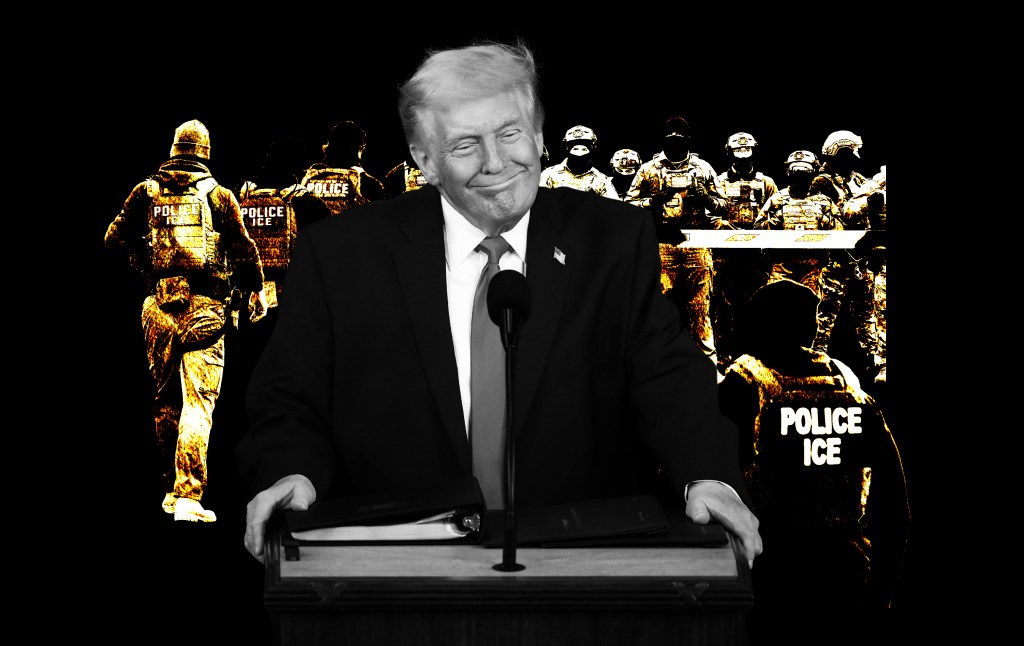
Presidents always operate within a bubble, but for Trump, the bubble is thicker and harder to penetrate without the assistance of outside and undeniable forces. It was the shock of the deaths of Renee Good and Alex Pretti at the hands of federal immigration officers, for example, that prompted Trump to reverse course on his administration’s aggressive immigrant dragnet in Minnesota, sending his border czar to institute a more “targeted” enforcement strategy. When financial markets reeled at the announcement of Trump’s raft of new and steep tariffs last year, the president eventually, repeatedly, and reluctantly relented.
And it was after Democratic wins in most of last fall’s off-year elections that Trump aides suggested the president would be more active in promoting his agenda on the road. Indeed, Trump spent much of his first year in office either in Washington, with the bulk of his domestic travel taking him to nearby Virginia or to Florida and New Jersey—all states where he has properties. Since the new year, Trump has traveled to Michigan, Iowa, and Georgia—and he heads to Texas today—to argue that his economic policies are working and that voters should reward him and Republicans in this fall’s midterm elections.
One can imagine how the first year of Trump’s second term might have gone differently without the president having such a closed-off perspective. A Trump administration that merely extended his first-term tax cuts, implemented its strong border-enforcement measures, and stayed far away from the aggressive deportation strategy and economically unsound trade policy would almost certainly be more politically popular. In other words, do less.
But Trump’s bubble remains intact, and inside it the most frequent answer to the president’s political struggles is always to do more. More tariffs. More taunting of his political enemies. More Trump.