In the recent State of the Union, Donald Trump boasted that no illegal immigrants have entered the United States during the past nine months. This is, like most of what Donald Trump says, untrue.
There are places all along the border where you can go first thing in the morning, as I have, and sit in your car nursing a cup of gas station coffee while watching illegal immigrants enter the United States. Some of them go straight to the Border Patrol to get arrested and make asylum claims, and some do not. The Border Patrol arrested about 6,000 at the southern border in January—but that does not mean that they got them all, which they almost certainly did not. What the Trump administration apparently meant to say was that, of the illegals arrested, the Border Patrol did not voluntarily allow any to proceed into the country, as they sometimes have in the past. But even that is misleading: Illegals arrested and detained at federal facilities are, from time to time, released for a variety of reasons: pending asylum claims, overcrowded lockups, etc.
It simply is not true that there are no new illegal immigrants entering the United States. There most assuredly are: Some crossing the border, while others are entering legally and overstaying their visas. Some of them are Central American construction workers, some of them are aspiring fashion models working without permits, some of them are Irish bartenders, and some of them are—whatever. It’s a crowd.
I do not think that the cretins and malefactors who compose the Trump administration stay up at night worried about questions of epistemology, but it is worth asking: If it really were the case that there were absolutely no new illegals coming into the United States—how would we know?
Trump’s incoherent State of the Union address on Tuesday featured his usual stroke-victim diction and his patented blend of stupidity and dishonesty. Fact-checking his claims is laborious, because he speaks almost exclusively in simpleton’s superlatives, and it also is pointless, inasmuch as the people who most need to know the facts are not much inclined to listen to them, being, as they are, members of an especially tawdry and shameful cult. Suffice it to say that inflation was not at record levels when Trump assumed office this time around, and it is not plummeting today—it was high when he came in and remains elevated. Foreign direct investment in the United States is in fact down, not soaring by trillions of dollars. There is no such thing as a “second lady,” with apologies to Usha Vance, who probably could have married a doctor. Some of the speech could have used some context: I admire Michael Dell and his generosity, and it is true that he made computers in his dorm room at the University of Texas—but mainly he has made them in China, a fact of corporate history that ought to be of some interest to the Trump gang.
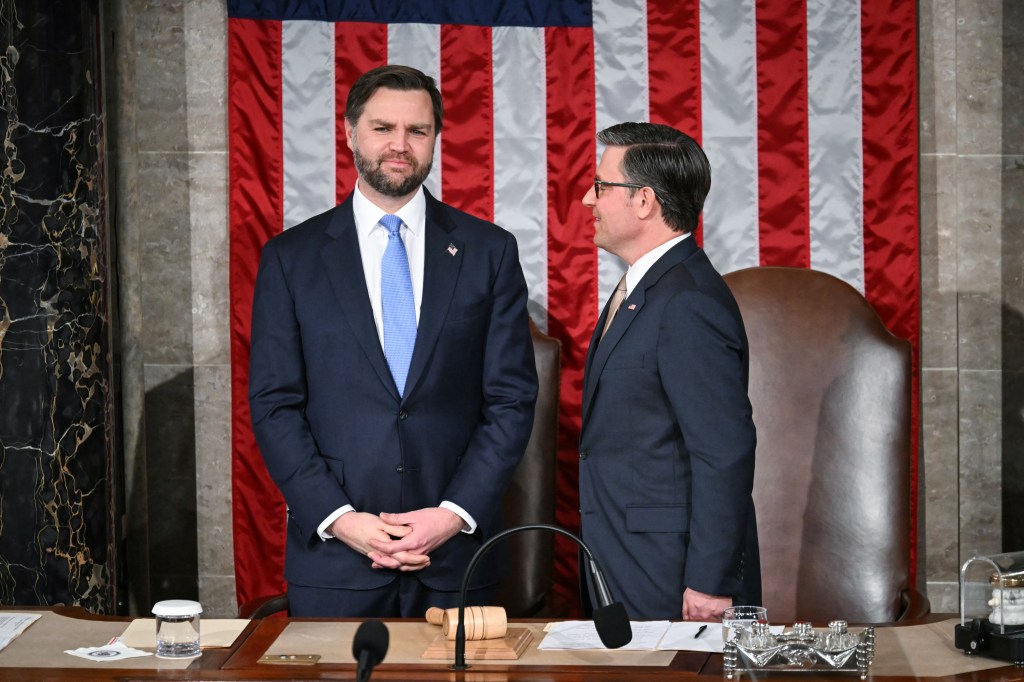
The competition is considerable, but it may be that the dumbest and most dishonest claim of the night was that J.D. Vance’s newly announced fraud commission will, if it does its job, produce a “balanced budget overnight.” Vance is as contemptible a specimen as American public life currently has to offer, but he is relatively new to the cult game, and he has here foolishly taken on a high-profile task that can be evaluated quantitatively. The projected deficit for 2026 is $1.9 trillion on its way toward more than $3 trillion per annum over the coming decade. For scale, this year’s projected deficit will amount to about 5.8 percent of GDP. Which is to say, to balance the budget by means of fraud prevention, fraud in federal programs would have to amount to an industry right around five times the combined global size of all those AI-enabling data centers we hear so much about.
I, for one, will be very surprised if the annual deficit or the projected 10-year deficit is $1 smaller when Trump leaves office than it is today. Rising spending is a good bet (ask that guy who bet his life savings against DOGE) and so are rising deficits. If Vance manages to balance the budget by means of policing fraud, then I will eat my favorite J.W. Brooks hat and post the video on The Dispatch for your entertainment.
But I am confident that millinery work is safe.
Like the administration’s immigration claims, its fiscal claims are preposterous—obviously so, if you take a second to think about them.
The administration’s current strategy for policing Medicaid fraud (which is a real thing) in Minnesota is withholding some federal reimbursement payments, amounting to $259 million—not billion, certainly not trillion. That’s back-office monkey business, not a fraud investigation. If you have good reason to believe that you have, say, $1 billion worth of Medicaid fraud, then what you need to have next is a federal fraud indictment and a trial in which $1 billion worth of Medicaid fraud is documented in the course of putting the fraudsters in prison for a long time. That, and not political showmanship, is how you do the actual work of policing fraud.
There have been fraud prosecutions and there will be more—as there should be—but the dollar numbers involved do not amount even to a rounding error on the federal deficit: We are right now talking about cases involving millions, not billions or trillions of dollars. Perhaps they will add up to a few billion. We are not balancing the budget on a few billion dollars, or a few hundred billion—and the balanced budget is Trump’s stated metric of success, not mine.
Undertaking those fraud investigations and prosecutions is hard and generally thankless work, which is one of the reasons the feds do not do as much of it as they should. But the Trump administration can, without very much effort, inflict economic damage on Democrat-leaning states such as Minnesota and California while forgoing the hard work of investigating and prosecuting most of the alleged fraud, at least some of which is imaginary. If we are to be so cruel as to pretend that J.D. Vance is numbskull enough to believe the baloney that comes out of his own mouth or Trump’s, then we should have fraud cases amounting to just about 5.8 percent of GDP, give or take. The notion is, of course, absurd.
But, then, so is the fact that Donald Trump is president of these United States.