Sometimes a single document can change the world, like the Declaration of Independence. Sometimes it’s a single telegram, like the Zimmermann telegram that launched the U.S. into World War I. Sometimes it’s a single phone call. That was the one made from the Oval Office on May 28, 1940, to a corporate office in Detroit—a phone call that saved the free world and put America on the trajectory to become the world’s dominant superpower.
It was President Franklin Roosevelt who dialed up the biggest industrial giant of his time. But not until after he called Bernard Baruch, a 69-year-old financier and long-time Democratic Party fundraiser.
Roosevelt had been watching events in Europe with increasing trepidation. Nazi forces had broken through the Allied front along France’s Meuse River after overrunning Holland and Belgium, as German Panzers pushed aside the French and British armies and drove closer to Paris. The possibility that France, and Britain afterward, might fall to Adolf Hitler meant that the United States would have to face the Nazi juggernaut alone should Germany’s expansion in Europe reach right across the Atlantic.
The United States was woefully unprepared for this kind of crisis. Its Navy, although modernized in the previous six years with four new aircraft carriers, would be no match against a German navy bolstered by the potential capture of French and British vessels. The U.S. Army ranked 17th in the world in terms of size and combat power, behind Hungary and Brazil and just ahead of recently defeated Holland. Its Air Corps had fewer than 2,000 planes, all outdated fighters and trainers. Army Chief of Staff George Marshall had warned FDR that if Hitler landed five divisions on the East Coast, there was nothing the U.S. military could do to stop him.
Something had to be done to get America ready for modern mechanized warfare from a virtual standing start. So Roosevelt had turned to Baruch, who had overseen America’s effort to arm itself during the last world war, albeit with very mixed results. But Baruch had the sense to realize that arming America this time would be a process far more complex, and far beyond even his powers. When FDR asked him to name the three top industrial production men in the country, Baruch answered simply: “First, Bill Knudsen. Second, Bill Knudsen. Third, Bill Knudsen.”
“Big Bill” Knudsen was president of General Motors, the greatest industrial corporation in the world. But he was no ordinary corporate manager. A Danish immigrant, he had worked and fought his way up from the Brooklyn shipyards (where he was the reigning heavyweight boxing champion) to work for Henry Ford and help redesign the automobile mass production line that made Ford famous. From Ford, Knudsen had moved on to Chevrolet, where he turned GM’s loss leader into the company that would outsell Ford nearly every year from 1931 to 1986—and make GM the global industrial colossus.
If anyone could figure out how to arm America to confront the Axis powers, it was GM’s president. That Tuesday, Roosevelt called up Knudsen, who agreed to take a job in Washington the very same week. The pair arranged a meeting for Thursday, May 30.
Knudsen’s family and colleagues were shocked. It didn’t make sense to move to Washington; America wasn’t at war yet. Besides, Knudsen was a Republican and FDR a progressive Democrat who had excoriated big business and capitalism ever since he took office in 1933. “My country has been good to me,” was Knudsen’s answer, “and I want to pay it back.” And when the president of the United States sent a summons, Knudsen believed it was his duty to answer the call.
Almost from the moment he arrived in Washington and had his first meeting with FDR and the newly appointed board he was supposed to head, the National Defense Advisory Commission, Knudsen realized no one knew how to meet the possible Axis threat—not only in Europe but also in Asia against imperial Japan. The most popular solution being proposed was that the federal government take over key industries like automobiles and steel, and simply order them to make whatever was needed for the war effort. “Democracy must wage total war against totalitarian war,” FDR’s closest adviser, Harry Hopkins, had written in a secret memo for the president. “It must exceed the Nazi in fury, ruthlessness, and efficiency.”
But Knudsen knew that kind of takeover was doomed to failure. Instead, he offered FDR a counterproposal: Give me 18 months, and my industry colleagues and I can produce for you more arms than you’ll know what to do with. “If we know how to get out twice as much material as everyone else,” he said, “know how to get it, how to get our hands on it, and use it—we are going to come out on top—and win.”
Knudsen had calculated it would take a year and a half for America’s major corporations to overhaul the country’s manufacturing infrastructure for wartime. Plants would need to be converted to produce things they had never made before, like tanks, machine guns, and bombers—and in record numbers. But Knudsen believed that private industry would rise to the task, and that it would do so on the basis of voluntary government contracts rather than forced nationalization.
Against the counsel of his wife and his closest advisers, FDR agreed to Knudsen’s terms. Starting in June from his desk at the National Defense Advisory Commission, and with no more authority to issue contracts than a handshake, Knudsen started making the deals that would lead to wartime conversion on a massive scale, all with business and private enterprise leading the way and the government providing the money where needed and directing the flow of critical materials when required.
The experiment in letting private industry figure out how to arm a nation for modern warfare was a spectacular success, thanks to Bill Knudsen and his colleagues.
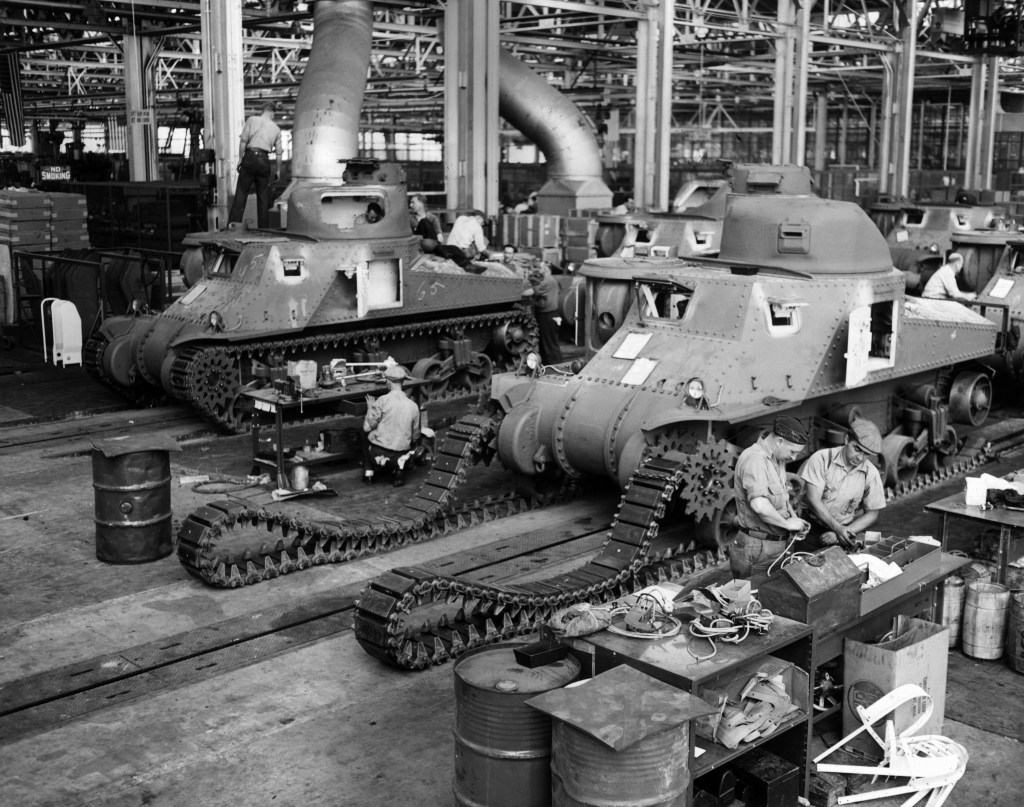
The Knudsen approach worked. By the time bombs fell on Pearl Harbor on December 7, 1941, Knudsen had won his critical year and a half. By the start of 1942, what FDR termed “the arsenal of democracy” (a phrase he is believed to have borrowed from Knudsen) was fully in motion. That year—the year of Midway, Guadalcanal, and Operation Torch—production numbers began to soar. In 1941, the United States produced 3,964 tanks—more than the previous three years put together. In 1942, that figure jumped to 24,754. Before the war was over, the total would reach 88,000—almost four times more tanks than Germany produced during the entire course of the war.
What was true for tanks was also true for warplanes, aircraft engines, machine guns, trucks, artillery, and anti-aircraft guns—not to mention rifles, helmets, uniforms, and medical supplies for a fighting force of more than 16 million men. By the end of 1942, the United States was producing more war materiel than Germany, Japan, and Italy combined. And it was achieved without ordering a single corporation to produce military equipment and without forcing American workers to stay at their defense jobs or even register for a national database, as many policymakers thought would be necessary.
General Motors and other automakers stopped producing civilian cars in February 1942, shifting to tanks, trucks, aircraft engines, and artillery shells—in GM’s case, more than 120 million of the latter. The Wurlitzer Company stopped making pianos and jukeboxes to make compasses and de-icers; International Silver made Browning Automatic Rifles instead of flatware; National Postage Meter and the jukebox company Rock-Ola made M-1 carbines. Meanwhile, Henry Kaiser and other entrepreneurs lined the nation’s coasts with new shipyards producing freighters, landing-craft, aircraft carriers, and submarines. By 1944, those shipyards were making eight aircraft carriers a month and five merchant freighters a day—while inland factories were producing a warplane every five minutes.
Meanwhile, a series of American corporations made it possible to build the ultimate weapon: the atomic bomb. They included DuPont, which built and operated the Hanford, Washington, plant for processing plutonium; Kellex, which handled the critical materials for enriching uranium-235; and Chrysler, which put together components of the K-25 gaseous diffusion plant in Oak Ridge, Tennessee. Union Carbide handled the uranium enrichment process at Oak Ridge, while Stone and Webster served as the main contractor for the Tennessee complex. Westinghouse and Tennessee Eastman also contributed their expertise to the project.
In the end, the United States produced 141 aircraft carriers, 807 cruisers, destroyers, and destroyer escorts, 203 submarines, 88,000 tanks, 257,000 artillery pieces, 2.4 million trucks, 2.6 million machine guns, and 41 billion rounds of ammunition. American factories, plants, and shipyards made two-thirds of all the war materiel consumed by the Allies in World War II.
Yet America’s civilian economy also continued to grow during the war years, despite nationwide rationing of gasoline, sugar, coffee, and shoes, and occasional shortages of goods like cigarettes, brass for buttons, and copper for pennies. The experiment in letting private industry figure out how to arm a nation for modern warfare was a spectacular success, thanks to Bill Knudsen and his colleagues.
But Knudsen’s reward was to be traduced by the media, unceremoniously shoved aside by Roosevelt after Pearl Harbor, and largely forgotten by history. When Knudsen died in 1948, his health broken by his wartime exertions, the usual narrative of America’s production miracle was that it had been the work of the federal government all along.
Knudsen deserved, and deserves, better. We now recognize he had the formula that built the much-maligned “military industrial complex,” which won the Cold War and which offers the secret for rebuilding a defense industrial base that’s been hollowed out since. That formula is to unleash the drive, energy, and know-how of the private sector to tackle the biggest problems in the public sector, then stand back and admire the astonishing results. It’s the path to not only restore American dominance, but to save the free world again from its enemies, from Beijing and Moscow to Tehran and Pyongyang.
“American ingenuity has never failed to cope with every specific problem before it,” Knudsen once told a radio audience. It was a message of hope when he uttered it in the darkest days of World War II. It remains an essential message today.