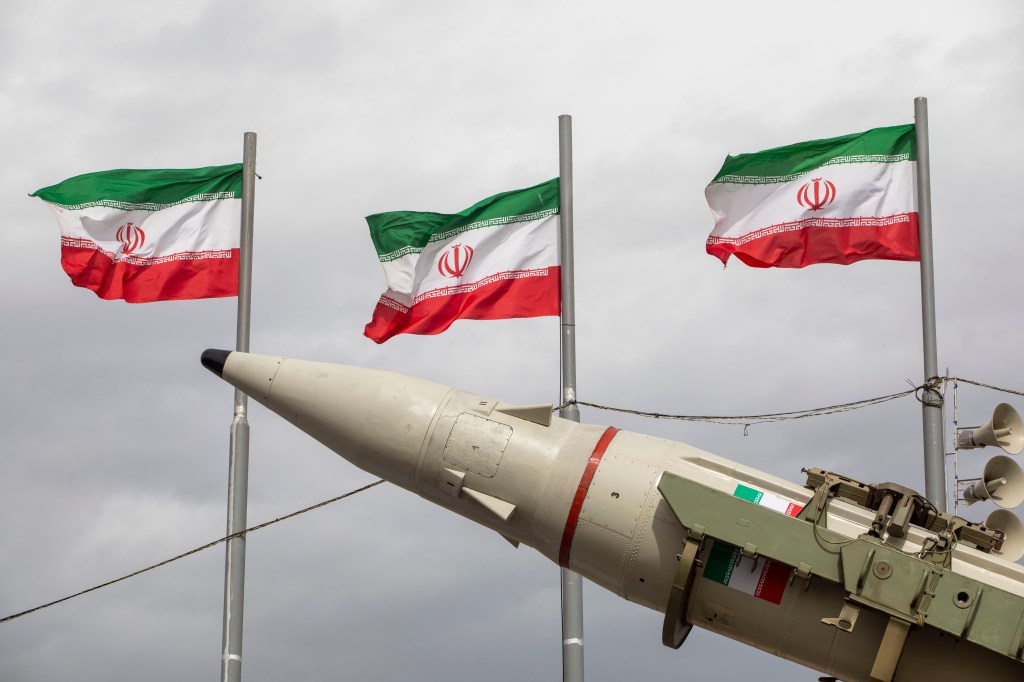
The least risky option would be for the U.S. to conduct long-range missile strikes on military and nuclear targets inside Iran. But it would also inflict the least damage. If U.S. forces rely on long-range Tomahawks and Joint Air-to-Surface Standoff Missiles (JASSM) to strike targets like military bases and missile sites, they would be limited to a campaign lasting a few days at most. “If we’re not going to overfly Iran, then you have to use the long-range missiles,” Mark Cancian, a senior adviser at the Center for Strategic and International Studies, told TMD.
Roughly 1,000 Tomahawk missiles, each with a range of up to 1,500 miles, and more than 2,000 JASSMs are available for U.S. use, Cancian said. But every missile launched against an Iranian target is one less that can be used in a larger conflict with, say, China. “Maybe at the 500 point [of Tomahawks being launched], the military planners would start getting very worried,” predicted Cancian.
Operation Midnight Hammer, the U.S. strike on Iranian nuclear sites last year, required seven B-2 bombers and more than 125 supporting aircraft—though the missile component was modest, with just a few dozen Tomahawks. And that targeted only nuclear enrichment sites after an Israeli air campaign had largely dismantled Iran’s air defenses. A missile-only campaign, risking no American lives, would be far more limited, Cancian said.
But the U.S. is reportedly thinking bigger. Earlier this month, U.S. officials told Reuters they were preparing for a sustained operation that could last weeks. The White House has also ordered the Pentagon to prepare a range of military options for Trump, from limited strikes on missile and nuclear sites to a campaign intended to topple the Iranian regime, which would include targeted strikes on officials like Supreme Leader Ayatollah Ali Khamenei. Chairman of the Joint Chiefs of Staff Gen. Dan Caine has reportedly warned Trump that attacking Iran could risk drawing the U.S. into a prolonged conflict.
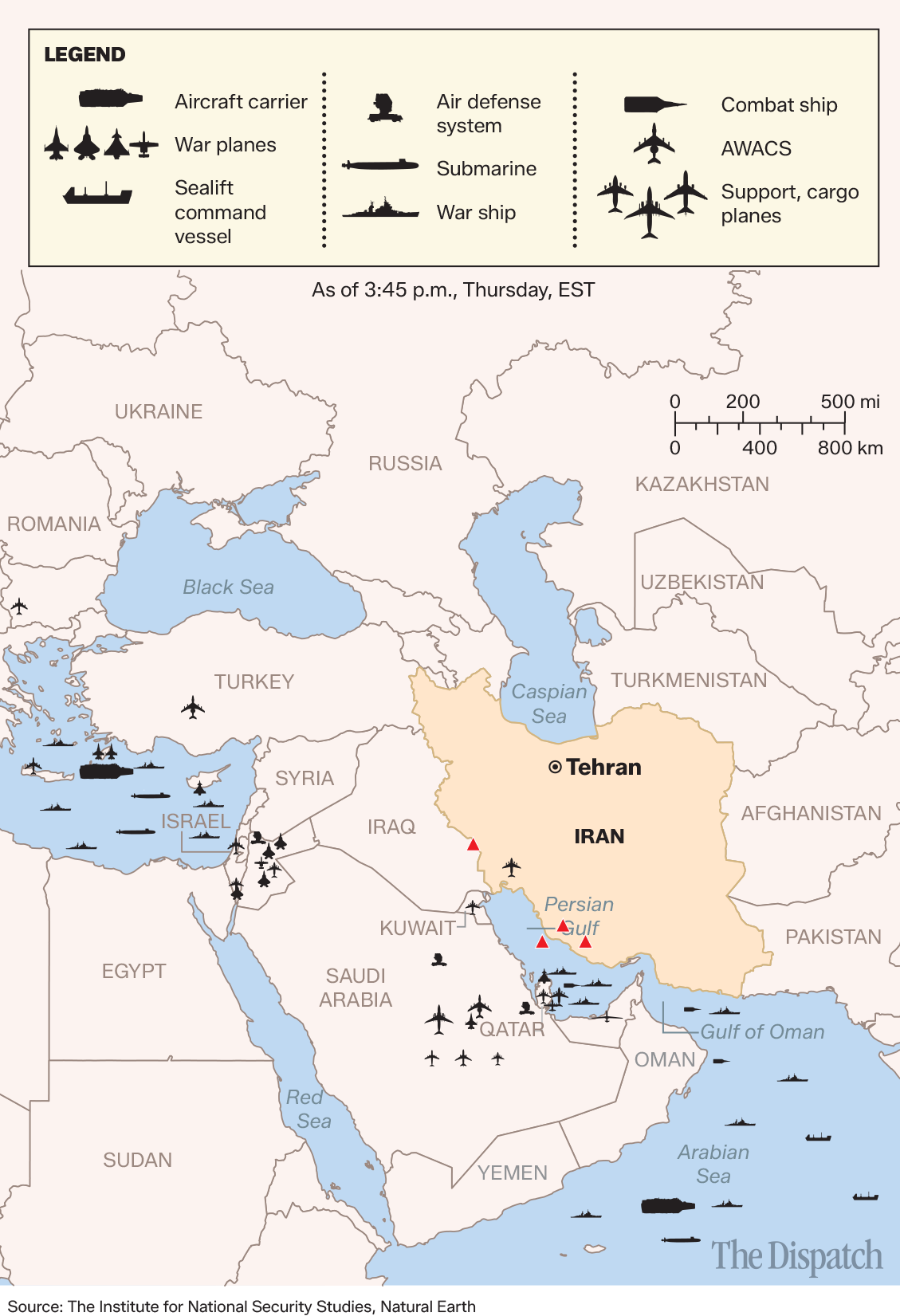
Given the size of the “armada” (as Trump calls it) that has surrounded the Islamic Republic in recent weeks, the U.S. is at least prepared for more substantial action. Between Air Force assets and the Navy’s two aircraft carrier strike groups currently in the Middle East, more than 200 planes are gathered around Iran, according to the Israel-based Institute for National Security Studies. Add the aircraft stationed in Europe, many of which have the range to reach Iran, and more than 300 fighters, bombers, and support aircraft are available, a far larger force than the roughly 125 aircraft used in Operation Midnight Hammer.
That force has the capacity to conduct an air campaign on a scale that hasn’t been seen since the seven-month NATO operation against Libyan dictator Muammar Gaddafi in 2011—a multinational assault that involved thousands of sorties and allowed Libyan fighters to capture and kill the strongman. But even a smaller-scale campaign would still involve considerable political calculation for Trump. While the risk to U.S. personnel from Iran’s damaged air defenses is “pretty low,” Daniel Byman of the Center for Strategic and International Studies told TMD, “one very lucky shot or one mechanical problem is a huge deal politically.”
Even a weakened Iran would have the ability to retaliate against the U.S., Byman said, likely through a mix of missile strikes, attacks by proxy groups, and potentially even state-sponsored terrorism against non-military targets. Tens of thousands of U.S. troops are stationed in the Middle East, and “there’s also U.S. diplomats and U.S. aid workers and U.S. businessmen and U.S. tourists, and you make the circles wider and wider.”
But it’s unclear whether the Islamic Republic is prepared to escalate. After last year’s 12-day war, “I don’t think they consider being bombed by the United States and/or Israel an existential threat,” Ray Takeyh, a senior fellow at the Council on Foreign Relations and former State Department adviser on Iran, told TMD. “That doesn’t mean it’s not profoundly damaging, but it’s like they’ve gotten in the ring with Mike Tyson and they proved to themselves that they can take a punch.”
On the American side, it’s still unclear what the White House’s goals are and whether strikes can accomplish them. Trump began the buildup to this confrontation in January by taking to social media in support of Iranian anti-regime protesters. But in recent days, the White House has focused its arguments on the Iranian nuclear program.
“The principle is very simple: Iran cannot have a nuclear weapon,” Vice President J.D. Vance told reporters on Wednesday. “If they try to rebuild a nuclear weapon, that causes problems for us. In fact, we’ve seen evidence that they have tried to do exactly that.” During his State of the Union speech on Tuesday, Trump’s three-minute section addressing Iran also focused on the country’s nuclear program. “We are in negotiations with them. They want to make a deal,” he said. “But we haven’t heard those secret words: ‘We will never have a nuclear weapon.’”
A deal focused solely on Iran’s nuclear program would be a climbdown from U.S. demands earlier this month that any talks include discussion of Iran’s ballistic missile arsenal and its support for regional proxy groups such as Hamas and Hezbollah. But Iranian officials are unlikely to offer concessions on either point, especially missiles, Gregory Brew, the Iran analyst for political risk consultancy Eurasia Group, told TMD. “Missiles are their main source of strategic deterrence,” he said. “It’s their only way of projecting strength outside their own country now, so they can’t surrender the missiles.”
So far, it appears that the U.S. is willing to separate nuclear discussions from other matters. But Witkoff told a private gathering earlier this week that any commitment by Iran would have to last indefinitely, a promise Iran has previously been unwilling to make.
It’s also unclear what an Iranian commitment not to enrich uranium would actually achieve, as most of its nuclear program lies buried under rubble and many of its top scientists have been killed by Israeli strikes and assassinations. International Atomic Energy Agency chief Rafael Grossi said late last year that Iran is not actively enriching any uranium to weapons-grade, but he has warned that some of Iran’s existing uranium stockpile is still likely accessible to the regime. “Zero enrichment is a practical condition as of today,” as Iran’s facilities for making enriched uranium have been destroyed, Takeyh told TMD.
Iranian officials claimed Thursday morning that talks would be restricted to nuclear matters, a potential win coming out of negotiations in which Trump has mused about attempting to enact regime change. But some analysts are skeptical that Iran can credibly commit to never building a nuclear bomb.
The regime may be too invested in a nuclear weapon to abandon the pursuit. “It’s ideological at this point,” Nate Swanson, who directs the Iran Strategy Project at the Atlantic Council and previously served as the NSC’s director for Iran, told TMD. “It’s become this core tenet of what the regime has accomplished.” Iranian officials have so far maintained that they want their country’s right to nuclear enrichment recognized in any future deal.
And some analysts think that Iranian negotiators are simply stalling for time. “The Iranians are sophisticated about American politics,” Michael Rubin, a Middle East analyst at the American Enterprise Institute, told TMD. “They also realize that they don’t need to survive until the end of Trump’s term—they need to survive until the midterm elections.” In Rubin’s view, Iran might view agreeing to a deal as a temporary shield until a less aggressive president comes into power.
But after a week of anticipation, with an enormous American buildup of forces in the region, it’s still unclear what Trump will decide. Speaking to reporters on Thursday night, Vance said that even he didn’t know what the president would do. He did, however, stress that the U.S. would not be caught in yet another foreign quagmire: “The idea that we’re going to be in a Middle Eastern war for years with no end in sight—there is no chance that will happen.”