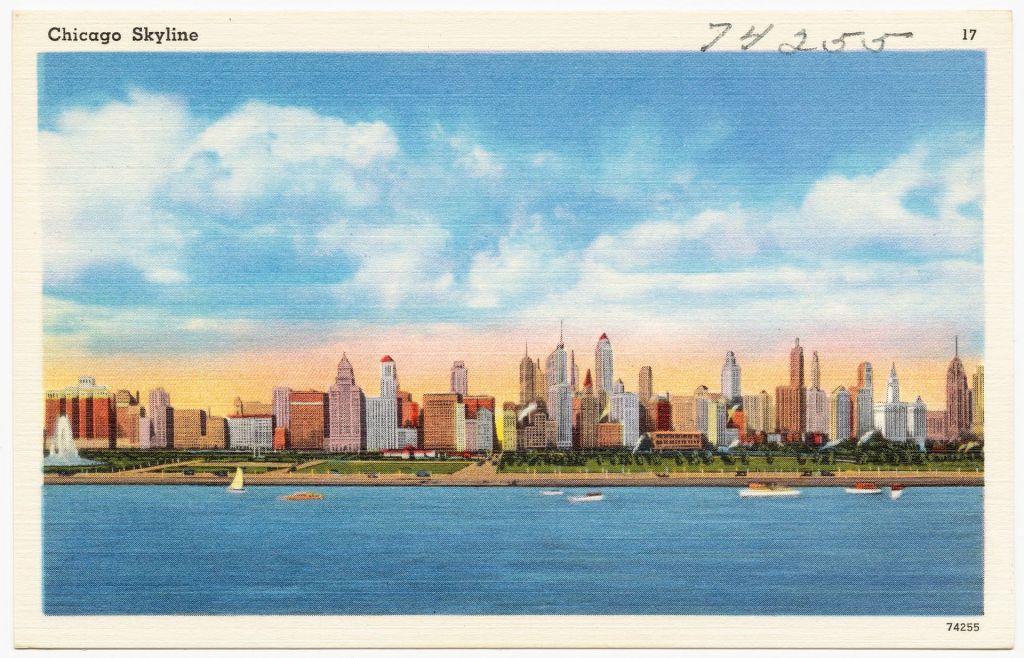
In certain shops in Chicago, you will find a bumper sticker reading, “Too Dumb for New York, Too Ugly for LA.” While grimly amusing, I find this, on another level, frustrating. The bumper sticker has a certain plainsman’s discontent to it, an angry determination to live with (presumed) mediocrity. “Sure, we’re stranded here in the flatlands, but we like it.” Is this level of self-deprecation, this inferiority complex, at all necessary?
When the literary-minded Chicagoan looks at New York, he or she sees a world full of activity. Writers socialize, schmooze, congregate at hip bars, flock to readings. All the major publishers are based there. The scene is there. It’s easy to feel envious, left out, striving to make it on your own in a city with regularly Antarctic wind chill factors.
Yet, for the most part, what does the average New York literary scenester actually do? Sure, there are writers. No one could deny the technical centrality of New York to American literature. But the most common literary species in New York is the non-writing writer, the poetaster, the wastrel. I think most New York writers of actual accomplishment (of whom there are many) would wholeheartedly agree with this statement.
The literary life of Chicago, on the other hand, has been defined by the work, rather than the scene. As befits Carl Sandburg’s “City of the Big Shoulders,” Chicago is concerned with production, with hustling, with getting the work done. It is plainspoken and populist in comparison to New York, yet still creatively fecund. All the commodities move through this central circulatory headquarters, the heart of the American body. Is it subject to tachycardia and the occasional myocardial infarction? Absolutely. But it still pumps fiercely.
Reading some of the greatest 19th– and early 20th-century New York writers—like Henry James and Edith Wharton—we are drawn into a WASPy old New York City, one that seems almost pseudo-English. But Chicago was never so free from the exhilarations of American vulgarity. It was, after all, built to move meat.
It is this unpretentious quality that sounds the signal note of Chicago, as befits the capital of the Midwest. In an interview with the Paris Review, playwright David Mamet argued that Chicago was notable for “the admixture of the populist and the intellectual.” He contrasted Chicago’s theater world with New York’s, stating, “But the version in Chicago was people went to the theater just like they went to the ballgame: They wanted to see a show. If it was a drama, it had to be dramatic, and if it was a comedy, it had to be funny—period.” This aversion to hipster hijinks betokens a groundedness, an earthiness, to the Chicago mindset. It perhaps hasn’t endured quite as unmixedly as when Mamet made that comment, but it still endures in an attenuated form. (For instance, I don’t get the sense that Chicagoans have the same level of deranged enthusiasm for AI current in other locales.)
In 1889, Rudyard Kipling, ostensibly no stranger to rough and rowdy ways of living, visited Chicago. His reaction was decidedly negative: “I have struck a city—a real city—and they call it Chicago. The other places do not count. San Francisco was a pleasure-resort as well as a city, and Salt Lake was a phenomenon. This place is the first American city I have encountered. … Having seen it, I urgently desire never to see it again. It is inhabited by savages.” Visiting somewhat earlier, Oscar Wilde was appalled by the city’s aesthetics but found the motion of its waterworks “the most beautifully rhythmic thing I have ever seen.” We see here the fear of the Old World, trembling before the industrial monstrosity of the new world: a great tide of vulgarity and mindless commerce rising up. Yet, as Wilde generously grants, there is something compelling about it all.
This supposedly cultureless and merely muscular world was soon to become fertile ground for great American poetry, drama, and fiction. The naturalistic novels of Theodore Dreiser and James T. Farrell depicted American strivers with careful, realistic attention to detail. Ernest Hemingway was born just outside Chicago in Oak Park and did some of his finest short story writing here (a reader looking for a sample of bracing Chicagoan vulgarity can consult Hemingway’s appropriately titled “A Very Short Story,” in which a soldier contracts a venereal disease from a Loop shopgirl in the back of a taxi). Sherwood Anderson wrote “Winesburg, Ohio” while living in Chicago, and Richard Wright memorably depicted life in a black neighborhood on the city’s South Side in his autobiography, Black Boy. Nelson Algren dug into Chicago’s dark underbelly with The Man with the Golden Arm, his study of a drug-addicted World War II veteran.
All these writers have a bracing directness in common. They were determined, in one way or another, to keep it real. When William Faulkner accused Hemingway of never using any advanced vocabulary that might disconcert his readers, Hemingway responded, “Poor Faulkner. Does he really think big emotions come from big words? He thinks I don’t know the ten-dollar words. I know them all right. But there are older and simpler and better words, and those are the ones I use.” This plainspoken but lyrical force is quintessentially Chicagoan.
We find it in the city’s poetry as well. Gwendolyn Brooks’ poems, like “the mother,” don’t shirk a confrontation with unpleasant emotions and unpleasant realities, and Carl Sandburg blends a full-throated celebration of Chicago (“Laughing even as an ignorant fighter laughs who has never lost a battle”) with a quiet, delicate sensitivity to physical detail, reminiscent of Chinese and Japanese poetry (“The fog comes/ on little cat feet.”) The minimal, the ordinary, the typical, even the sordid, is regularly brought to its epiphany. While not a novelist or poet, the Chicago writer Studs Terkel granted dignity and interest to the lives of ordinary people through his incisive interviewing and editing. His oral history of World War II, The Good War, remains a remarkable, many-sided document of what the war meant to people who lived through it, and his collection of interviews, Working, is unique in paying attention to people in various jobs in various walks of life. In writing, we frequently skate over the minutiae of work, ready to get to the weekend, get to the drama. So there is something unique in Terkel’s prose; he brings out the inherent interest in that from which we so often seek to escape.
The Chicago way of doing drama is similarly in touch with crude realities. David Mamet is probably still the preeminent living playwright in the United States. From his early works like American Buffalo and Sexual Perversity in Chicago on to plays like Glengarry Glen Ross and Oleanna, along with his copious filmography, Mamet has always been defined by his wise awareness of the cynicism and self-seeking that motivate so much human activity. Colorfully profane, “Mamet-speak” has earned itself a permanent place in American diction. In terms of theatrical practice, Chicago has also always had a strong do-it-yourself culture. The Chicago way has always been to gather a handful of friends and put on plays yourself, without worrying about permission from gatekeepers. Major theatrical companies like Chicago’s Steppenwolf Theater originated in exactly this way.
But does this rich legacy project itself into the present day? To some extent. There are still strong writers who are inspired by Chicago and bear some of the traits I mentioned. Nathan Hill’s The Nix, for instance, gives us a great sense of “the way we live now,” and grounds the lives of its protagonists in the city’s history. Tracy Letts’ plays, including the Pulitzer Prize-winning August: Osage County and the heartfelt Superior Donuts, convey a gritty sense of nasty familial dynamics and, in the latter work, reckon with the city’s history and racial tensions. But the Chicago “scene” is, inevitably, diffuse compared to New York’s. Writers here are more solitary and the opportunities for networking are more limited than they are in the publishing mecca.
But it doesn’t need to be this way, and there are good economic reasons for why it shouldn’t. New York, to say nothing of the Bay Area, is extremely cost-prohibitive. It’s easier to “make it” in New York if you already have a nice, fluffy cushion of familial resources to fall back on. It thus feels more gate-kept, inaccessible. Despite Chicago’s notorious fiscal mismanagement and nationwide food and housing price increases, it remains far more livable for a young person of some literary or artistic ambition than New York. While the average studio apartment in New York rents for around $3,300 per month, the same in Chicago rents for around $1,600 per month. And these aren’t starving artist accommodations: If you’re willing to be somewhat bohemian, you can make it work for under $1,000 a month here and even less if you’re willing to have roommates. William Somerset Maugham’s Of Human Bondage shows that the typical starving artist in Paris was willing to live merely on bread and butter, if it came to that. What’s your excuse for not making the most of the opportunities provided by America’s own spiritual center?
But it’s not going to hold your hand: You have to come to it and make it work on your own terms. My own experience as a writer here has been positive overall. A writer friend and I run a workshop group, I attend readings, and I’ve been hanging out a bit at a café near me, Chess Club Coffee, which is trying to become a spot that attracts writers and is finding some success. None of this is lacking. But it needs a push, it needs a jolt: New York, based on my own experiences and the stories of friends, still has us beat in the community sense.
While New York’s “scene” can be a distraction, it still provides a necessary stimulus to the creative process. In Chicago, a literary community exists, but it is more diffuse than it needs to be. As Walker Percy notes, the “genie soul” of Chicago is its spaciousness, which has both benefits and downsides. I think this diffuse quality, the lack of a centralized community with a clear place to hang out, is one of the downsides. But Chicago still provides a great point from which to observe the crossroads of America. The city has immense depth, with tons of neighborhoods and interesting enclaves to explore. You can’t exhaust it. Plus, the looser nature of the scene helps writers protect their solitude and cultivate a more personal and less imitative vision. You’re not overly influenced by trends and ephemera or consumed by the endless extra-literary clout-chasing endemic to New York.
There is always the risk of overvaluing the brutal and vulgar. But what Chicago writing aims for at its best, and what the city can still facilitate, is finding the extraordinary hidden in the ordinary, finding a shattering beauty that still exists within mundane, workaday life. In the end, the opportunity for literary greatness abides, and it makes sense to seek it in Chicago. What hardy spirits will dare to bear the Chiberian cold? The question awaits your answer.