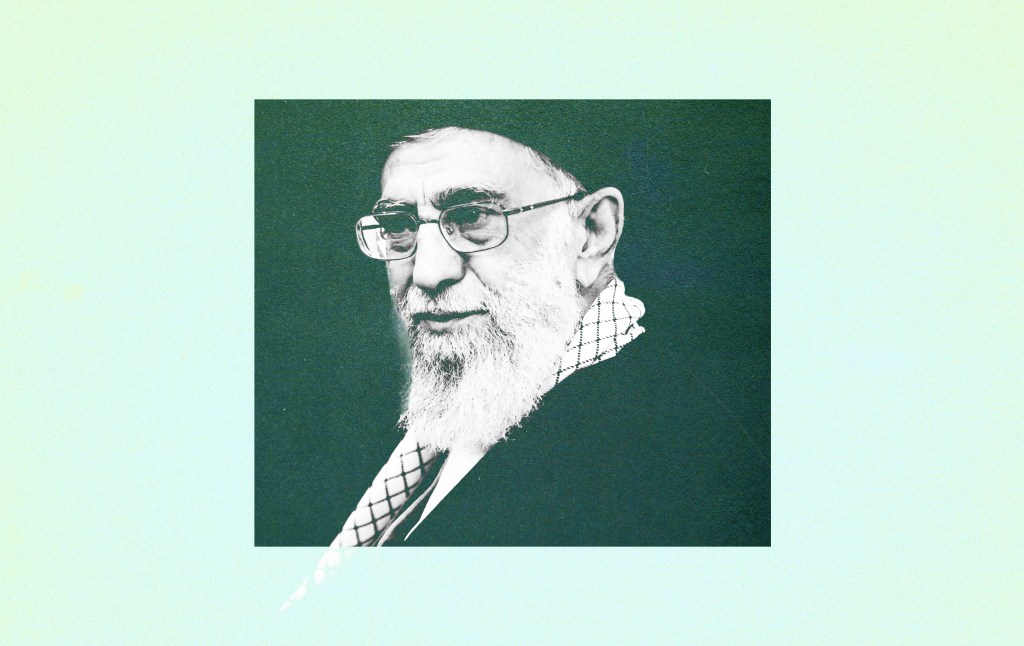
In May 1978, on the eve of the Islamic Revolution in Iran, a little-known Muslim cleric delivered a sermon urging believers to rid their society of the corrupting forces of Westernization and modernity.
“The power which has stood up against deviation and chaos throughout history—today, it is doing the same as well—is the power of knowledge, religious awareness, and the power of obeying the Quran,” 39-year-old Ali Khamenei said from Iran’s southeast city of Iranshahr, where he was exiled because of his opposition to the shah’s rule. “They are drowning our boys and girls in the swamp of perversion.”
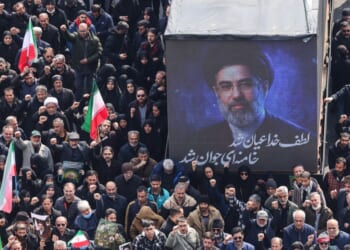
Rousing speeches like this propelled Khamenei to the highest levels of Iran’s new leadership after the establishment of the Islamic Republic in April 1979, culminating in his elevation to the supreme leadership in 1989, an office he would hold for the next 36 years. And he carried the same revolutionary zeal into the final days of his life, refusing to reform his sclerotic regime despite overwhelming Iranian opposition to the 47-year-old Islamic Republic. Khamenei died at age 86 on Saturday, in the opening salvo of a U.S.-Israeli military campaign to overthrow the theocratic dictatorship he devoted his life to sustaining.
Born in 1939, Khamenei grew up the son of a poor cleric in Iran’s northeast city of Mashhad. As a young man in the late 1950s and early 1960s, he pursued his own religious studies at a seminary in Qom, where he became enthralled to the teachings of Ruhollah Khomeini. A radical Islamic scholar and later revolutionary leader, Khomeini committed his movement to the destruction of Israel and the U.S., and the hedonistic values for which he believed they—and by extension, Iran’s American-backed monarchy—stood.
A young Khamenei’s support for this ideological project brought him to the attention of the Pahlavi government. In the years leading up to the 1979 revolution, he was arrested six times by the shah’s secret police. The prison stints helped Khamenei establish the revolutionary bona fides that helped propel him to prominence during the Islamic uprising and after, under the rule of Supreme Leader Khomeini. He served as deputy defense minister and later president, a post he held at the time of Khomeini’s death in 1989.
The supreme leader saw the very existence of a Jewish state on Muslim holy land as an affront to Islam, simultaneously the symptom and the cause of the region’s theological decay. Seeking Israel’s destruction, therefore, was both a righteous cause and a religious imperative.
But Khamenei’s path to Iran’s highest political and spiritual role was far from assured. The presidency was a largely ceremonial position, and he was only a midlevel Shiite cleric when his predecessor died. Khamenei was appointed interim supreme leader while the Assembly of Experts—a body charged with choosing Iran’s top cleric—fielded other candidates, and only held the role upon the council’s failure to agree on an alternative. In a June 1989 report, the Washington Post described Khamenei’s selection as “a clear victory for the moderate or pragmatic political faction in Iran’s ruling hierarchy” over hardliners.
Yet those hoping to see Khamenei lead as a hands-off moderate were sorely mistaken. The new supreme leader, resentful of how little authority he wielded as president, quickly moved to consolidate power under his new office. He seized control of Iranian media, sidelined political opponents, and hollowed out state institutions. Presidents of the Islamic Republic have served more or less at Khamenei’s pleasure since Hashemi Rafsanjani’s term ended in 1997.
Khamenei’s close ties with the Islamic Revolutionary Guard Corps (IRGC) aided in this undertaking. In exchange for helping the supreme leader solidify his grip on the Islamic Republic, Khamenei allowed the paramilitary to become one of the country’s most powerful institutions, with significant sway over Iran’s economy, political system, and foreign policy. Some scholars have even described the IRGC as Khamenei’s “Praetorian Guard,” a reference to the Ancient Roman military guardians who used their proximity to emperors to seize power for themselves.
But the relationship between Khamenei and the guard corps was perhaps more symbiotic than Praetorian. For example, both shared a deep ideological commitment to the demise of Israel, which they pursued by creating a “ring of fire” of armed proxies surrounding the country, including Hamas in Gaza, Hezbollah in Lebanon, the Houthis in Yemen, and Shiite militias in Iraq and Syria.
The supreme leader saw the very existence of a Jewish state on Muslim holy land as an affront to Islam, simultaneously the symptom and the cause of the region’s theological decay. Seeking Israel’s destruction, therefore, was both a righteous cause and a religious imperative. “By Allah’s favor and grace, nothing called the ‘Zionist regime’ will exist by 25 years from now,” Khamenei said in 2015. “Nations have awakened. They know who the enemy is.”
The network of Iranian proxies across the Middle East served another purpose: as a strategic deterrent against a direct Israeli attack on Iran. But that safety net unraveled amid the regional war that followed the Hamas-led massacre on October 7, 2023. Hamas has been battered in the Gaza Strip, its senior leadership devastated over the last two years, and Hezbollah has been similarly hollowed out by Israel’s military campaign in Lebanon. Neither group has declared the resumption of wars against Israel in the wake of Khamenei’s death.
The supreme leader lived long enough to see another of his crowning achievements, Iran’s illicit nuclear program, ravaged by enemy attack. In June 2025, Israeli and U.S. strikes on the country’s nuclear sites significantly degraded the Islamic Republic’s ability to enrich uranium. But the U.S. remained determined to reach a deal with Tehran to rein in its future enrichment, and in the final days of Khamenei’s life, American negotiators were meeting with Iranian envoys in an effort to reach a deal that dismantled the program. In 2015, the Obama administration famously penned an agreement with Tehran to restrict its production of fissile material, but its output of highly enriched uranium reached record levels prior to the June war.
But perhaps the gravest threat to Khamenei’s legacy is from within. In the final years of his life, the supreme leader met growing popular unrest with brutality, overseeing the murder of the regime’s opponents both in prisons and on the streets of Iran. Waves of mass protests between 1999 and 2026 evolved from pleas for political reform to demands for reprieve from the sanction- and corruption-ridden economy to calls for the downfall of the Islamic Republic.
As the revolution’s self-appointed custodian, Khamenei responded by doubling down on his efforts to dictate the everyday lives of Iranians, including through the imposition of strict morality codes. Opposition to his theological rule bubbled up in September 2022, with the 22-year-old Mahsa Amini’s death in custody after her arrest for alleged dress code violations.
Young people in particular have grown disillusioned with the 1979 ideals that transformed a once-prosperous nation into a global pariah. “For Ayatollah Khamenei, the Islamic Republic and Islamic Revolution are intertwined, with Islam at their core,” Middle East scholar Yvette Hovsepian-Bearce wrote in her 2015 biography of the supreme leader. “While he clings to an ideology that began over fifty years ago—ideals rooted in a government wherein religious rule is interpreted within a political setting—Khamenei is faced with discontented Iranian youth who feel isolated from the contemporary global community.”
As he grew older, Khamenei is believed to have become more uncompromising in his devotion to a dying movement. It’s perhaps unsurprising, then, that the octogenarian was willing to die before succumbing to the demands of Western countries or Iranian demonstrators. One of the final acts was also one of his bloodiest. As unprecedented protests spread across the country in January, Khamenei ordered his security forces to use live fire to put down the demonstrations, killing thousands in the process.
The supreme leader’s death now imperils the revolution he maintained over the will of the Iranian people. Will the Islamic Republic die alongside its longest guardian? The choice is Iran’s.