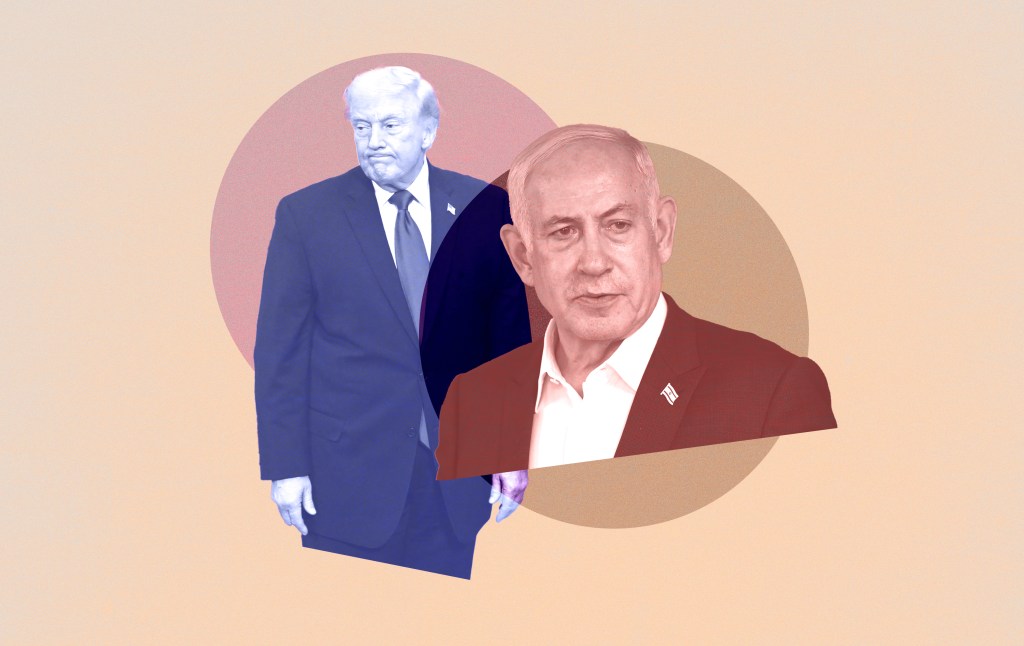
Israel first?
“We knew that there was going to be an Israeli action,” Rubio explained in remarks promoted by the White House. “We knew that that would precipitate an attack against American forces. And we knew that if we didn’t preemptively go after [Iran] before they launched those attacks, we would suffer higher casualties.”
House Speaker Mike Johnson echoed the point after being briefed on the war. “Israel was determined to act in their own defense here, with or without American support,” in order to counter an existential threat from Iran, he said. “If Israel fired upon Iran and took action against Iran to take out the missiles, then [Iran] would have immediately retaliated against U.S. personnel and assets.”
White House press secretary Karoline Leavitt also joined the chorus: “The United States understood that Israel was going to strike Iran, and when they did, Iran would attack the United States. President Trump was not going to sit back and watch the evil Iranian regime prepare to attack Americans. If he had, and Americans were killed, the media would be criticizing him for his carelessness and unwillingness to attack.”
The New York Times chimed in too with a long tick-tock of how the war came together. Israeli Prime Minister Benjamin Netanyahu “had been pushing Mr. Trump for months on the need to hit what he argued was a weakened regime,” the paper reported. Netanyahu was apparently alarmed by the White House’s last-ditch negotiations with Tehran to avert a conflict and “wanted to make sure that the new diplomatic effort did not undermine the plans” for a joint military campaign.
Buried deep in the story was this line about a meeting Trump had with “America First” demagogue and neo-Nazi-platformer Tucker Carlson: “The president said he understood the risks of an attack, but he conveyed to Mr. Carlson that he had no choice but to join a strike that Israel would launch.”
Even allowing for the likelihood that Carlson himself was the Times’ source for that detail and is mischaracterizing what Trump said to serve his own anti-Israel agenda, the White House is obviously engaged in a coordinated effort to treat the Jewish state as the motive force in the war—at least with respect to the timing and arguably more than that. After all, if there was any chance of talks between the U.S. and Iran bearing fruit and resolving this dispute peacefully (which one White House official now insists there wasn’t, of course) then Israel’s decision to attack triggered a conflict that might have been averted.
Right-wing postliberals are taking the news exactly as well as you might expect.
“So he’s flat out telling us that we’re in a war with Iran because Israel forced our hand,” Daily Wire blowhard Matt Walsh observed of Rubio’s comments. “This is basically the worst possible thing he could have said.” News anchor turned podcast chud Megyn Kelly complained that U.S. service members killed in the war haven’t died for their country but “for Iran or for Israel.” Carlson, eager to cut to the chase, bluntly described the conflict as “Israel’s war.”
It wasn’t just luminaries of the populist right who smelled blood, though. Numerous congressional Democrats also seized on Rubio’s comments to complain about Israel’s role in America’s newest conflict.
“Our foreign policy is not determined by what some other nation does. It should be determined by our own national interest,” Sen. Tim Kaine declared. Sen. Ruben Gallego condemned the current campaign by recalling Netanyahu’s enthusiasm for the invasion of Iraq, alleging that the Bush administration had also gone to war “on somebody else’s word.” Sen. Brian Schatz wondered why the prime minister of Israel was addressing Americans about the war on Sean Hannity’s show instead of the president of the United States.
Starkest of all was Sen. Mark Warner, who’s no Hamas-headband-wearing progressive. “There was no imminent threat to the United States by the Iranians,” he told reporters, apparently accurately. “There was a threat to Israel. If we equate a threat to Israel as the equivalent of an imminent threat to the United States then we are in uncharted territory.” In an interview afterward, he denounced “outsourcing our foreign policy decisions to another government.”
Given how predictable and poisonously antisemitic the public reaction to all of this is destined to be, why on earth did the White House emphasize the Jewish state’s role in starting the war?
Maybe not for the reason you think.
The pretext.
The lazy explanation for the buck-passing by Rubio et al. is that Team Trump fears the war will go sideways and is preparing to blame the eternal scapegoat when it does. I think that’s too easy.
The probable truth is closer to the opposite: Team Trump wanted to go to war but needed a way to make it appear that its unprovoked attack on Iran was actually a defensive response to an imminent threat. It needed an answer to the “Why now?” question.
So it contrived a pretext. Israel would undertake to bomb Iran—with full American support—and the U.S. would treat the near-certainty of Iranian retaliation against American regional assets for that bombing as an excuse to join in the initial bombing.
Don’t take my word for it: Those in the know all but admitted it to Politico in a piece published 48 hours before the war began. “There’s thinking in and around the administration that the politics are a lot better if the Israelis go first and alone and the Iranians retaliate against us, and give us more reason to take action,” one person told the publication, anticipating Rubio’s remarks about Israel’s role in the initial attack almost precisely. The only difference is that, in the end, the U.S. didn’t wait for Iran to throw a punch at us; we treated it as a foregone conclusion that they would do so after Israel’s opening strike and chose to join that strike instead.
We preempted an enemy attack responding to an attack that we not only helped orchestrate and supplied intelligence for but actively participated in. Classic self-defense.
Needless to say, actively partnering with Israel to manufacture an imminent threat to the United States is not a case of Israel “dragging us to war” without our consent. The question is why the White House would suggest otherwise. Do Trump and his people not realize that nearly every major faction in U.S. politics right now has an incentive to fault Israel for this already decidedly unpopular adventure?
Progressives sure do. They despise the Jewish state as a far-right outpost of Western “settler-colonialism” war-criming its way across the Middle East to establish hegemony over the Muslim natives.
Liberals like Warner also have a straightforward reason to blame Israel: Namely, they read polls. In the aftermath of the war in Gaza, Democrats now sympathize more with Palestinians than with Israelis by a margin of 65-17 according to Gallup, a reversal of 53 net points since 2021. There’s been a similar, if smaller, earthquake in independent opinion, from a 30-point sympathy advantage for Israelis five years ago to an 11-point advantage for Palestinians now.
For their own electoral safety, Washington Democrats needed a way to get in sync with their base on Israel. Now, thanks to Rubio, Johnson, and Leavitt, they have one.
The postliberal right also has abundant reasons to blame Netanyahu for the war. A movement of conspiratorial nationalist authoritarians is a natural enemy for a Jewish-majority liberal democracy, even if certain American Jews who found something to like in the modern right’s anti-Enlightenment turn were too dim to realize it. And figures like Tucker who dream of making the world safe for fascism by ending America’s hostility to regimes like Iran’s are destined to resent Israel for throwing a wrench into their plans.
As for MAGA cultists whose politics consist of nothing more than “whatever Trump wants,” they’ll also pivot to blaming Israel in case his war goes south. While I’m confident in their zombified willingness to go on defending him no matter how bad this gets, they might eventually feel the need to shift responsibility for a fiasco away from their deity. Israel’s role in starting the war will come in handy.
All told, “Israel got us into this” is not a crowdpleaser for most of America anymore. But it might be for mainstream Republicans.
That’s the group that the president needs to worry about, as that’s the group that will determine whether the bottom drops out of support for the conflict. As long as the mass of GOP opinion is with him—MAGA, of course, but also evangelicals, Reaganites, Jacksonians, and other remnants of the un-Tucker-fied right—he can expect approval for the conflict to hold at no lower than a non-disastrous 40 percent. It’s enough for him politically that “his people” stick with him even if no one else does.
Knowing that Israel was gung ho for this war might plausibly make “his people” more likely to stick. Whether due to religious faith, political kinship over Western liberalism or the war on terror, or admiration for Israelis’ strength and ingenuity in dominating their enemies, most right-wingers still carry a torch for the Jewish state. (To answer Sen. Schatz’s question, that’s why Fox News invited Netanyahu on to make the case for war.) The same Gallup poll I mentioned above showing sympathy for Israel collapsing among Democrats and independents found that Republicans still sympathize with Israelis more than with Palestinians at a 70-13 clip, little changed from 2021.
Tucker Carlson and Mike Huckabee are each extreme in their views on Israel but there’s no question that, of the two, Huckabee’s opinion is closer to the average GOPer’s.
So when Marco Rubio and Mike Johnson and Karoline Leavitt answer the “Why now?” question by pointing to the Israelis, I don’t get the sense that they’re angling to scapegoat Jews for the war. My hunch is that they’re trying to firm up Republican support for it by relying on the almost talismanic sense of justness that Israel’s cause inspires among most of the right.
Considering how thick the information bubble is in which the president and his deputies operate, it would not surprise me to learn that they’re unaware Israel doesn’t have the same talismanic appeal anymore to most of the rest of the country.
Now or never.
But there’s a chance I’m wrong about all of this.
I can imagine Netanyahu informing Trump that Israel intended to attack Iran whether the White House approved or not, as Mike Johnson alleged, essentially presenting his patron with an ultimatum to join the war from the start or be dragged into it later by Iran. And yes, I’m aware that the president successfully vetoed an Israeli strike on Iran at least once before. I’m not convinced that Israel would have taken no for an answer this time as easily as it did on that occasion.
That’s because there’s a “Why now?” calculus for the prime minister and his government in all of this too.
The close alliance between his country and ours is doomed, in case the polling didn’t already make that clear. The Israelis know it too, which is why Netanyahu has begun to make noise about ending U.S. military aid to Israel. (Well, that, plus the fact that the uber-hawks in his coalition are tired of the White House wielding the sort of veto I just mentioned.) If Tel Aviv wants to maintain some sort of partnership with Washington, it will need to deprive its American critics of some of their arguments against it. Ending aid is a big one.
Relatedly, it’s unthinkable that the president who follows Trump into office will approve a massive air campaign against Iran like the one that’s playing out now. No Democrat would dare do it in light of the left’s mushrooming antipathy to Israel, and J.D. Vance would be held back by his own postliberalism and his need to atone to his chud base for his role in supporting the current war.
If the Jewish state wanted American help in striking a death blow at an Islamist regime that’s tormented it for ages, it was now or never.
So Netanyahu chose now. I don’t believe he gave Trump an ultimatum—and the president, always desperate to seem in command, doesn’t want you to believe it either—but I can certainly believe that he would have ignored a White House veto this time and attacked anyway, knowing that Iranian reprisals would have sucked America into the war anyway. This is the last presidency in which Israel will feel reasonably confident in expecting significant American military support in a conflict. And this moment might have been the last opportunity for Netanyahu, who’s forever in political peril, to fulfill his dream of neutralizing Iran before heading off into retirement (or prison).
The geopolitical stars seem to have aligned, too. The eternal risk that attacking Iran might cause Iranians to rally behind the regime was negligible after January’s massacre. Drawing U.S. military attention away from the Far East and Europe was also low-risk, as China is preoccupied with purging its military leaders and Russia is preoccupied with feeding its male population into a Ukrainian woodchipper. And of course there was zero risk of the U.S. Congress stepping in to short-circuit any Trump-Netanyahu war plans because the U.S. Congress doesn’t exist anymore.
Now or never: For Israel and the United States, imminence had nothing to do with it.