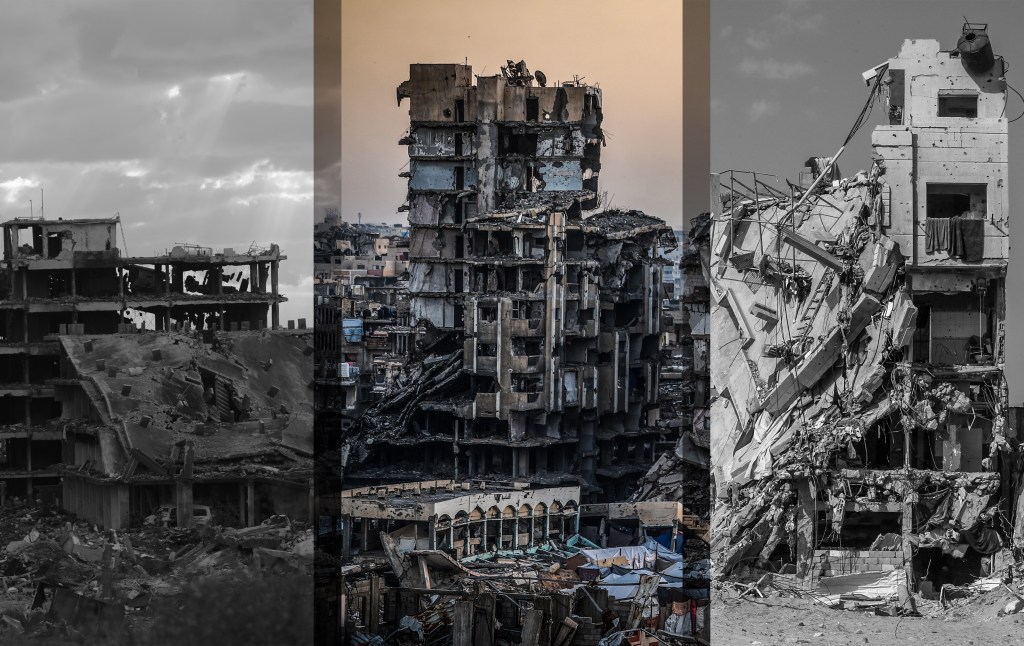
Hamas and Israel are five months into an unstable ceasefire that has been in effect since last October. Hostilities have largely ceased following a devastating war triggered by Hamas’ deadly terrorist attack on Israel on October 7, 2023, but the Gaza Strip remains under occasional Israeli fire.
I wanted to understand how people in Gaza are living now, so I spoke to Kareem Jouda, a 29-year-old Palestinian aid worker from Gaza who has built a following on X. Like me, Jouda is a Palestinian opposed to Hamas and Islamist ideology. But unlike me, he has lived his whole life in Gaza. He witnessed the armed takeover of Gaza by Hamas in 2007—and its militarization over the following years—as well as the destruction of the recent war.
When I asked him what a normal day for him is like at the moment, he answered: “When you don’t have a home, there can be no normal or ordinary day.”
Before the war, he worked in finance and lived with his family in what he calls a “beautiful house” in northern Gaza. Early in the conflict, his family’s house was destroyed. Now his family is living in a tent after evacuating south during the course of the war.
I find what he tells me difficult to process. Images flash in my mind’s eye of my own childhood home, a Victorian brick terraced house in England. I imagine it being destroyed in a war, perhaps hit by a rocket or an artillery shell.
I ask him if there has been rebuilding in Gaza since the start of the ceasefire. “There is no rebuilding—no signs of it at all,” he replies. “We are still living in a tent, and it seems this situation will last much longer.”
When Hamas launched its attack on Southern Israel, killing more than 1,200 people and taking 254 to Gaza as hostages, Jouda viewed it as “something extremely horrific” and realized what the implications for Gaza would be. “I smelled the scent of a fierce war coming here,” he said. He recalls Hamas-affiliated mosques chanting celebratory Islamic slogans. But he himself was deeply concerned for the future and the risk of Israeli retaliation, feeling as if the Hamas government was endangering the people of Gaza for its ideological goals. “That day I wrote on Facebook: ‘Will you sacrifice us?’”
Soon, he says, “the war began, and the bombing started. The first two weeks of the war were indescribably frightening, which forced us to flee to the southern part of the Strip.”
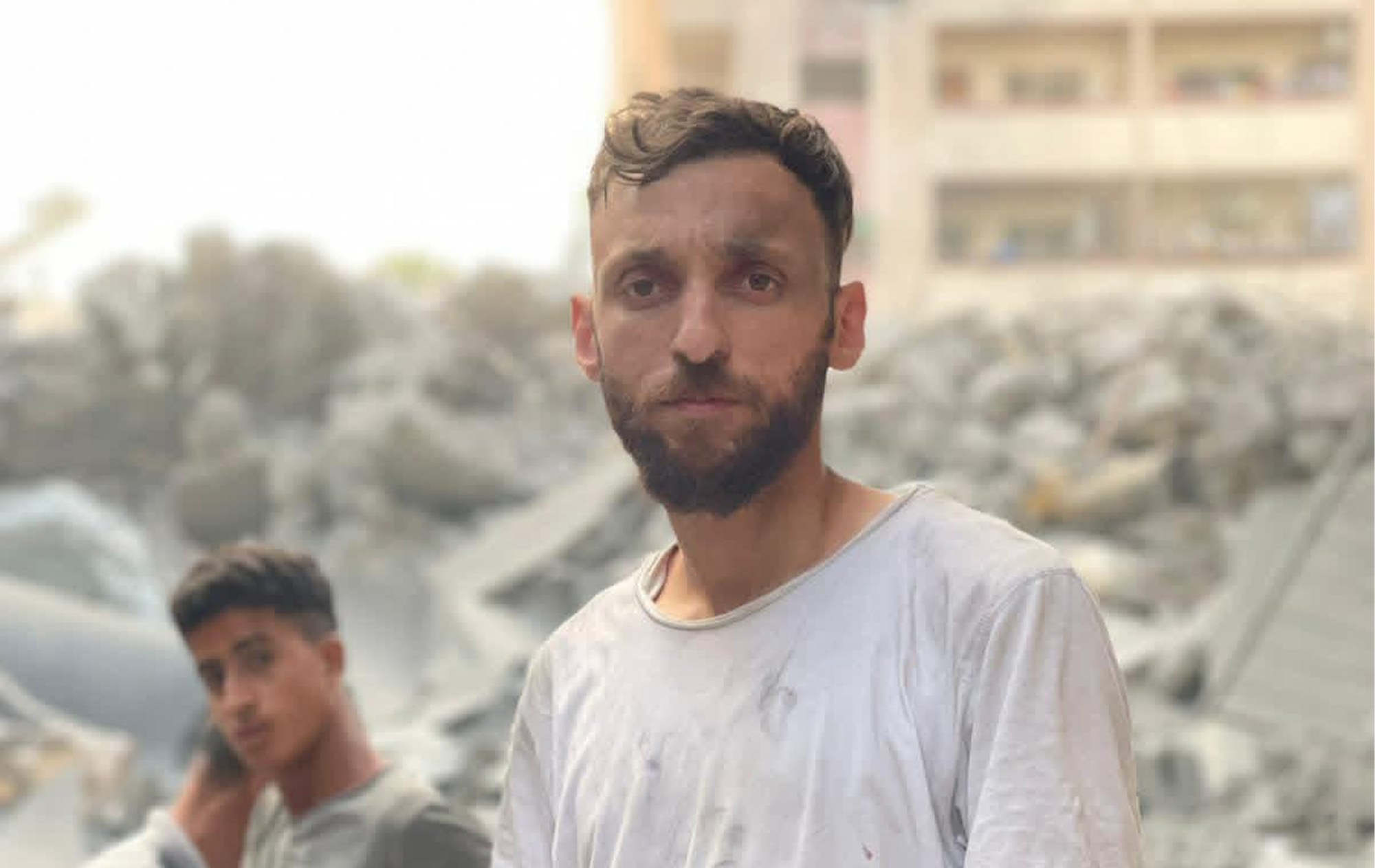
In recent months, Jouda has been working with World Central Kitchen, a humanitarian organization founded by Spanish American chef José Andrés. World Central Kitchen began running food operations in Gaza during the war, trying to feed a hungry and mostly jobless and homeless population at a time when conditions on the ground made it dangerous for many aid groups to operate and delivery of international food aid was frequently interrupted. Jouda describes the work with pride.
“They are wonderful,” Jouda said. “They have several kitchens across the Gaza Strip. They carefully prepare hot meals and distribute them to the most vulnerable people.” His role is in “the kitchen section.” He tells me that his favorite meals to prepare are pasta with vegetables and rice with chicken.
I ask him what people misunderstand about Gazans. “The biggest misunderstanding is thinking that Gazans are all the same, or that they can be put into one mold to serve a certain narrative,” he says. “Gazans are human beings who deserve life.”
He describes civilians as having been “held hostage for a long time by Hamas and … prevented from speaking freely.” As a result, many people censor themselves to avoid trouble.
This illustrates why we in the West need to be cautious of jumping to conclusions when we see polling that shows high or rising levels of Palestinian support for Hamas or other authoritarian jihadist groups. In the months following the October 7 attack, pollsters such as PCPSR released polls showing widespread Palestinian support for Hamas. Some polls in recent months have shown the same thing.
But such polling obscures the fact that Gazans who oppose Hamas and their ideology have to be very cautious about what they say and to whom they speak. Someone claiming to be a political pollster might not be a political pollster but a Hamas agent. Hamas has a long history of surveilling Palestinians and bludgeoning their critics into submission.
Jouda was taking a risk to speak to me openly, under his real name. But he has chosen to speak out because of his fervent desire for change in the situation for people in Gaza. I ask him how his views about Hamas developed.
Jouda dates his opposition to Hamas to an experience he witnessed as a teenager. While Hamas’ attacks against Israelis are widely publicized and discussed, the group’s brutality and violence against Palestinians get far less coverage by international media.“During Hamas’s coup against the Palestinian Authority in 2007, the streets were full of masked Hamas members, practicing killing mercilessly in those days,” he said. From his window, he watched masked men “taking young men and then shooting them in the feet. This incident was a turning point in my life.” He was just 13 years old at the time.
“I, and many people here, demand that Hamas hand over its weapons and leave our lives forever.”
Kareem Jouda
Jouda also describes what he sees as political pressure within Gaza’s public life, including education. He says he went “through all levels of education in Gaza” and graduated from Gaza’s Al-Azhar University. “Hamas used public schools to spread its ideas among students and banned any other ideas that did not align with theirs,” he says. “In universities, it’s a bit different—they do this in the universities they control, like the Islamic University of Gaza.”
I ask Jouda what he misses about his life before the war. “I miss many things,” he said. “But most of all the personal things I loved and used to do. I loved going to the cinema and playing football.” He tells me he is an FC Barcelona fan, and his favorite movies were the Harry Potter series and the Marvel Cinematic Universe.
As for the current ceasefire and the White House’s newly announced Board of Peace, Jouda cites the need for outside actors with enough power to enforce an agreement. He is skeptical of ceasefires “without guarantees.” Although the nations making up the Board of Peace pledged some $7 billion to help rebuild Gaza, that amount is far short of what will be needed, and no timeline has been set for international troops to police the Strip.
“I believe we need a board that includes strong and influential countries to enforce peace here by force,” he said. “The ceasefire is not good because it comes without guarantees, and many breaches happen here and there. No one’s life—or even food—is guaranteed … Gaza now urgently and immediately needs rescue.”
Jouda’s preference for what should replace armed factional rule is clear: “I would like to see a professional secular government that enforces civil law, bans weapons, and takes them from all factions,” he said. “We are looking forward to this greatly.”
And when asked directly about disarmament, he doesn’t hedge. “I, and many people here, demand that Hamas hand over its weapons and leave our lives forever,” he said. “This is what I and my friends always write about.”
With the United States and Israel launching a new war in the Middle East, I asked Jouda about his views on Iran, whose government has funded the Hamas government since 2007. He opposes the Iranian government, calling it “evil,” and believes that the government in Iran has “burdened [the Arab world] with internal conflicts in Syria, Lebanon, Iraq, Gaza, and Yemen. They have supported militias against official governments, which has made life much harder in these countries because of what Iran is doing.” Now Gazans are again facing shortages of fuel and food following the closure of the Strip’s border crossings.
Jouda’s final plea is simple. “The problem now is first and foremost humanitarian,” he said. “Gaza needs help now more than ever. I don’t want Gaza to be forgotten under the rubble.”
In a media environment that often rewards the loudest ideologues with the most attention, Jouda is asking for something simpler. “Gaza has an amazing people,” he says, “with a young generation that is highly educated … but unfortunately, no one wants this voice to be heard.”
If there is to be a better future for Gazans, it starts with people like Jouda—those with the honesty and the courage to speak of a better future, free from the rule of authoritarian extremist groups like Hamas that led Palestinians into the abyss.
In that sense, Jouda and other Palestinians who share his views have a lot in common with many of the Iranians living under the Islamic Republic. Outsiders often misunderstand a captive society, viewing it as if it’s the same as the men who rule it. But many decent Iranians spent years pleading not to be equated with Khamenei’s state and demanding freedom, even as the regime cracked down on their dissent.
Separating people from the regime that claims to represent them has become unfashionable in a lot of contemporary discourse. Jouda’s testimony is inconvenient for many precisely because it introduces a category many activists and pundits would rather not deal with: Palestinians who oppose Hamas and want a secular civil order, even while living through war and displacement.
In the West, the Gaza conversation has become an identity performance. For some activists, acknowledging Palestinian opposition to Hamas spoils the clean story that “resistance” is automatically righteous. On the other hand, for some pro-Israel hardliners, acknowledging Palestinian opposition to Hamas spoils the story that Gaza as a whole is united behind Hamas. Jouda doesn’t fit either script. He’s a Palestinian who wants Hamas gone and wants his people to live—two truths that should be easy to hold together, and yet for many are not.