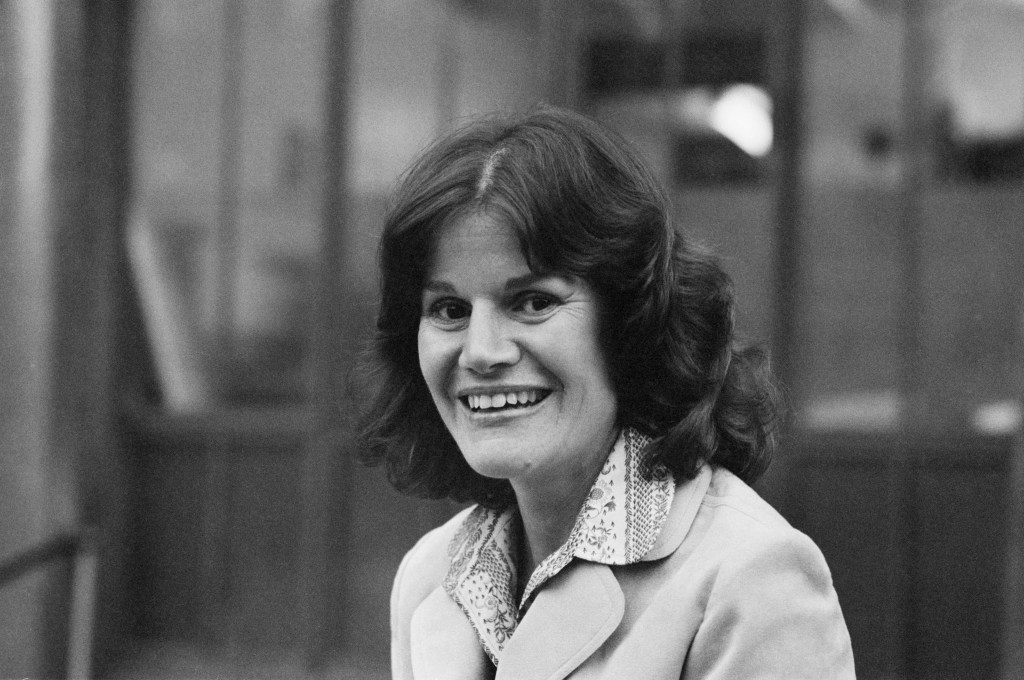
Editor’s Note: This essay is adapted from Judy Blume: A Life (G.P. Putnam’s Sons, 2026), by Mark Oppenheimer.
Like all children, Judith Marcia Sussman, born in 1938, dreamed of what she would be when she grew up. Judy knew that she would be a wife and a mother. If she decided to get a job, maybe she would be a movie star, like her beloved Esther Williams, the swimming starlet, who always emerged from her underwater acrobatics with her hair and lipstick intact, a broad, toothy smile on her face. If Hollywood never called, Judy could be a teacher, which was a job that women could do. And maybe, she thought, she could be a librarian. Because the library was where the books were.
There were books in Judy’s house, too, lots of them. But they were almost entirely books for grown-ups. Judy’s father, Rudy—only his wife called him Rudolph—a prosperous dentist, liked to unwind after a day of cavities and crowns by sitting in his easy chair, smoking one of his Camels—he went through three packs a day, on his way to a coronary and an early grave—and reading a mystery. It was the golden age of American mystery fiction, and Rudy could choose from Dashiell Hammett’s noir novels, such as The Maltese Falcon (1930) and The Thin Man (1934), or Erle Stanley Gardner’s courtroom dramas, featuring the tenacious defense attorney Perry Mason, who made his debut in 1933’s The Case of the Velvet Claws. The year that Judy turned 1, mystery lovers like her dad were reading Raymond Chandler’s The Big Sleep, the classic that introduced detective Philip Marlowe.
Rudy’s wife, Essie, was a full-time homemaker with no college education, but she read more than her husband, and more widely. Her principal love was historical fiction, but she could also have talked knowledgeably about John Steinbeck, Ernest Hemingway, and many other authors.
Judy saw her parents’ books, and she wished she could read them, or just touch them. One of her earliest memories was of looking up at books, out of reach.
“At our house, we have books on both sides of the fireplace, and also on the shelves of the breakfront,” she thought to herself, according to a memoir she started writing, then abandoned, in her 80s. “‘Breakfront’ is a funny word for a piece of furniture,” she remembered thinking. (It is a funny word: A breakfront is a glass-fronted hutch, with a protruding center section; it typically holds china or books and was the perfect piece for an aspirational, middle-class home.) “I can’t reach the books,” she thought. “But I can play on the floor in front of the books. None of them have pictures.”
For books with pictures, one had to go on an adventure.
“So, I’m about four years old, and my mother takes me to the public library in Elizabeth, New Jersey,” she wrote in her fragment of a memoir. “The children’s room is upstairs—up an outside stairway of about a million steps—but once I make it up—oh, it’s heaven. All those books! I sit on the floor and pull [books] off the shelves, sniff the books. I love the way they smell, like my schmatta, which must be a Yiddish word for blanky.”
In the library, her mother checked out Madeline, and they read it so many times that Judy had it memorized. It was the first book she fully digested, the one that made literature feel as essential as food. “In an old house, the smallest one is Madeline. That’s me, the smallest one, always.” Judy was the smallest child in the house—brother David was four years older—and she was scrawny, chronically underweight. “But unlike Madeline, who isn’t afraid of anything, including the tiger at the zoo, I’m afraid of everything. Which is why I need my schmatta at night. But in my four-year-old fantasies, I am Madeline.”
Judy decided to keep Madeline. “I hide Madeline in the drawer, way in the back, toys covering it. My mother can’t find it. I’m sure if she knew, she’d have bought me my own copy—but I can’t risk losing this book.”
Nobody remembered what became of that copy of Madeline, but if it was lost forever, the library surely forgave the Sussmans. Judy learned to read in first grade, and she and her mother took regular trips to the library to replenish her stock. As Judy got older, she began to ask for, and receive, books as presents. After leaving picture books behind, she discovered L. Frank Baum’s Oz books (she owned the whole set), then the Nancy Drew mysteries, attributed to “Carolyn Keene” but written by a syndicate of ghostwriters, many of them women and all of them underpaid. Like so many girls of her age, she fell headlong for the Betsy-Tacy series, semi-autobiographical novels by Maud Hart Lovelace about a Minnesota girl growing up at the turn of the century. In 1991, declining an invitation to a centennial birthday celebration at the Maud Hart Lovelace house in Mankato, Minnesota, Judy wrote, “Happy Birthday, Maud Hart Lovelace! I wish I could be there to help celebrate your centennial. When I was ten years old, my mother bought me two of your books. She promised if I read and enjoyed them she would order the rest of the set. Oh, I did!! (and she kept her promise). I wish I still had my original copies, but at least I have a boxed set, proudly displayed on my bookshelves, to remind me of all the enjoyment your books about Betsy, Tacy, and Tib brought.”
And then she added, “When I was young, I never thought of becoming a writer, like you. But I’m sure your books were always there—right from the start—inspiring me.”
It’s surprising: Judy Blume—whose books for children, young adults, and adults have sold tens of millions of copies, in dozens of countries; who gave us Are You There God? It’s Me, Margaret and Tales of a Fourth Grade Nothing and Tiger Eyes and Superfudge; who rewired the English-speaking world’s expectations of what literature for young people could be (frank, candid, earthy); and who as an adult became something of a graphomaniac, not just a prolific novelist but an avid letter-writer and, later, emailer—as a child “never thought of becoming a writer.”
Blume would not begin to nurture that ambition until she was nearly 30 years old, an unhappily married stay-at-home mother of two young children. She might have sought therapy. But in New Jersey, in the mid-1960s, that was a scary prospect. Poolside at Shackamaxon Country Club, sitting with the other suburban Jewish housewives, one did not discuss such things. “Today I would have sought therapy when my father died and during my early marriage,” Judy said in 2024. “But that was not an option for me or any of my friends. Three of them wound up in the hospital with ‘breakdowns’ after they had children.” Judy’s husband, John, a well-meaning personal injury lawyer whom she had married too young, thought she should take up golf.
Instead, Blume began to take the bus to New York City every Monday night, leaving John to feed and bathe the children, so she could attend an evening class in writing for children. She wasn’t sure where this ambition came from. She had tried other creative outlets, like drawing and felt art and songwriting, but this was something new. She had always loved reading, and she’d made up stories inside her head—but writing? This was new.
What is it about Judy and her work that won her so many millions of fans? There is no obvious explanation.
To begin, there’s the talent. It’s unevenly distributed, of course; not all the books are great. I’d point to Are You There God? It’s Me, Margaret and the Fudge books as exceptionally good in two ways: They have memorable characters, and they are very funny. Page for page, Margaret has fewer laughs than, say, Tales of a Fourth Grade Nothing, but who doesn’t remember “I must increase my bust”?
Even a lesser book like Forever… was injected with Judy’s absurdist humor. Katherine and Michael are not memorable characters, but the penis named Ralph? He (it?) definitely is. I doubt very much that Utah would be banning Forever… today if not for Ralph. Sex is easy, but humor is hard.
Judy also helped establish a new genre—realism for young people—at a time when young readers had more autonomy, when cheap paperbacks in mall stores made books more available to them, and when progressive librarians were keen to stock books for them. Having helped pioneer the genre, Judy was very prolific, and very public. The breakout success of Margaret notwithstanding, it was the run of books that followed, more than one a year for the next decade, that made reading Judy, for teenagers in the 1970s, not just a rite of passage but a habit. She was shooting arrows to their hearts, again and again.
Other realists (or “problem novelists,” to use the unfortunate term), like Paul Zindel and Norma Klein, wrote as much, but they did not become celebrities. They toured less; their books did not sell as well. After Margaret, Judy was in demand to talk about each subsequent book, and she never disappointed: pretty, witty, and, as Pat Buchanan learned, cutting when necessary, she was a winning guest in person, onstage, and on television. The Outsiders was as great as anything Judy ever wrote, but nobody knows what S.E. Hinton looks like. Hinton wrote four classics by her early 30s, but she hated doing interviews; most of her fans never learned her first name (Susan) or even knew her sex. Also, she published very few books for the rest of her life.
Being a famous author is work, and Judy—who still gives speeches, accepts prizes, mentors younger writers, helps run a bookstore—never stopped doing the work. She can’t stop. Her written responses to my questions probably run to over a hundred pages, making me wonder why she didn’t just write an autobiography. If she had, the audience would still be there. After all, as the writer Tayari Jones said to me, “You never love a book the way you love a book as a child, the way you’ll never love a boyfriend the way you love one at 13. After a certain age, you don’t have it in you. She taught us to love to read.”
From JUDY BLUME: A Life by Mark Oppenheimer, to be published on March 10, 2026, by Putnam, an imprint of Penguin Publishing Group, a division of Penguin Random House LLC. Copyright 2026 by Mark Oppenheimer.