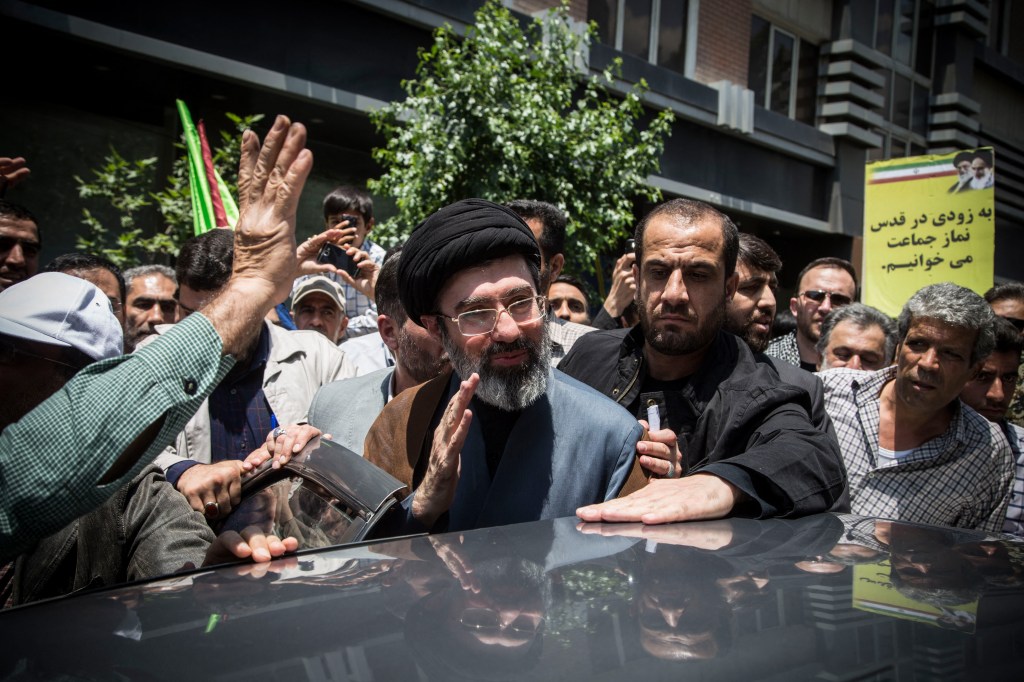
There is a long-running debate in soccer: Should you change a winning lineup? On the one hand, the players have already proven their skill, but on the other hand, opponents may have learned the team’s tactics and adjusted accordingly. But the Islamic Republic of Iran is perhaps the only place that continues to send a losing lineup back to the pitch. Case in point: After the death of Supreme Leader Ali Khamenei, who fundamentally transformed the country for the worse, the regime has elevated his son to stay the course.
Mojtaba Khamenei has always been in the shadows. There is only one video of him in which viewers can hear his voice, and very few confirmed details about his private life. He is the 56-year-old second son of Ali Khamenei, and he briefly taught at the politically powerful Qom seminary. His wife Zahra, the daughter of regime insider Gholam-Ali Haddad-Adel, died in the Israeli strike on his father’s compound.
Understanding the younger Khamenei requires understanding the regime powers that elevated him—in theory, the clerics at the Assembly of Experts, but in practice, the security forces. The context of his elevation gives him a weak footing, which may grow even weaker once the war is over. But this possibility presumes that he will survive the war; it is the fear that he will not that has kept him in hiding since the conflict’s start, not appearing in public to celebrate his enthronement.
In the Islamic Republic, it falls upon the Assembly of Experts, a clerical body, to “discover” the righteous deputy of the Mahdi, the messiah, to be the country’s leader. The leader ought to be a grand ayatollah, the highest rank in the Shiite clerical hierarchy. This way, the body’s members ensure that the clerical class’s interests remain a regime priority. But this process failed to meet that objective in its first test in appointing Ruhollah Khomeini’s successor. The late supreme leader’s son, Ahmad, and powerful revolutionary cleric Akbar Hashemi Rafsanjani conspired to elevate Ali Khamenei in 1989, largely so that they could run the regime in the background. The assembly went along. But Ali Khamenei got the better of them. He sidelined his rivals—both the younger Khomeini and Hashemi Rafsanjani died under mysterious circumstances—and the clergy and elevated the armed forces, filling their ranks with loyalists. Under his leadership, the clerical regime began transforming into a military dictatorship. Three key factors drove this transformation.
First, Ali Khamenei was not an astute religious scholar but a political activist cleric. In the 1970s, he was one of the founders of the Combatant Clergy Association, a revolutionary organization that did not uphold traditional Shiite scholarship, which overwhelmingly rejected the Islamic Revolution’s doctrine of rule by the clergy. The elder Khamenei’s rule was also shaped by his virulently anti-American and anti-Jewish worldview. One of his influences was Seyed Jamaladdin Assad-Abadi, a 19th-century Shiite cleric—and suspected atheist—who believed in overthrowing Iran’s monarchy and embracing modern tools to elevate Islamic civilization as a rival to modern Europe. For him, Islam was a civilizational vessel, not an end in itself. As historian Abbas Milani has observed, Ali Khamenei’s major scholarly work was the translation of four of Sayyid Qutb’s books—all of which focused on Jews and Israel. When he was Iran’s president in the 1980s, a foreign reporter asked him about the nation’s greatest enemy. Without hesitation and with great charisma, Ali Khamenei responded, “America.” There is no reason to believe that Ali Khamenei had as low a view of Islam as Assad-Abadi, but he treated the mosque somewhat similarly, using it as a tool to promote his preferred foreign policy.
Second, the end of the Iran-Iraq War in 1988 triggered the “construction era,” forcing Iran to have an inward economic outlook. At the same time, the war left the country with large armed forces who had become an important constituency within the regime during the eight-year conflict. The Islamic Revolutionary Guard Corps (IRGC) thus became an economic player. Months into Khamenei’s rule in 1989, the guards created the Khatam al-Anbiya Construction Headquarters. The IRGC’s powerful engineering arm became an important player in the postwar reconstruction and a cash cow for the security forces. The force’s wealth and power grew together.
Third, the increasingly secular Iranian people grew resistant to the regime’s Islamic orthodoxy. To maintain legitimacy among its supporters, and blessed with Khamenei’s vision, the regime adopted much harsher anti-American and anti-Zionist rhetoric. A geopolitical event provided an opening: In 2003, the United States entered Iraq and removed Saddam Hussein, which allowed Iran to play a more activist role in foreign policy, fueled by oil money and a power vacuum in Iraq. Iran was becoming Khamenei’s regime.
In 2005, 16 years into Khamenei’s rule, IRGC veteran and favorite Mahmoud Ahmadinejad became the first non-clerical president of the Islamic Republic since 1981, defeating Rafsanjani, who was competing for his old job. Although Ahmadinejad would later fall out of favor with the Khameneis, his victory symbolized the regime’s transformation to military dictatorship. The old guard gave one last push for power in 2009, but the regime’s establishment fraudulently declared Ahmadinejad as the winner. Meanwhile, Mojtaba Khamenei’s star within the regime began to rise at the age of 39.
The first initiative of the younger Khamenei was the regime’s crackdown on the 2009 Green Movement, which emerged in response to the fraudulent presidential election. The regime ignored the protesters’ demands for a recount, which fueled challenges to Ali Khamenei’s legitimacy. Mojtaba Khamenei was resentful of the security forces’ soft touch and the growing radicalism of the protests. It is unclear whether he volunteered for or was tasked with crushing the movement, but his willingness to deploy brutal force against the demonstrators quickly became clear.
Around this time, people began suspecting that the younger Khamenei had ambitions to succeed his father. But 16 years later, his candidacy would face several obstacles. First, the Islamic Republic had toppled the Pahlavis, partly in objection to the dynasty’s hereditary character. Second, he lacked the necessary religious credentials. This he had in common with his father, who—unlike Mojtaba—was able to forge credentials in a time before the internet. Before Mojtaba Khamenei’s appointment on Sunday, the younger supreme leader was referred to in press reports as Hujjat al-Islam, two ranks junior to the title the regime suddenly used to announce his selection (ayatollah) and three ranks below the required one (grand ayatollah). He had more than a decade to forge his rank; that he never bothered suggests that the mosque has given way to the guns.
Reading between the lines, one could see that the Assembly of Experts is uneasy about its decision. On March 3, opposition news outlet Iran International reported that the clerics had selected Khamenei as the new supreme leader with an important caveat: under pressure from the security forces, with whom he had aligned himself.
The assembly took five days to officially announce the new supreme leader. On March 7, Khamenei’s backers within the Assembly of Experts began a public pressure campaign. Ahmad Alamolhoda, the wealthy and powerful custodian of the shrine of Rida in Mashhad and a member of the assembly, commented, “The supreme leader has been chosen, and the [Assembly of] Experts do not have the legal rights to change the supreme leader.” Another member assured that “the Khamenei name will carry on.”
After the Assembly of Experts announced the new supreme leader, the regime propaganda began boosting his warrior credentials, including (likely exaggerated) accounts of his military service. In one picture, he is shown kissing a rifle; in another, he is embracing slain Gen. Qassem Suleimani. But assuming that Khamenei survives the war, his opponents have reasons and tools to defy him. Iran’s clerical elite are likely to challenge his religious credentials—and last name—amid their own declining influence over both the society and state. And nobody knows how powerful the Praetorian Guard will be once the war is over.
So far, the clergy has been mute in its congratulations. The regime is trying to make it appear that messages are pouring in to legitimize Khamenei, but most come from political actors and the armed services, not the clergy. These dynamics have raised the prospect of a clerical revolt against the new supreme leader’s reign, a possibility that would force the clergy to decide whether to conspire against him from within the system or join forces with the revolutionaries. Indeed, even prior to the most recent wave of domestic upheaval in Iran, Ayatollah Javad Alavi Boroujerdi cautioned the clergy against confrontations with the Iranian protesters amid legitimate economic demands. Elsewhere, he said, “They see all these shortcomings, all these difficulties, stemming from this turban and religion.”
If Boroujerdi worries that the mosque is losing its influence over the society, there is a second camp that fears the loss of influence over the state. Ayatollah Alireza Arafi, the head of the seminaries and a favorite of Ali Khamenei, complained in 2023 that, whenever the seminaries decide on an initiative, they are told by the security forces that the matter is “the business of another organization.” Arafi frequently locked horns with the security establishment that backed Khamenei in the past. The new supreme leader will also have to keep the pro-regime clergy lusting after its old status at bay.
The Khamenei-to-Khamenei succession is both illustrative of the regime’s transformation and a challenge to it. It signifies that Iran is now a military dictatorship and a security state fighting a civilizational conflict, not a theocracy. If the clergy allows Khamenei to solidify his position uninterrupted, it might never have another chance to restore its power and influence. The question is, when the next protests erupt, will it side with the regime or the people?