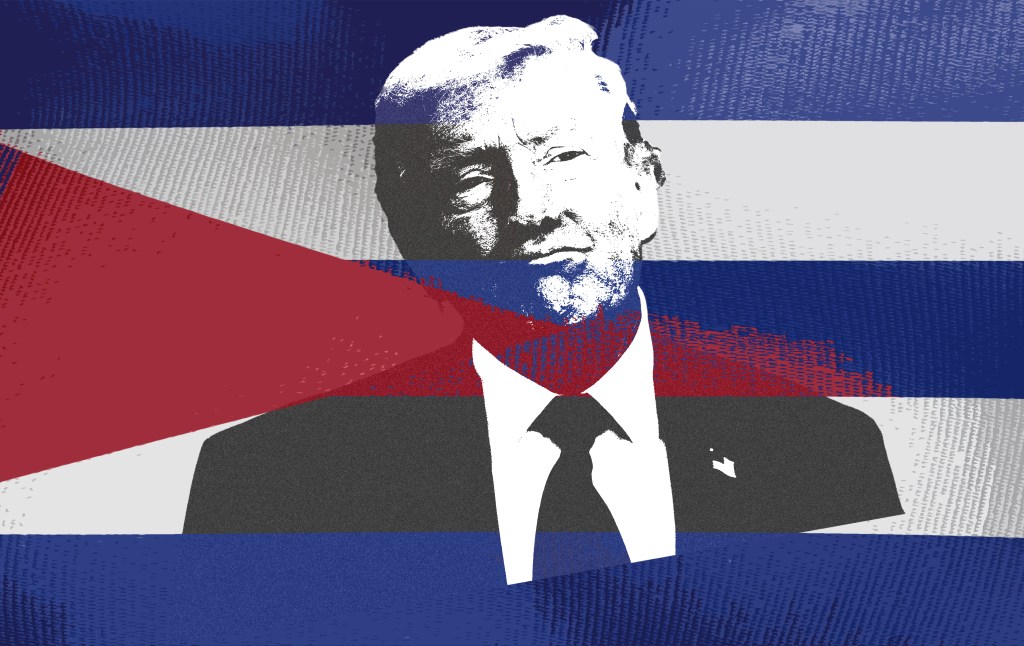
A ripe target.
Well, for starters, the regime there really is at the end of the line.
It’s been near the end for 67 years thanks to the economic miracle of communism and a deathless U.S. embargo enforced by presidents from both parties, but Trump’s Venezuela excursion has at last pushed it to the brink. Without cut-rate crude flowing in from the now Maduro-less government in Caracas, Cuba’s economy is in total collapse.
There are reports of locals picking through trash to find food, losing running water in their homes, and doing chores in the middle of the night because that’s the only time of day when electricity is available to power appliances. This week a CNN reporter based in Havana told of Cubans complaining to him that “we have returned to the Stone Age” and that they can’t feed their families. “Let the Americans come, let Trump come, it’s time to get this over with,” one whispered.
Forcing Venezuela to turn off the oil tap to Cuba was a brutal hardball gambit by the White House, but it achieved its intended purpose, forcing Raul Castro’s grandson and caretaker into private talks with Rubio about the future of the regime. That’s one answer to the “why now?” question: Cuba is “next” because it’s a hostile power in America’s backyard that’s never been more vulnerable than it is at this moment, especially with its friends in Moscow otherwise preoccupied.
As for “why Cuba?”, Trump himself supplied the rationale at a public appearance yesterday. “No other president can do some of this sh-t I’m doing,” he boasted to the crowd.
It’s very important to him, I think, to be remembered as a president who did sh-t no other president could do, from small-ball stuff like smearing his brand all over the Kennedy Center to world-changing matters like helping Israel assassinate the supreme leader of Iran. The common thread in his turn towards militarism this year is settling Republican foreign-policy grudges that his predecessors never forcefully addressed.
For years Venezuela’s Chavista regime agitated against the United States, irritating the American right. Now its heir is sitting in a U.S. jail and his successor takes orders from Washington. For years Iran’s revolutionary regime waged proxy wars on America and Israel and stockpiled enriched uranium intended for nuclear bombs, causing American hawks to warn of an apocalypse if nothing were done. Now its uranium is buried under rubble, and its leadership is dead.
The next, all-but-inevitable score to settle is with the communists of Cuba, who’ve outlasted every U.S. president from Eisenhower to the present day. They’re in Trump’s crosshairs not because he holds some strong ideological objection to central economic planning—to the contrary—but because he’s bent on succeeding where those who held his office before him failed. He’s going to harpoon the great white whale that eluded other American captains of state and impose regional U.S. hegemony at last on the most unlikely and infamous holdout of the post-war era.
No wonder crazed hawk Sen. Lindsey Graham sounds like he’s in the throes of religious ecstasy during his Fox News appearances lately.
Sphere of influence.
There’s one more answer to the “why Cuba?” and “why now?” questions, though. If Trump ends up humiliated in Iran, forced to cut the war short to avert an economic disaster before his goals are achieved, I think he might decide that he’s done with power projection outside the Western hemisphere for the rest of his presidency.
His administration is already trending that way. In January the Pentagon’s new National Defense Strategy de-prioritized the threat from China, a predictable turn to those of us who long ago saw through nationalists’ phony hawkish pretenses toward Beijing. And the president has no interest in containing Russia, needless to say. (That’s the stark, unexplained exception to his foreign-policy score-settling tour aimed at traditional Republican enemies.) If and when the shooting finally stops in Ukraine, the White House will almost certainly proceed to some comprehensive new rapprochement with Moscow.
That’s why France is suddenly offering to create its own nuclear umbrella for Europe. The era in which the United States meaningfully deterred Russia is unofficially over already and will be officially over soon enough.
As for the Middle East, I expect that it too will become a no-go for an administration that’s bruised by its failure to subjugate Iran, by the heat it’s taken from diehard “America First-ers” for waging another regional war, and by polling that shows Americans turning against Israel. Interventions there are too messy, too far-flung, and too difficult to be worth the political trouble anymore.
Instead, I suspect, Trump will tend to his own garden by focusing on America’s “sphere of influence” in its own hemisphere, where it can menace military lightweights with little fear of resistance until 2029. That means taking another run at Greenland eventually. (It’s coming. Don’t kid yourself.) It means attacking Mexico’s cartels at some point. And it most assuredly means dumping Castroism into the dustbin of history.
Regime change in Cuba is an easy win relative to regime change in Iran. But what would a “win” look like?
Delcy redux.
If the president had his wish, I think it would look like Batista 2.0.
Fulgencio Batista was the strongman who ruled Cuba before Castro’s rebellion toppled him in 1959. He was an s.o.b. (it was during his tenure that Marco Rubio’s parents fled to the United States) but, as the saying goes, our s.o.b. Batista was a U.S. client during the Cold War who made Cuba a playground for American corporations and organized crime before the economic resentment he sowed helped bring the communists to power.
He’s exactly the sort of character whom Trump would like back in charge of the island, I suspect. Who is Delcy Rodríguez, after all, if not a sort of Venezuelan Batista?
The president will want three things from a new Cuba. First, of course, is a leader who does his bidding unquestioningly. Second is an island economy that American businesses are free to colonize—after earning the president’s favor on an ad hoc basis, of course—and a Riviera where rich American tourists can frolic. (Remember how Gaza was teed up to become the Riviera of the Mediterranean? Wait until the Trump Havana Hotel and Casino opens in 2028.) And third is a government that will keep the population quiescent as the great redevelopment project commences.
An iron fist for Cubans and a velvet glove for Americans: That’s the White House’s dream candidate to lead post-Castro Cuba. Batista 2.0.
But where can they find someone like that? They’ve been looking for months within the regime for a Rodríguez-type who might be willing and able to fill the role but without luck, as far as I’m aware. And maybe that’s no surprise: As one Obama-era official explained to the Wall Street Journal, Cuba is far more repressive and Stalinist in its indoctrination tactics than even Venezuela is. “There’s nobody who would be tempted to work on the U.S. side,” he predicted.
That would also complicate American operations to remove the regime by force. “When you have a police state populated by people who have no future in a pro-American successor government, they have no incentive to give up, and they have the monopoly on firepower,” one historian warned The Atlantic of Cuba. That apparatus is diffuse and decentralized too: “Even more than [Venezuela and Iran], Cuba’s revolutionary police state has been embedded and threaded throughout the country on a literally block-by-block level,” Reason’s Matt Welch explained.
It’s the same problem the U.S. faces in Iran. Having easily liquidated the Ayatollah and his top commanders, the White House is now at a loss as to how to dislodge the vast Islamic Revolutionary Guard Corps that actually runs the country.
But it gets trickier. In addition to being a nonstarter for Cuba’s Castroists, Batista 2.0 might be a nonstarter for anti-Castroists here in the United States.
At the risk of being naive, I doubt Americans will tolerate strongman rule by “our SOB” on the island as easily as they’re tolerating it in Venezuela. Cuban expats and their descendants haven’t spent 67 years calling for another Batista, they’ve spent it crying out for Cuba libre. After generations of oppression and immiseration, the Cuban people deserve real freedom—human rights, of course, and democratic elections. The moral pressure on the White House to deliver it if the Cuban leadership abdicates will be much greater than it was after Maduro was snatched from Caracas.
And that could work out for the president. If elections were held (er, somehow without the remnants of the Castroist police state interfering), Cubans might plausibly elect a pro-American candidate in the belief that a Trump-friendly leader would be better positioned to secure economic aid from Washington. But there are no guarantees: Decades of communist brainwashing and grievances about the U.S. embargo might produce a winner who refused to be a White House puppet. And even if a pro-American candidate prevailed, that person would serve two masters—not just Trump but the voters who elected him or her.
That’s precisely why the president is in no hurry to hold elections in Venezuela. The moment a new leader answerable to the people is chosen, he loses his marionette.
So what’s a mafioso who yearns to rule Cuba by proxy to do? How does he install Batista 2.0 in Havana without tearing Castro’s police state up by its roots and without angering the Cuba libre cohort here at home?
Patience.
I don’t know how he does it successfully, but I think I know how he plans to try. He’s going to solve the problem of how to replace the Castroists by … not replacing them.
A few days ago USA Today reported that an economic deal between the U.S. and Cuba is in the works and could be announced soon. “An agreement could include a relaxation on Americans’ ability to travel to Havana,” the story alleged. “Discussions have included an off-ramp for President Miguel Díaz-Canel, the Castro family remaining on the island and deals on ports, energy, and tourism. The U.S. government has floated dropping some sanctions.”
A “friendly takeover,” we might call it.
The “off-ramp” for top officials could mean many things—exile, amnesty from prosecution, or simply stepping down with assurances that they won’t be targeted—but it sounds like the broader strategy is to open up the island economically and hope that the infusion of cash proves so intoxicating to the Castroist police state that its members decide to play ball with Trump.
Is it likely that a vast Stalinist KGB will opt to go straight and begin acting like normal peacekeeping cops? It is not. But I assume that the White House will push a lot of money at them under the table to try to secure their cooperation or, failing that, to entice them into emigrating from the island.
It wouldn’t be regime change as much as it would be regime co-optation, in other words, but with an extra degree of difficulty than the U.S. faced in Venezuela. In that case, Trump left the Chavistas in place without asking them to renounce their ideology; in this case, he’d be trying to bribe America-hating communists en masse into supporting a new pro-American capitalist regime.
“But the Cuba libre faction in the U.S. won’t trust having Castroist thugs keep order in a post-Castro country,” you might say. Are we sure about that?
If they can be convinced that the only way to achieve long-term freedom for the Cuban people is to do so in stages, with the first step involving economic liberalization to improve the dire standard of living on the island, they might be amenable. And I know just the guy to convince them.
“Cuba needs to change. It needs to change, and it doesn’t have to change all at once. It doesn’t have to change from one day to the next. … Everyone is mature and realistic,” Marco Rubio said last month. “They need to make dramatic reforms, and if they want to make those dramatic reforms that open the space for both economic and eventually political freedom for the people of Cuba, obviously the United States would love to see that,”
The most credible member of Trump’s Cabinet, himself the son of Cuban exiles, is on the verge of a diplomatic breakthrough that might at last end Castroist rule in that country and send the country’s president into the sort of luxe Moscow retirement that Bashar al-Assad is currently enjoying. All he’s asking from Americans who are cheering on the effort is patience.
It might look initially like Batista 2.0, with plenty of thugs weaned on Castroism still in positions of influence, but only as a transitional point toward Cuba libre. That’s the ask. Patience.
Castro-haters aren’t the only ones capable of patience, though. Delcy Rodríguez appears to be waiting the White House out on matters like elections and severing ties with Russia and China, while making Trump happy on higher priorities like oil. By next year Democrats might be back in charge of Congress and/or by 2029 back in the White House—and an America where Democrats wield real power will be one that’s less willing to compel Caracas to carry out its wishes.
Cuba’s Castroists might take the same approach. If Washington wants to bail them out of the economic calamity in which the island is mired in exchange for their cooperation on “liberalizing,” they’ll take it … and then, when the president is no longer in a position to threaten them, they’ll reassert their authority by cracking down.
It’s less a question of whether we end up in the long run with another strongman in charge there, in other words, than how willing that strongman will be to work with the United States. That may not be Marco Rubio’s dream for Cuba. But it’s probably the realistic best he can do.