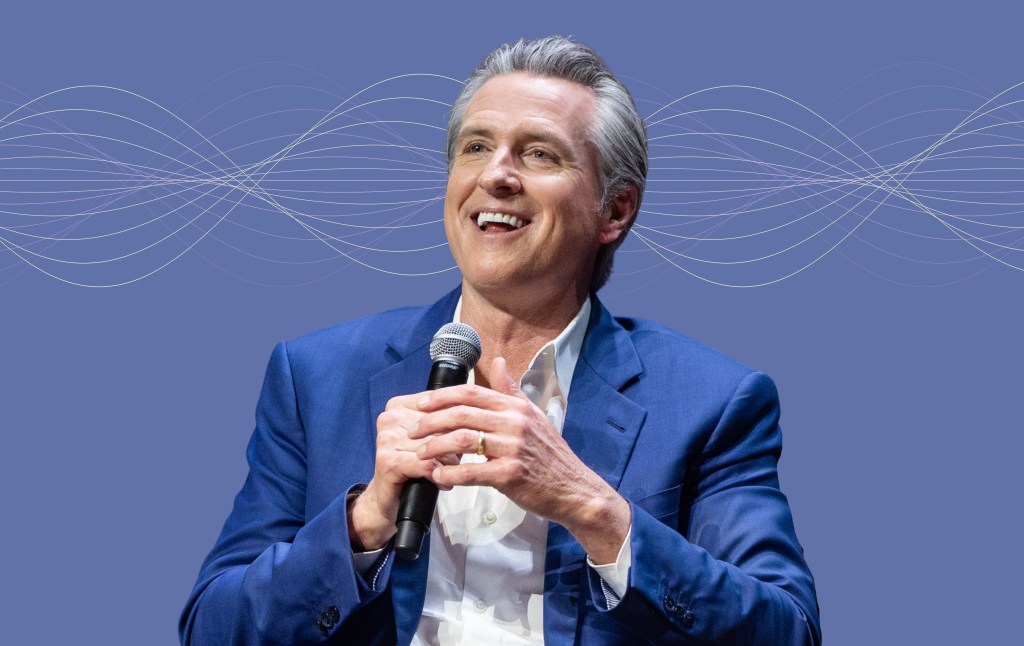
A few years back, someone on Twitter wrote that Gavin Newsom looks like the president in a movie where the protagonist is a dog. The tall, silver-templed guy in the Oval Office who exists to look dignified and sign a piece of paper while a golden retriever saves Christmas or solves a crime or becomes scary good at basketball. Gov. Newsom has always looked more like a casting director’s idea of a politician than an actual politician. In his memoir, he describes emulating Pierce Brosnan’s Remington Steele as a kid, coiffing his hair, wearing suits to school, until his classmates started calling him “El Presidente.” Vogue called him “embarrassingly handsome.” Katie Couric asked him on her podcast if being “ridiculously good-looking“ was a problem, a “Zoolander” situation. Nathan Heller, profiling him for The New Yorker, declared Newsom “the Tom Cruise of politics, more successful than beloved.”
I’m not sure I agree with that construction.
Newsom is liked, possibly even beloved, in his own idiosyncratic way. (The currency of the day, after all.) People who meet him in person talk about his magnetism almost begrudgingly. The late Charlie Kirk, after appearing on Newsom’s podcast, wrote that he was “charming and friendly in-person,” even though, “there [was] clearly a layer beneath the charm” and “he has a shark’s instincts and is hoping that voters will have a goldfish’s memory.” Helen Lewis of The Atlantic described him as “enormously charismatic,” and so good-looking that it’s vaguely “sinister.” Even Tucker Carlson, who declined to appear on his podcast, called him “legit smart” in the same breath as calling him “a truly wounded, screwed-up person,” whom we should be “rooting for.” You get the sense that Newsom is the kind of guy who could charm you at a dinner party while you remained fully aware that he was working you, and that awareness somehow wouldn’t ruin the effect.
So: likable, telegenic, a natural in every room he walks into. And over the past year, he has been trying to walk into every room simultaneously. Maybe he can do it.
Since launching the podcast This Is Gavin Newsom in early 2025, the California governor has built what is the most ambitious alternative-media operation any Democrat has ever attempted. He has interviewed Charlie Kirk, Steve Bannon, Ben Shapiro, Dr. Phil, and Newt Gingrich—a man methodically working through a Rolodex of people his base despises. He went on The Shawn Ryan Show for four hours and accepted a Sig Sauer pistol as a gift on camera. More recently he appeared on The Adam Friedland Show, a comedy podcast hosted by a 38-year-old socialist comedian, where the topic of ketamine came up three times, among other more relaxed topics one might not expect a sitting governor to freely and casually discuss.
He co-hosts a separate weekly podcast with former NFL running back Marshawn Lynch. He trolls President Donald Trump in all caps on X, sells parody MAGA merch, posts AI-generated memes of his own face on Mount Rushmore with the caption “WHAT AN HONOR!”, and has taken to the epithet “TACO,” which stands for “Trump Always Chickens Out.” His press office’s X account has 697,000 followers. His TikTok following has cleared 3 million.
Newsom did all of this because Donald Trump won the 2024 election in part by going where the voters actually were. Not cable TV but Joe Rogan. And Trump did sit with Joe Rogan for three hours, pulling in 61 million YouTube views. He went on Theo Von’s podcast and was both funny and sentimental. He let Logan Paul and Adin Ross ask him dumb questions. The whole operation targeted young men who would never watch a debate but who would listen to a long conversation in the car on the way to work. According to AP VoteCast, more than half of men under 30 voted for Trump. Newsom clearly internalized the lesson—as he’s said himself, he’s following Trump’s example.
Is Newsom becoming an influencer or a viable political candidate? Are we still able to articulate the difference? I mean, Trump is our president, so what could that distinction even mean at this point?
My sense is that people are underestimating Newsom, just as they underestimated Trump in 2015.
Newsom’s ability to game the attention economy isn’t the interesting part; plenty of politicians get attention. J.D. Vance, who many suspect will run for president in 2028, certainly embraces it—he’s online constantly, he engages in arguments with his critics, and when the Internet turns him into a meme, he doesn’t get embarrassed, he leans in. (I’ve heard that he “loves it,” but maybe he’s just coping with the fact that people make fun of him. We may never know.) But being terminally online—even good at posting—is not the same thing as having charisma. Vance is interesting; he is not magnetic.
What’s different about Newsom is that he has the famous, once-confined-to-Hollywood “it” factor, the thing you either have or you don’t, that makes people latch onto you as a cultural object before anyone asks them to. Kamala Harris tried to become this in the summer of 2024, glomming onto Charli XCX’s “brat” moment—the pop star’s neon-green, irreverent album cover that became a sort of aesthetic lingua franca online—but she couldn’t sustain it. The fact of the matter is that Harris was borrowing someone else’s coolness: She just doesn’t have “it.” Ron DeSantis similarly tried, and the outcome gives me so much second-hand embarrassment, I’ll spare the readers the gory details. DeSantis didn’t have it. Newsom, like Trump, does.
On TikTok, fan accounts post “thirst edits,” highlight reels of his most attractive moments set to Usher’s “Hey Daddy (Daddy’s Home).” After Trump’s 2024 victory, someone on X wrote: “If we want the White House back in 2028 then we need to start making Gavin Newsom thirst edits RIGHT NOW!!!” The most common fan-account comparisons are Patrick Bateman and President Fitzgerald Grant from Scandal, one a charming sociopath and the other a handsome empty suit, and the fans seem to mean both as compliments. Nobody posting this stuff appears to care that his track record as governor is, generously, spotty.
Thirst edits are not endorsements. But not every politician generates this material. There is an it-factor involved, some combination of looks and blankness and screen presence that invites projection, and Newsom has it in a way that Pennsylvania Gov. Josh Shapiro and Kentucky Gov. Andy Beshear—both possible 2028 contenders—simply do not. What Newsom appears to have figured out is that this reservoir of unprompted cultural fascination can be nurtured, fed, and pointed in a useful direction.
His media strategy shows this: He gives people material to remix, is a character and not just a candidate, and generates content that circulates because it’s entertaining rather than because anyone cares about the shifty things you did when your state was literally burning to the ground or in an apocalyptic-feeling lockdown. In a world where meme candidates are viable, and they are (our president is proof), that little bit of organic appeal might be worth more than any policy paper or endorsement. Harris’ “brat summer” evaporated because she never had the underlying fan-object quality to sustain it.
But the blankness that makes Newsom great fandom material is precisely what makes him unreliable on a podcast where someone asks him who he actually is. On the Adam Friedland Show, when Friedland asked him to articulate his political project, Newsom couldn’t do it. He said, “I don’t have a brand” and spiraled into word salad about Gandhi, Martin Luther King Jr., Nelson Mandela, “the spirit of the ’60s, the nonviolence movement.” Then he caught himself: “Why do I have political consultants? It’s bad. I just got my ass kicked. I sound like a f-cking politician.” On Ben Shapiro’s show, when Shapiro pressed him about his office calling ICE agents “state-sponsored terrorists,” Newsom folded. Progressives were furious. One commentator wrote: “If you get cooked by Ben Shapiro, you don’t have a chance against Vance.”
There’s a belief, at least from commentators, that Trump succeeded on podcasts because the underlying character was always legible — authentic in long-form, sincere in a way policy discussions don’t allow — but Newsom is a different person in every room. NPR’s Ailsa Chang asked him the best question anyone has put to him: Why not present one consistent Gavin Newsom across all these platforms? He didn’t have a good answer.
But I’m not sure the critique is as devastating as it sounds. Trump is a chameleon too, which is why he was elected. He just doesn’t care if you notice the contradictions. He’ll say opposite things to different audiences and dare you to call it incoherent. Newsom’s problem isn’t that he shapeshifts; it’s that he seems to want each room to believe it’s getting the real him. That’s a thinner gap than it looks, and it might be closable. And the moments where Newsom fails at it are, oddly, some of his most likable. The mask slipping turns out to be more appealing than the mask. If Newsom ever figures out how to weaponize the slip, to let the awkwardness be the brand, he’ll be a force.
The right path for Newsom isn’t trying to come off as more sincere; it’s getting more comfortable with shamelessness. Not finding his core but making the lack of one look like a feature, the way he almost did on Friedland when the mask slipped. Stop trying to convince every room it’s getting the real Gavin Newsom—and critically, that the “real” Gavin Newsom is a good, virtuous guy. Maybe he’s not! Let the audience all see the performance and enjoy it anyway. Policy, where Newsom’s record is middling at best, matters less to voters than personal magnetism—something the past decade of American elections has made nearly impossible to deny.
In the movie, the protagonist is the dog, not the president. The president’s just eye candy. If Newsom can lean into that—that he’s the president in the movie where the protagonist is a dog who plays basketball and saves Christmas and whatever else—he might actually win 2028.
But what does it mean for the rest of us, that this might just be the right advice? Trump was the first president to fully dispense with the pretense that the job required anything beyond entertainment value and fan service. If Newsom follows suit, and I think he should, then the question isn’t whether the office of president truly has become divorced from duty and reason. It’s how long it’s been like this without the mainstream acknowledging it. I’m not nihilistic about this; I’m not accepting or celebratory or “just enjoying the show.” The shallowness of our politics is not a good thing. It is deeply tragic.
But it’s been the way of the world for long enough that pretending otherwise is also dishonesty.