A fresh report in Reuters says what should already be quite obvious to all: US intelligence has assessed that Iran’s leadership and government are largely in tact and the system does not risk collapse, after two weeks of heavy sustained US-Israeli bombardment and ‘decapitation’ strikes which have killed Ayatollah Ali Khamenei and over forty top military leaders.
One of the intel sources was cited as saying that “multitude” of intelligence reports provide “consistent analysis that the regime is not in danger” of collapsing and “retains control of the Iranian public”.

The source in the Wednesday-issued Reuters report indicated the most recent US intelligence was only completed within a few days prior. This week President Trump has also been busy declaring that the war could end “soon” and that “we won”.
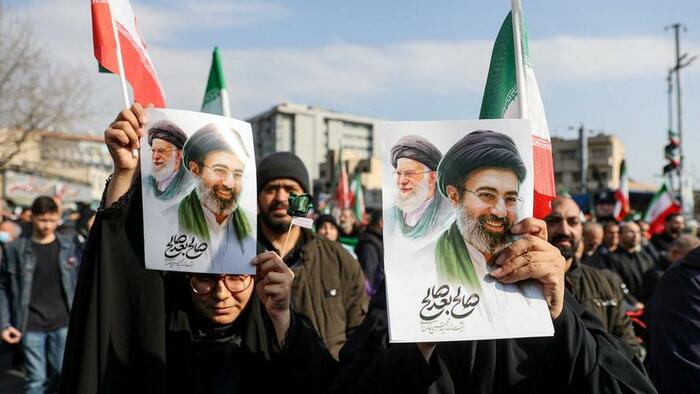
And yet, the intelligence assessments indicates Iran’s clerical leadership has remained cohesive, now rallying around the late supreme leader’s successor – his son Mojtaba Khamenei, who is said to be more hardline. Other sources suggest that it is the elite Islamic Revolutionary Guard Corps (IRGC) effectively running the country and executing the war. Indeed Israel and Gulf states continue to get pummeled in retaliatory missile and drone waves. Of course, Tehran itself is enduring heavy destruction, also as the US-Israeli strikes go after civic infrastructure.
Reuters adds: “Israeli officials in closed discussions also have acknowledged there is no certainty the war will lead to the clerical government’s collapse” – based also on the perspective of a senior Israeli official.
We might point out that any serious analyst would have assessed this before the strikes had even started, and indeed there’s some evidence that the Chairman of the Joint Chiefs of Sstaff tried to warn just this before Trump ordered the operation.
As one pundit has pointed out: “Endurance regimes do not need clean victory to change the game. They only need to survive the shock while making the old equilibrium too costly for their adversaries to restore.” So ‘winning’ for Iran looks much different, compared to US objectives.
Journalist Jeremy Scahill, who starting over two decades ago covered the lead-up to the Iraq war from on the ground in Baghdad, has reiterated that “In asymmetric warfare, the less powerful side does not need to militarily defeat an adversary, but rather force it to a point where it determines the costs of continuing the war is too high.”
“When past presidents balked at the possibility of war with Iran, they weren’t just dodging a hard choice; they were deterred by all the obvious reasons a conflict could perilously spiral. Nobody should be shocked that the expected is now coming to pass” https://t.co/diHQNCGKvB
— Jonathan Lemire (@JonLemire) March 11, 2026
Concerning Trump’s Operation Epic Fury, there does appear to be a concerted effort to collapse the system, though pretty much all war analysts are in agreement that doing this in a purely air campaign is next to impossible.
Striking directly at the banking system could be part of these efforts, as a Wednesday regional report indicates:
The data center of Iran’s state-run Bank Sepah was hit by a strike in Tehran on Wednesday, The Jerusalem Post learned.
The disruption at the bank, which is largely responsible for paying the salaries of Iran’s military and the Islamic Revolutionary Guard Corps, is expected to prevent it from paying salaries for a period, forcing it to find alternative solutions.
Reports suggest that a vital data center crucial in carrying out payments to some up to 190,000 IRGC members was impacted, though we might also presume there’s redundancy to the data and other systems capable of carrying this out. But the thinking might be that if the troops can’t get paid, and their families can’t survive, this would immediately weaken the country’s ability to defend itself.