Forty-eight hours after her husband, conservative firebrand Charlie Kirk, was assassinated, Erika Kirk strode into the studio where he had recorded his blockbuster podcast. Just a week earlier, the show ranked 17th in the nation and drew roughly 500,000 monthly listeners on average.
Dressed in a white pantsuit, Erika Kirk stood poised at a lectern, shoulders back and head upright, summoning the pageant-ready composure that had helped her win Miss Arizona 14 years earlier. Yet what ensued felt far less like a shared moment of mourning and pastoral outreach that many expected from her than a well-rehearsed and well-timed political address—one delivered from the very place where her husband had built a movement.
As readers may already know, only six days after this address, Erika Kirk would be named CEO of Turning Point USA, one of the most prominent conservative nonprofits in the country. And it certainly bears mention that she has the credentials to do so. Kirk holds a double major in political science and international relations from Arizona State University, a master’s degree in American legal studies from Liberty University, and is currently pursuing a doctorate in biblical studies, also at Liberty. She had also been a podcaster and nonprofit executive in her own right before stepping back from what she has described as her “boss babe” days to focus on raising her family.
In other words, a political address was not something totally new for Erika Kirk.
Still, something about that moment—the speech, the staging, the facial expressions, even the simple fact that Erika Kirk stood before a camera at all and was not at home with her children—seemed destined to provoke judgment, no matter what she actually said. Social media erupted almost immediately.
In one Reddit thread, a commenter wrote, “I get that everyone grieves differently but this came across less like a heartbroken spouse and more like a demo reel for a bad soap opera actress. … It felt so fake I was legitimately uncomfortable watching it.” More allegations of false grief—including from far-right characters like Nick Fuentes—have followed. And other suspicions have followed suit, including salacious online speculation about a beat-too-long hug with Vice President J.D. Vance at a Turning Point rally, where she ran a hand through his hair while wearing what have now become infamous, skintight black leather pants. Erika Kirk, some in the public decided, was not acting as she should.
When Kirk spoke in that studio, her tone was not, shall we say, conciliatory. “You have no idea what you just unleashed across this entire country and this world,” she told listeners. With tears flashing in her eyes, she continued: “The cries of this widow will echo around the world like a battle cry.”
Later, when pressed by Bari Weiss of The Free Press about what she meant by the word “unleashed,” Kirk said she was referring to the work of the Holy Spirit moving across the country after her husband’s death, circling her message back to Scripture. But the real question is not what she said—or even what she meant. The real question is this: What did viewers expect her to say? Because long before Erika Kirk opened her mouth, many viewers had already decided how a widow—especially a conservative widow—ought to behave. And what she ought to say.
This question is part of a broader discussion about conservative women’s political opportunities, and the way the public perceives them writ large. Republican women remain far less represented in elected office than their Democratic counterparts: Of the 25 women currently serving in the U.S. Senate, only eight are Republicans; in the House, just 13 of the 102 women belong to the GOP. And although a record 13 women currently serve as governors nationwide, only four of them are Republicans.
Turning Point USA is not a government organization, but it represents a significant center of Republican power. Unlike organizations that explicitly foreground women in their identity—such as the Independent Women’s Forum or Susan B. Anthony Pro-Life America—Turning Point arose from the same ecosystem of conservative institutions that have been founded and generally led by men, including the Heritage Foundation, the Leadership Institute, the Claremont Institute, the Daily Wire, and the American Enterprise Institute. Women, by contrast, have more often led organizations focused specifically on women’s advocacy, family policy, or pro-life issues.
In this context, Erika Kirk’s appearance at the center of conservative institutional power was unlikely to be read as a neutral succession—a reading former Turning Point employee-turned-conspiracy-podcaster Candace Owens has been more than happy to amplify. Readers might be well-aware already that Owens has produced an entire series called Bride of Charlie, in which Owens claims that Kirk is unable to recall basic facts about her past—former lovers, childhood hairstyles, even her own birthdate—details Owens presents as evidence that something more sinister might be lurking beneath the surface of Erika Kirk—and of Charlie Kirk’s death. (That series has, as of this writing, been viewed by millions.) In a September 13 post on X—three days after the murder—Owens wrote simply: “Erika Kirk knows everything.” And in December, CNN reported friction between Owens and Kirk, seemingly because Kirk did not platform Owens’ apparent belief that Israel, among other countries, was behind Charlie Kirk’s murder.
Owens’ claims reek of personal animus toward Kirk. But that said, it bears mentioning that those who buy into conspiracy theories—the audience Owens is courting and who listen to her on this topic and others—are likely not motivated by hatred. More probably, they are attempting to make sense of a world that suddenly feels destabilized or contradictory. According to the American Psychological Association, “social identity motives can draw people toward the content of conspiracy theories.” When events threaten people’s sense of order or belonging, conspiratorial explanations can begin to feel plausible. For conservatives grappling with the shock of Charlie Kirk’s death, that impulse to search for hidden meaning may be particularly strong—and embracing conspiracies about Erika Kirk might be one way they seek that meaning.
But people do not reach only for conspiracy theories when events feel destabilizing. They also reach for familiar cultural scripts. In moments of shock, we instinctively search for roles that make the situation intelligible: hero and villain, victim and avenger, widow and successor. When the person standing before us does not neatly fit the role we imagined, confusion—and oftentimes suspicion—quickly follows.
And what could feel more illegible to many conservatives than watching one of their most visible leaders shot in broad daylight—and then witnessing a response from his widow that does not align readily with how they imagine grief should look?
But the destabilization many observers seem to feel in response to Erika Kirk is not simply about her method of grieving; it is in part about timing. After her husband was shot, she suddenly moved from one contemporary conservative female archetype into another—from the “trad wife,” who had spoken openly about leaving behind her career and New York lifestyle to focus on family, into the role of institutional leader, “a girlboss.” Conservative culture, like most cultures, tends to prefer its archetypes clearly separated, but how could anyone transition so quickly from one way of being the next?
Adding another layer of complication is the fact that the “girlboss” model has never sat easily within conservative culture. Ambitious women are often lauded—think of figures like former South Carolina Gov. and U.N. Ambassador Nikki Haley or Supreme Court Justice Amy Coney Barrett—but their authority tends to be positioned carefully alongside commitments to marriage, motherhood, and faith. In other words, the conservative “girlboss” can exist, but only insofar as she remains tied to the rhetoric of family. Female ambition is rarely framed as distinct from family life; it is almost always discussed in relation to it.
Prior to her husband’s death, Erika Kirk herself publicly described setting aside her own career ambitions to focus on marriage and motherhood—precisely the kind of narrative that fits easily within this framework. Even though she maintained a clothing brand, podcast, and public platform, she has always emphasized her marriage to Charlie and their two children. Within the conservative “girlboss” model, then, a woman may pursue ambition—but typically only after demonstrating that she does not need, or even particularly desire, to do so.
What unsettles some observers now, I suggest, is that Kirk—now without a husband—has veered away from what’s typically expected of high-profile conservative women: She is neither the tradwife, who docilely serves her husband and children, nor the conservative girlboss, for whom a husband and children are at the very least necessary prerequisites. For some critics, that departure from expectation might make her behavior seem strange, even if they struggle to articulate exactly why.
The expectations placed on political women have never been simple.
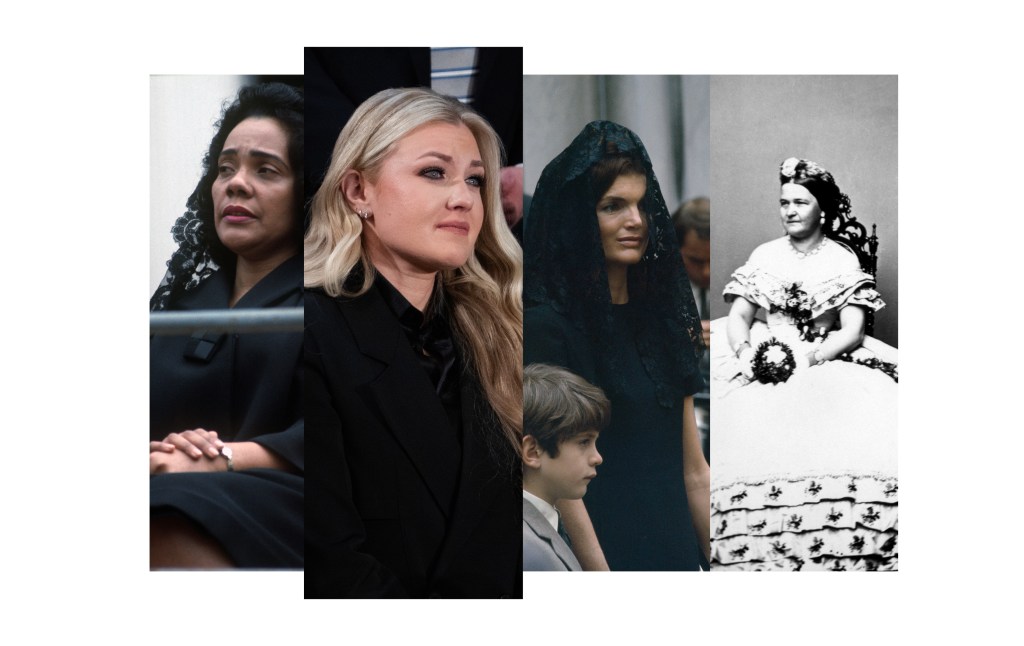
After President John F. Kennedy was assassinated, Jacqueline Kennedy waited nearly a month before addressing the public. When she finally spoke, she thanked Americans for their condolences before largely withdrawing from public life altogether, along with her children. This retreat helped solidify her image as the model of dignified widowhood. Indeed, Jacqueline Kennedy appeared on Gallup’s list of the most admired women 14 times in total. She ranked No. 1 for several years during her husband’s presidency and after his assassination, but fell to No. 7 following her 1968 marriage to Aristotle Onassis. America’s most famous widow, it seemed, was expected to remain in mourning.
But not every political widow is held to the same standard. Four days after Martin Luther King Jr. was assassinated, Coretta Scott King led a march in Memphis in support of the sanitation workers’ strike that had brought her husband to the city. A few critics accused her of failing to display “proper grief,” but most praised her resolve. As she once told her father-in-law, who worried about her safety, “You don’t understand Dr. King. I’m married to Martin, but I’m also married to the movement.”
I imagine that Erika Kirk sees herself as married to a movement, too. And like Coretta Scott King—who later appeared at the 1976 Democratic National Convention and again at the 1988 Democratic National Convention—I would not be surprised if we someday see Erika Kirk at a Republican convention, not merely in support of her husband’s movement but as a leader in her own right.
But that would take, it seems, a broader understanding by the public of what a conservative woman can be. In a recent post on X, Meghan McCain argued that the Republican Party leaves little room for the complexity of women’s lives. As she wrote:
One thing that really bothers me about conservative messaging on this is there are so many women who want to become mothers and can’t or just haven’t found the right person. Also some women don’t want children and it’s ok. We should be welcoming of all kinds of women and voters. … I just don’t get what we’re doing here and [it] would be cool if we focused on a broader idea and more nuanced image of a conservative woman.
If we followed McCain’s advice, perhaps there would be room for women like Erika Kirk and others to occupy their own spaces—not as appendages to male political figures, but as political actors moving through different seasons of life. Seasons when you stay home with your children for a while, or decide to go back to work. Seasons when you work part-time. Seasons when you have another child—or don’t—or choose not to have one at all. Seasons when circumstances change in ways you never expected. There seems to be a little movement in this direction, albeit with girlboss flavor: As one conservative female influencer recently posted on Instagram: “Breaking news: you can have a job, a martini, and still be conservative.”
Consider Erika Kirk in the studio at the beginning of this essay—and how much her life changed in a single instant. Consider how your own life may have changed in different ways, at different moments, across different seasons. At the end of the day, the grieving widow will step up to the microphone and tell the world her story. The rest of us—the audience—will argue about whether she has played “the part“ correctly. And in the process, we reveal far more about ourselves than we do about her.