Editor’s Note: This is the second entry in a new Dispatch series entitled “Where I’m From.” Every Saturday, a writer will share a meditation on his or her hometown—a bustling metropolis, distant desert outpost, quiet suburb, or somewhere in between—and what makes it unique. The goal? Highlight voices—and good writing—from every corner of these United States.
To many from the coasts and beyond, the Midwest is a uniform patch of land—full of corn and Christians, with an oven mitt shape somewhere in the middle.
To me, it’s the most beautiful place in the world.
I spent the first 18 years of my life in Plymouth, Minnesota. (The following 10 brought me out East for the usual reasons of work and education.) Initially, as a Midwestern expat hurled among the sophisticates of The City, I was self-conscious of my hometown. Distant seemed the time when, in 2008, Money magazine (then a publication of Time) labeled Plymouth the best small city in the U.S. Back then, I was enthralled! To my young mind, this seemed like a grand entrance upon the world stage.
A “small city” is a silly turn of phrase, but I suppose it’s accurate, as my place of origin earns neither the title of “city” nor “town.” Plymouth is an immaculate suburb, the platonic ideal of a suburban area. The perfectly square plot of land measures 6 miles wide by 6 miles long. Within its bounds, winding neighborhood roads curve into countless culs-de-sac bordered by countless basketball hoops. “Topnotch schools, good jobs, affordable housing, low crime, (and) an active outdoor culture,” per Money, lure families of 3.4 into Plymouth’s perfectly-plotted arms.
Like any suburb worth its salt, Plymouth has a predictable history and pattern of growth. The village of Plymouth was first formed in the middle of the 19th century by farmers and millers, homesteaders and fur traders. At the time of the Civil War, the village maintained some 1,000 inhabitants—though for most Minnesotan settlers at the time, the Civil War was merely background noise to the real fighting: the Dakota Uprising.
The Dakota tribe had, of course, arrived at my hometown centuries earlier. A pool of crystal-clear water, Medicine Lake, served as Plymouth’s cradle of civilization. According to an early explorer of the region, Joseph Nicollet, the Dakota called the lake “I CA-PA CA-GA-STA-KA MDE,” or, “Where-the-Beavers-Strike-Their-Mouths-in-the-Manner-of-an-Indian-Warcry.” (I regret to say I never witnessed beavers committing such ululations while kayaking its waters.)
Driving around Plymouth today—now a “small city” of 80,000 residents—one might believe that God made the world in 1974. Almost nothing there remains from earlier times, save some sturdy oak trees and the old town hall. Plymouth’s population exploded in the ’80s and ’90s as a family-friendly oasis for Minneapolis commuters, and it shows.
My childhood church—an outpost of the Wisconsin Evangelical Lutheran Synod—is one big beige trapezoid reaching up to heaven. The surrounding neighborhoods vary between ’70s split-levels, ’80s contemporaries, ’90s colonials, and ’00s McMansions. Plymouth’s “City Center” is 90 percent parking lot and 10 percent strip mall. The town’s central landmark is a warehouse-like movie theater covered in brick veneer.
What the small city may lack in architectural beauty it makes up for with the natural kind. The land is level—not flat with the harsh emptiness of the desert or the monotony of the plains, but with the moderate hospitality of woodlands and ponds. Lakes and creeks and streams abound. Bike paths and nature trails snake through the leafy neighborhoods. Local parks are home to verdant forests.
The trees serve as a testament to the state’s initial source of prosperity: logging. Grizzled, hungry men cleared hundreds of miles of forest, particularly in the north. On early maps of the region, the little-known upper reaches were simply marked “Abundant Pine.” And so the legend of the lumberjack lives on—the axe-wielding Paul Bunyan and his sturdy companion, Babe the Blue Ox, are folk heroes in Minnesota. (Most families, including my own, have embarked on a pilgrimage to Bemidji to visit their sculpted likenesses.) These days, agricultural manufacturing has replaced lumber as the dominant player in Minnesota’s economy. This tradition lives on in Cargill, the largest privately held company in the U.S. by revenue. (And headquartered next to Plymouth.) A commodities company that keeps a low profile, Cargill has touched just about every processed food product sold in your local grocery store—even the tires on your car.
My own suburb of Plymouth both assumes and demands that residents have a car. A landscape built for automobiles, however, does not necessitate isolation. As high schoolers, we piled in each other’s moms’ SUVs and drove around just to be going somewhere. Besides Target, we drove to Ridgedale mall, Southdale mall, the Mall of America, Caribou Coffee, Culver’s, a different Caribou Coffee, and each other’s houses. We blasted Cities97 on the radio and rolled our windows down no matter how cold it was. On Labor Day, friends from church drove to the fairgrounds in St. Paul and we gorged ourselves on Pronto Pups and cheese curds.

Every summer, stowed away in my grandparents’ motorhome—a gleaming 2004 Itasca Spirit—my family drove up to the shores of Lake Superior. We collected flat rocks made smooth by the frigid, clear waves and painted them with local fauna. We stood on the iron-rich cliffs and stared into the endless sea of melted ice. The sublimity of earth’s largest body of freshwater is hard to surmise. Confronting the ocean creates a certain sense of discord: Its salty waters clash with human welfare and deny vitality. In a lake, however, lies a boundless pool of the stuff of life. A sense of serene eternity emerges from Superior in the summer months.
After our wanderings, we would hike back to the campground to build a fire and roast s’mores. As the stars alighted, a guitar and a fiddle emerged. A chorus of wrinkled, round voices emerged to sing “Amazing Grace.” Then Johnny Cash. Then other hymns.
There is a simple, Scriptural spirit that hangs over the region. (This is perhaps best captured by Marilynne Robinson in her Gilead series.) Bible verses populate a common lexicon. Minnesota largely lacks the Pentecostal passions of the South, the Jesus Freaks of the West, and the established collars of the East: Thanks to its widely Germanic Lutheran heritage, burgher virtues reign: The original middle class, burghers prize order, moderation, and civic service.
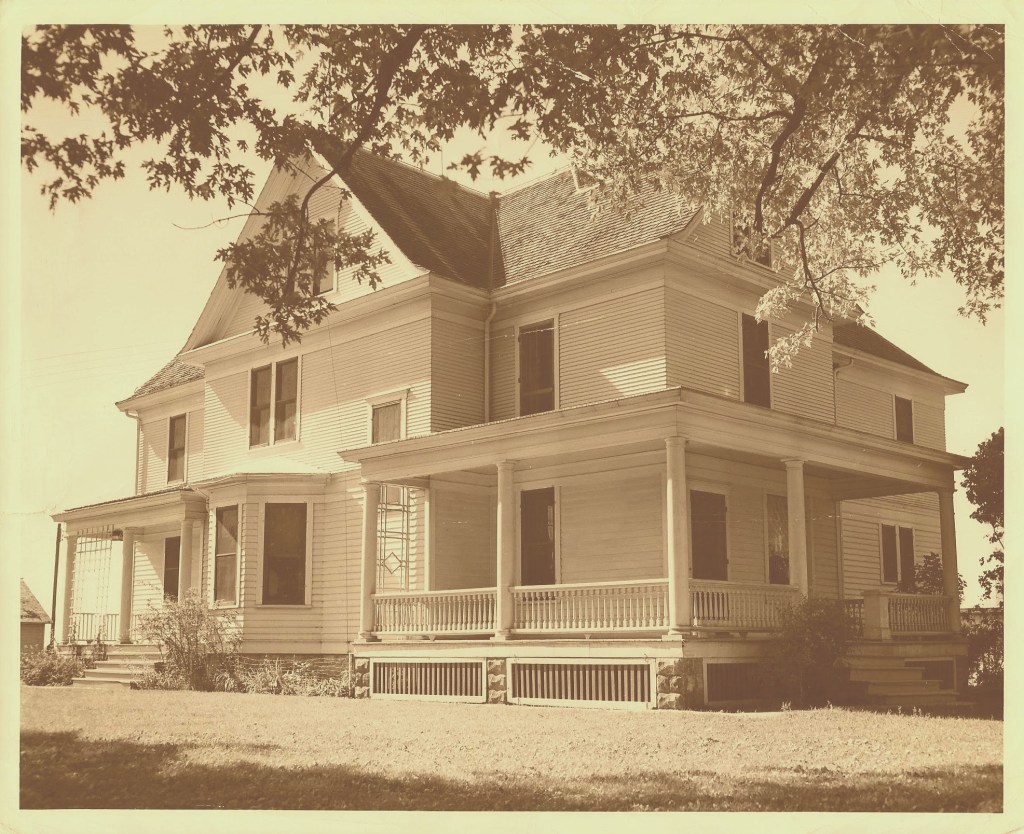
My own family’s history serves as an archetype. My grandpa’s great-grandfather, Christian J. Bartsch, emigrated to Minnesota from Prussia around 1870. He settled some 130 acres in Owatonna, a farming community in the south of the state, and helped found one of the first Lutheran churches in the region. His youngest son, Albert Philip Bartsch, took over the family farm and built a white, wooden home that would house Bartsches for generations.
According to his obituary, A.P. Bartsch “had a very active interest in community affairs, especially in co-operative organizations. He served for many years as a member of the board of Central Co-op Oil Assn., Farmers Gilt Edge Creamery, Farmers Elevator and Mercantile Co., Owatonna Livestock Association, Owatonna Rural Fire Association, and many others. As a lifetime member of Redeemer Lutheran Church, he served as an active officer for more than 50 years.” The Protestant work ethic is no farce.
My parents carried on the family tradition by first settling in New Ulm, a small town where signs on Main Street are still in German, young men study at Martin Luther Seminary, and a monument to Hermann the German watches over the town. When they moved to Plymouth, a Lutheran church awaited them, where every service concluded with seven layer bars and every event included Crock-Pots.
While “Minnesota Nice” may have its downsides, the type rings true. The harshness of winter, the blandness of the built world, and the lack of earthly diversions all foster (necessitate?) real, person-oriented community. No frills. No objective. Just lots of hot dishes in the fellowship hall, Apples to Apples in the finished basement, and songs around the campfire.
Money magazine was right. I’m from the best place in America—nay, the world! Don’t let the aristoi fool you, the Midwest can be sublime.