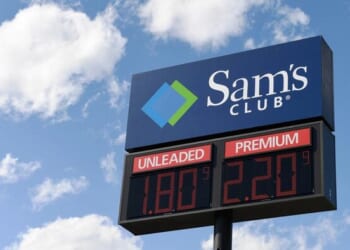
AAA (American Automobile Association) reports that the national average price for a gallon of regular gasoline has surged nearly 25% so far this month, putting it on track for the largest monthly increase on record, even surpassing the May 2009 spike, unless the Middle East conflict is resolved quickly.

This consumer fuel-price shock is coming at about the worst possible moment: it is a midterm election year for MAGA, and as we have noted previously, an emergency SPR release would do little to contain the spike, leaving the administration with few viable options.

Brent crude is trading near $102 a barrel and WTI around $95 on Monday afternoon, levels that suggest the national average price for regular gasoline could soon push even closer to the politically sensitive $4-per-gallon threshold.

Consumers have already noticed, as Google Search trends for “Why are gas prices going up” have surged to levels seen when crude prices spiked during Russia’s 2022 invasion of Ukraine.

The good news is that comments from the Trump administration show an urgency to reopen the critical maritime chokepoint, the Strait of Hormuz.
Treasury Secretary Scott Bessent told CNBC’s Squawk Box this morning that the US is deliberately “allowing Iranian oil tankers to transit the Strait of Hormuz” and is “fine” with some Indian and Chinese ships moving through “for now… to supply the rest of the world.”
He highlighted “more and more of the fuel ships start[ing] to go through” and a possible “natural opening” the Iranians are permitting – a tactical concession to stabilize global supply while full escorts remain “militarily” off the table for now.
Last week, we highlighted JPMorgan’s head of commodity research, Natasha Kaneva, who warned that policy measures will have, at best, a limited impact on oil prices unless safe passage through the Strait of Hormuz is assured, given the potential for up to 12 mbd in losses over the next two weeks.
Some of those policy maneuvers included the 32-nation IEA’s emergency release of 400 million barrels that will soon hit crude markets, along with the initial flows from the U.S. SPR release of 86 million barrels, which could begin as soon as this week. As we have noted, this is not a stockpile problem, but a flow problem.
Kaneva’s other five options beyond SPR releases to contain soaring oil prices include export restrictions, lifting the Jones Act (which Trump is set to do), waiving federal fuel taxes (which could occur if gas hits $4 a gallon), relaxing E15 gasoline blending rules, and issuing a Reid Vapor Pressure waiver (read her full note here).
With the national average price of gas inching closer to the politically sensitive $4-per-gallon level, the key question is what tools the Trump administration is prepared to use to contain pump prices to mitigate any risk of political fallout.
The immediate focus at the start of the week is clearly on reopening the Strait of Hormuz, but domestically, the policy maneuvering is far narrower, likely centering on an SPR release by mid-week and potentially a temporary waiver on federal fuel taxes.
Soaring pump prices come as spring break begins. Will Trump’s Iran conflict be over before the Memorial Day driving season?