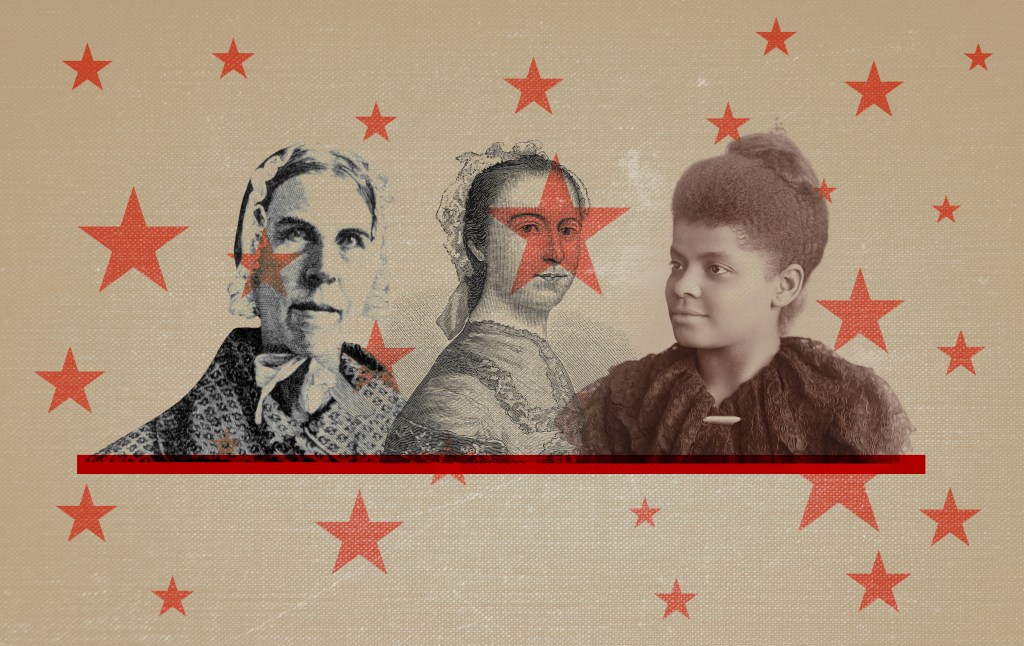
Mercy Otis Warren, born in colonial Massachusetts in 1728, lived in a world in which women could not participate publicly in politics. Yet, as the daughter and wife of prominent Revolutionary War-era leaders, Warren was not content leaving the practice of citizenship to men alone.
The American Revolution created new opportunities for civic involvement outside official institutions. Newspapers and political essays circulated widely, shaping public opinion and mobilizing resistance. Warren joined the conversation, writing pamphlets, plays, and political satires criticizing British authority and warning her fellow colonists about the dangers of tyranny.
Published anonymously until 1805, her work circulated widely and helped frame the argument for independence. At a time when women were expected to remain silent, Warren made her voice heard in support of her country, and she was not alone. Long before American women could cast ballots, many were already engaged as citizens. Their stories serve as instructive examples to inspire our contemporary national ethos—and help us think beyond the debilitating attitude that stems from a perceived lack of civic agency. Approximately 85 percent of Americans say elected officials don’t care what people like them think, a stark indicator of how many feel their voice lacks influence.
The positive news is that as the United States approaches its 250th anniversary, Americans are once again asking fundamental questions about our government. What sustains a large democratic republic? How can we maintain civic trust when institutions are strained, citizens are disillusioned, and polarization intense?
These are not new questions. At earlier moments in American history, such as during the Civil War and after Watergate, citizens confronted comparable doubts about whether democratic government could survive division, injustice, and competing visions for the nation’s future. At a time when trust in all levels of government, the press, and even elections themselves has eroded, and when civic participation is often reduced to a single day in November, history can offer a useful corrective.
Every year during Women’s History Month in March, we read or learn about the stories of suffragists, civil rights leaders, barrier-breaking firsts, and occasionally the modern-day stories of women as STEM and business leaders. But what about women who shaped the republic before they had access to the ballot? Long before women could participate in elections, they provided indispensable support to American democracy, despite being denied full participation in it. Far from being politically irrelevant, their influence wasn’t merely symbolic. It was structural and essential.
The story of American democracy is often told through elections, presidents, wars, and major policy decisions. But the health of our republic has always depended on citizens who operate outside formal institutions. Writers, teachers, reformers, and journalists shape public understanding and hold our elected representatives accountable. For much of American history, women were excluded from official governmental positions. Yet they remained deeply engaged in the civic life of the United States.
Three women from different historical eras—Mercy Otis Warren, Sarah Grimké, and Ida B. Wells—demonstrate how citizens can act even in the absence of political power. Their stories reveal three underappreciated roles essential to democratic resilience and growth: public persuasion, moral voice, and accountability.
Warren, for her part, did not merely comment on events; she interpreted them for the public. She warned in her writings that arbitrary authority threatened liberty, and that it was the job of citizens to remain vigilant against abuses of power. After the Revolution, she wrote a comprehensive history of the American founding. In doing so, she offered an acute warning. Political liberty was not only vulnerable to monarchy and tyranny but could also be lost through a gradual accumulation of power within republican institutions themselves. A student of history, she observed:
The love of domination and an uncontrolled lust of arbitrary power have prevailed among all nations, and perhaps in proportion to the degrees of civilization. They have been equally conspicuous in the decline of Roman virtue, and in the dark pages of British story. It was these principles that overturned that ancient republic. It was these principles that frequently involved England in civil feuds. It was the resistance to them that brought one of their monarchs to the block, and struck another from his throne.
Warren understood implicitly that a democratic republic depends on an informed and engaged public. In many ways, she was America’s first civics teacher. As the author of the biting satire “The Group” and the anti-Federalist pamphlet “Observations on the New Constitution,” Warren claimed her place in the public marketplace of ideas long before women were recognized as intellectual equals. Prior to the institutionalization of civics education in schools, she modeled it by using persuasion, history, and reason to shape the republic’s nascent political culture. Strikingly relevant today, she drew attention to the danger of complacency in a democratic republic.
A generation later, another woman challenged the boundaries of civic participation in a very different way. Born into a wealthy slaveholding family in South Carolina in 1792, Sarah Moore Grimké witnessed the brutality of slavery firsthand. As a young woman, she rejected both slavery and the social conventions that silenced women. She left the South to live in Philadelphia, and in the 1830s became one of the most outspoken abolitionists of her time.
Wells, Warren, and Grimké did not share a political ideology or a single method, but they did share a common civic ethic. They believed that citizenship carried obligations independent of formal political rights.
Grimké delivered lectures to audiences made up of both men and women, an action considered highly improper. At this time in American history, men and women existed in separate spheres, with women confined to domestic and family life. Public speech by women was considered socially unacceptable and even dangerous.
When critics attacked her overstepping, Grimké did not retreat. Instead, she articulated a radical civic claim: Moral responsibility did not depend on gender, and obedience to conscience sometimes required defying accepted social norms. In her 1837 series Letters on the Equality of the Sexes, she argued that women had not only the right but the civic obligation to speak on critical matters such as slavery because they were morally equal to men. If a moral wrong threatened the nation, silence was a form of complicity. In Letter VIII of the series, she wrote, “Can any American woman look at these scenes of shocking licentiousness and cruelty, and fold her hands in apathy, and say, ‘I have nothing to do with slavery’? She cannot and be guiltless.”
Grimké’s opposition to slavery was not grounded in formal institutions or dependent on electoral mechanisms. Rather, it was moral and civic. She insisted that democracy depends on the free exercise of conscience. Preventing women from speaking moral truth, she argued, was an abdication of civic responsibility that weakened the entire republic.
If Warren shaped public meaning and Grimké defended moral agency, Ida B. Wells practiced citizenship through the pursuit of accountability and truth. Born enslaved in Mississippi in 1862, Wells was emancipated as a child and later trained as a teacher. She entered adulthood after Reconstruction collapsed, ushering in a period of political volatility and violence in the United States. After being forcibly removed from a segregated rail car in 1884, she turned to journalism to expose racial injustice. She began by writing about discrimination in local newspapers.
Denied the vote because of both her gender and race, Wells nonetheless undertook one of democracy’s most essential tasks. She documented nearly 250 acts of mob violence and extrajudicial killings of black people. During the 1890s, lynching had become a form of widespread terror throughout the South. White mobs murdered African Americans with little or no fear of legal consequences. These heinous actions were justified through false claims that black men had committed crimes, often against white women.
Through investigative journalism, Wells exposed the realities of lynching by collecting data, naming victims, and dismantling the false narratives used to justify racial terror. Her reporting shed light on “what lynching really was: an excuse to get rid of Negroes who were acquiring wealth and property and thus keep the race terrorized.” In the 1892 pamphlet Southern Horrors, Wells explained: “It is with no pleasure I have dipped my hands in the corruption here exposed. Somebody must show that the Afro-American race is more sinned against than sinning, and it seems to have fallen upon me to do so.”
This work was perilous and often dismissed. After she criticized the lynching in Memphis, a mob destroyed the newspaper office where she worked. She received death threats and had to leave the city. Yet Wells understood that democracy cannot function when violence is hidden and facts are suppressed. She continued to write about lynching and spoke publicly about it in the United States and Europe, aiming to expose its brutality to a wider audience.
Wells, Warren, and Grimké did not share a political ideology or a single method, but they did share a common civic ethic. They believed that citizenship carried obligations independent of formal political rights. They practiced citizenship when institutions excluded them, they spoke up when threatened, and they recorded what others wanted erased.
Public trust in institutions has declined dramatically in recent decades. Many Americans feel disconnected from government, and they remain skeptical about the information provided to them. At the same time, technology makes it easier than ever for misinformation and hostility to spread. These challenges can make democratic participation seem futile. But the histories of these three women suggest a different, and more hopeful, conclusion.
The collective example of Mercy Otis Warren, Sarah Grimké, and Ida B. Wells carries an implication we cannot afford to ignore. A healthy, resilient democracy does not begin or end with elections. The lesson is not that voting is unimportant. Rather, it is that democracy cannot survive if we outsource our civic responsibilities to elected officials alone. Public persuasion, moral courage, and accountability are not merely adjacent to self-government. They are its foundation. Before they were permitted to cast a single ballot, women did not merely reinforce American democracy; they helped rescue it.