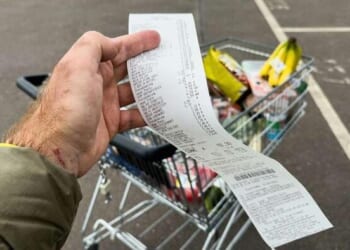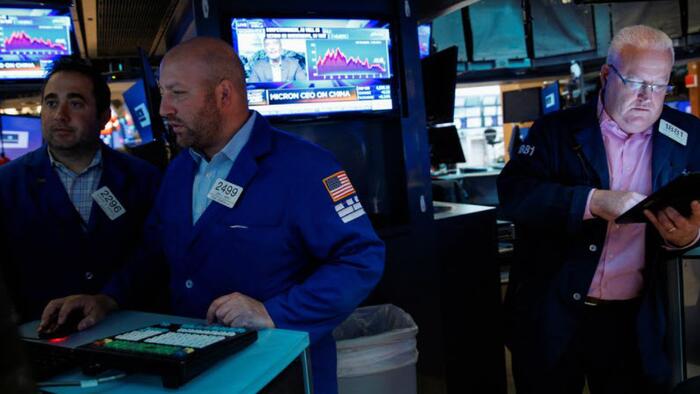
Stock futures have reversed overnight losses and traded at session high, just above the flatline, despite diesel topping $5 a gallon – the highest since 2022 – with Iran expanding attacks on energy infrastructure around the Middle East and Israel targeting military / security leadership, reportedly killing Iran security chief Ali Larijani and the commander of Iran’s paramilitary Basij unit. As of 8:15am ET, S&P futures were up 0.1%, while Nasdaq futures were still red, with most big tech stocks edging lower except Nvidia after its bullish sales outlook. KOSPI leading overseas up 163bps but other parts of Asia strong as well with TWSE up 148 and Brazil bouncing +125bps. China property the notable laggard down 85bps. Cyclicals rallying in Europe with autos and chemicals squeezing higher. Large miss in German ZEW expectations with current data point more or less in line. Australia’s central bank raised interest rates on Tuesday as the conflict in Iran worsened existing concerns around an acceleration in inflation and the country’s reliance on oil imports. Energy prices are off their highs as markets analyze the outcome of a partial opening of SoH, even as forecasts for production curtailments to grow from ~6.5mm bpd (Mar 13) to ~12mm bpd (Mar 20). US transport fuels continue to surge. For investors, growth optimism is tanking, inflation expectations are jumping, and cash levels are surging, according to Bank of America. WTI was back near $100 after an Iraqi oil field and key Emirati port were targeted by Iranian drones and missiles. Trump reiterated his appeals for other nations to help secure the Strait of Hormuz, which has still only seen a trickle of vessels pass through. He also delayed a summit with China for about a month. Bond yields are flat to up 1bp, the USD is mixed though the JPM desk flows remain defensive via USD buying. US economic data slate includes weekly ADP employment change (8:15am), March New York Fed services business activity (8:30am) and February pending home sales (10am)

In premarket trading, Nvidia shares edge higher after its GTC event, however other Mag 7 stocks are mostly lower (Nvidia +0.2%, Tesla -0.1%, Apple -0.2%, Microsoft -0.2%, Meta -0.3%, Alphabet -0.4%, Amazon -0.3%)
- Coherent and Lumentum, developers of data center optical components, fall after Nvidia CEO Jensen Huang’s comments that copper wires remain important in server racks. Coherent (COHR) falls 4% and Lumentum (LITE) declines 4%.
- Delta Air Lines Inc. (DAL) rises 4% after issuing a more optimistic sales target for the first quarter after bookings by leisure and corporate customers accelerated into March.
- DraftKings (DKNG) slips 1% after Argus Research stepped away from its buy rating, citing aggressive competition from prediction markets.
- Janus Henderson Group (JHG) climbs 2% after Victory Capital Holdings Inc. submitted an improved proposal to acquire the company.
- Lemonade (LMND) rises 6% after Morgan Stanley upgraded its rating to overweight, noting that the insurer is an early stage winner as autonomous vehicles transform the auto insurance industry.
- Semtech (SMTC) falls about 2% after the chipmaker provided an outlook that failed to extend the stock’s 2026 rally.
- Uber (UBER) gains 3% after the rideshare firm and Nvidia said they will expand their autonomous vehicle partnership to launch a global fleet of Nvidia software-driven autonomous vehicles across 28 cities globally by 2028.
In other corporate news, Finland’s Kone is said to be in talks to acquire TK Elevator, the Advent and Cinven owned elevator maker that’s been planning an IPO. Uber expanded its autonomous vehicle partnership with Nvidia to launch a global fleet of Nvidia software-driven robotaxis across 28 cities globally by 2028.
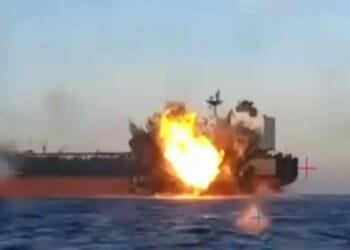
In the latest Iran war news, Israel said it killed Iran security chief Ali Larijani and the commander of Iran’s paramilitary Basij unit. Iran ramped up attacks on energy assets around the Persian Gulf, setting a massive UAE gas field ablaze. The conflict “is shifting into a prolonged war of attrition, embedding a persistent geopolitical risk premium in oil rather than a brief price spike,” according to Fidelity’s global head of macro and strategic asset allocation, Salman Ahmed. The prospect of a longer conflict has led the market to price out rate cuts, though there are some dissenters: Morgan Stanley is sticking with its forecast for a cut in June and another reduction in September.
Oil has risen more than 40% since the war started. In the latest developments, operations were suspended at the Shah field in the United Arab Emirates, while an Iraqi oil field and an Emirati port were also targeted by drones and missiles. Meanwhile, President Donald Trump renewed calls for other nations to help secure the Strait of Hormuz and threatened to expand strikes to Iranian oil infrastructure.
Fund managers in BofA’s survey, meanwhile, have turned bearish due to the the war, as well as concerns over private credit. Cash levels jumped from 3.4% last month to 4.3% in March, the biggest increase since the pandemic, Michael Hartnett wrote. Still, there’s no equity capitulation yet, and positioning hasn’t reached the uber-bearish levels seen in other recent shocks like April’s tariff turmoil and Russia’s 2022 invasion of Ukraine.
“The longer the oil price stays above $100 per barrel, the louder the alarm bells for the market over inflation risks,” said Dan Coatsworth, head of markets at AJ Bell.
Amid the geopolitical chaos, AI news has become a market sideshow at the moment, with Nvidia shares having a muted reaction to CEO Jensen Huang’s presentation of new products and forecast for $1 trillion in sales through 2027. Elsewhere, Samsung unveiled its next-generation AI chip HBM4E, while South Korean conglomerate SK Group said that a global shortage of memory chips is likely to persist another four to five years.
The Reserve Bank of Australia increased the official cash rate to 4.10% from 3.85%, the second increase this year.
“The bias is certainly that central banks will be more hawkish that the markets wants them to be,” said Andrew Chorlton, chief investment officer of fixed income at M&G Investment Managers. “We don’t expect anyone else to raise rates but no one is going to cut rates and any remaining expectations of rate cuts are slowly diminishing.”
European stocks and bonds rally and US assets lag behind, while oil rises and US diesel prices hit the highest since 2022. Stoxx 600 up by 0.3%- led by utilities and energy stocks – headed for its first back-to-back gain since the war began. Here are some of the biggest movers on Tuesday:
- Sartorius shares gain as much as 5.9% after the German lab equipment maker provided medium-term targets which Morgan Stanley analysts called a “clear positive.”
- Fraport shares climb as much as 4.7%, the most since November, after the German airport operator encouraged investors by reporting positive free cash flow.
- Springer Nature shares jump as much as 9.6%, the most in almost a year, after the German publishing group reported results and gave guidance for 2026 including 5%-6% revenue growth.
- Wickes shares rise as much as 8.6%, the most in 10 months, as full-year sales and profit beat analysts’ forecasts and the DIY retailer unveils a £10 million ($13.3 million) buyback.
- Allegro shares fall as much as 4.1% as InPost’s plan to launch an AI shopping assistant was seen posing a competitive thread to online market places.
- Indra Sistemas shares fall as much as 7.5% after El Confidencial reports that the government is planning to ask Chairman Ángel Escribano to step down from the defense firm.
Asian stocks rose, poised for a second day of gains, as tech shares advanced with help from an upbeat Nvidia outlook while investors continued to eye crude prices. The MSCI Asia Pacific Index gained as much as 1.4% Tuesday, with Samsung and TSMC among the biggest contributors after Nvidia CEO Jensen Huang unveiled new products at a company event. South Korea’s Kospi rose 1.6%, while benchmarks also climbed in Taiwan, Hong Kong and most of Southeast Asia. Monday’s tech-led rebound in the US provided relief, along with continued optimism over the central role played by Asian companies in the ongoing AI buildout. Nevertheless, concerns remain about the impact of rising energy costs on inflation. Oil climbed as Iran stepped up attacks on energy infrastructure around the Persian Gulf.
“I would not read this as investors suddenly becoming comfortable with risk,” said Charu Chanana, chief investment strategist at Saxo Markets. “The rally can continue through the week if oil stays contained and central banks do not sound more hawkish, but conviction is still fragile.”
In FX, the Bloomberg Dollar Spot Index was flat after rising 0.2% the previous day. AUD/USD was down 0.2% to 0.7056 after the Reserve Bank of Australia voted five-to-four in favor of raising its interest rate, potentially signaling a less hawkish path ahead
In rates, Treasuries are slightly cheaper vs Monday’s closing levels, underperforming European counterparts, which are higher despite oil price rebound after Germany’s March ZEW expectations gauge missed estimates. US yields are about 1bp cheaper on the day with the curve marginally steeper. 10-year is near 4.225%, trailing bunds and gilts in the sector by 3bp and 4bp respectively. European bonds higher, led by the UK. German investor outlook slumped on risks from the Iran war. Treasuries face duration supply Tuesday in the form of 20-year bond reopening at 1pm New York time and another heavy corporate new-issue slate expected. Treasury’s $13 billion 20-year bond reopening has WI yield around 4.855%, ~19bp cheaper than last month’s weak auction, which tailed by 2bps. IG dollar issuance slate includes a couple of names so far; eight borrowers raised a total of nearly $30 billion on Monday. Issuers paid about 8bps in new issue concessions on deals that were 3.6 times covered. Five to seven issuers stood down and may try again Tuesday ahead of Wednesday’s Fed policy announcement
In commodities, Crude bouncing in commodities with WTI up 270bps to $96, European gas up similarly; Brent crude is around $103 a barrel after Iran struck energy facilities around the Persian Gulf; US diesel prices are the highest since 2022. Gold little changed around $5,000/oz and Bitcoin dipping slightly further below $74,000.
US economic data slate includes weekly ADP employment change (8:15am), March New York Fed services business activity (8:30am) and February pending home sales (10am). No significant earnings are expected before the market open. Earnings from Lululemon and Docusign follow later in the day. Nvidia’s GTC AI conference continues in San Jose. Conferences include BofA global industrials (London), Piper Sandler energy (Las Vegas) and JPMorgan industrials (Washington).
Market Snapshot
- S&P 500 mini -0.1%
- Nasdaq 100 mini -0.2%
- Russell 2000 mini -0.2%
- Stoxx Europe 600 +0.3%
- DAX +0.2%
- CAC 40 +0.5%
- 10-year Treasury yield +1 basis point at 4.22%
- VIX +0.1 points at 23.65
- Bloomberg Dollar Index little changed at 1207.96
- euro +0.2% at $1.1523
- WTI crude +2.8% at $96.14/barrel
Top Overnight News
- Israel said it killed Iran security chief Ali Larijani and the commander of Iran’s paramilitary Basij unit. Iran ramped up attacks on energy assets around the Persian Gulf, setting a massive UAE gas field ablaze. BBG
- Iraq said it’s in contact with Iran to allow some oil tankers to pass through the Strait of Hormuz after the OPEC nation was forced to reduce oil output to a quarter. BBG
- President Donald Trump has asked America’s NATO allies to help unblock the Strait of Hormuz — and their response has not exactly been enthusiastic. “This is not our war, we have not started it,” German Defense Minister Boris Pistorius told reporters Monday. That appeared to sum up the mood among U.S. allies, with leaders from Berlin to London expressing reservations about Trump’s demands and indicating they had no immediate plans to provide military support to reopen the crucial waterway. NBC
- Trump announces and signs executive orders to bring more community banks back into the mortgage business and to lower construction costs for building more affordable homes.
- Despite more than two weeks of relentless airstrikes, U.S. intelligence assessments say, Iran’s regime likely will remain in place for now, weakened but more hard-line, with the powerful Islamic Revolutionary Guard Corps security forces exerting greater control. WaPo
- China said Tuesday it remains “in communication” with the United States over a widely anticipated visit by President Donald Trump to Beijing, after Trump said he had requested a delay of about a month because of the ongoing war with Iran. SCMP
- The PBOC is set to surpass the ECB as the world’s largest central bank this month, as measured by respective balance sheets in dollar terms. BBG
- The IMF raised concerns about Ukraine’s ability to keep receiving aid from its $8.1 billion package as lawmakers stall on measures to unlock the financing, its representative said. BBG
- Australia’s central bank raised interest rates on Tuesday as the conflict in Iran worsened existing concerns around an acceleration in inflation and the country’s reliance on oil imports. The Reserve Bank of Australia increased the official cash rate to 4.10% from 3.85%, the second increase this year. WSJ
- BYD and Hyundai were among Asian auto stocks that rallied after announcing plans to work with Nvidia on autonomous vehicle development. BBG
Central Banks
- RBA hikes the Cash Rate by 25bps to 4.10%, as expected, with the decision made by a majority decision (5-4 vote split). Five members voted for a 25bps hike and four voted to leave the Cash Rate unchanged. Material risk inflation will stay above target for longer. Inflation risks have tilted further to the upside. Board will do what’s necessary to deliver price and jobs goals. Short-term inflation expectations have already risen. The conflict in the Middle East poses substantial risks in both directions and has resulted in sharply higher fuel prices, which, if sustained, will add to inflation. Will be attentive to data, evolving outlook, and risks in decisions. Wide range of data over recent months confirmed inflationary pressures picked up materially in H2 2025.
- RBA Governor Bullock said rise in oil prices is not the reason for the rate increase and that inflation was already too high, adds risks to inflation are to the upside and cash rate was not high enough to bring inflation back to the target. All members agreed inflation was too high, board agreed inflation was too high. Had a very robust meeting. Members that voted to hold, voted in a hawkish sense. Discussion was about timing, not the direction of policy and hike. Difference was timing and those who voted against, still felt the need for an eventual rate increase. Today’s hike does not say anything about the forward path, and the forward path for rates is uncertain.
- BoJ Governor Ueda said price trend is rising gradually and underlying inflation is gradually accelerating towards the 2% target. Will implement appropriate policy to maintain stable prices. Will guide monetary policy suitably to steadily and durably achieve the 2% price target. Expect underlying inflation to approach the target in the latter half of fiscal 2026 through fiscal 2027. Reaffirmed stance that it will act flexibly in exceptional situations when JGB yields suddenly rise. BoJ to conduct bond operations flexibly in exceptional cases.
A more detailed look at global markets courtesy of Newsquawk
APAC stocks eventually traded mixed, with the region initially following suit to the gains on Wall Street, where sentiment was underpinned amid softer yields and oil price declines, although gains were capped overnight as oil prices partially rebounded and with participants bracing for this week’s central bank bonanza, which was kicked off by the RBA, which delivered a widely expected back-to-back 25bps rate hike. ASX 200 was kept afloat as gains in miners, utilities, and financials offset the losses in tech and consumer discretionary, although the upside was limited amid the RBA rate decision, in which the central bank hiked rates for the second consecutive meeting in a 5-4 vote split. Nikkei 225 briefly reclaimed the 54,000 status but later fell into the red as oil partially rebounded from an early trough. Hang Seng and Shanghai Comp were mixed with the Hong Kong benchmark outperforming in early trade amid strength in consumer stocks, while the mainland lagged after US President Trump revealed the US asked to delay the Trump-Xi summit by a month or so due to the Iran war.
Top Asian news
- China’s Ministry of Finance said more pro-active fiscal policy is to continue in 2026, while it is to support the domestic market and self-reliance in tech, as well as ensure necessary expenditure levels.
- Japanese PM Takaichi reiterates that not considering further increase in consumption tax.
European Bourses are all gaining as markets continue to price in the effects of oil prices. The IBEX 35 is the outperformer, closely followed by the FTSE 100. On the other hand, the DAX 40 is the laggard. European Sectors give no additional bias. Utilities outperform, with an upgrade for Neste at Barclays, lifting the entire sector. The Technology sector lies towards the bottom of the pile, not benefiting from the NVIDIA GTC event. Other key movers include Close Brothers, Fraport and Roche.
Top European news
- UK, Finland and others are reportedly exploring new defence financing mechanism by 2027, with the aim of increasing the availability of critical capabilities such as munitions.
FX
- DXY is flat within a narrow range, easing from overnight highs and trading closer to session lows after recent weakness. Price action remains sensitive to oil and geopolitics, with limited fresh escalation. Headlines around potential US–Iran dialogue and conflicting reports of contact have kept direction subdued, while reports of a senior Iranian security figure being killed briefly weighed on the USD.
- EUR/USD edges higher, reversing earlier weakness in line with the softer USD. Focus includes comments from EU’s Kallas, who suggested a Black Sea-style security model could be applied to the Strait of Hormuz and left the door open to EU participation. Broader EUR catalysts remain limited, with little reaction to progress on an EU–Australia trade deal. EUR saw downticks on the sub-par ZEW Economic Sentiment metrics.
- GBP/USD trades firmer alongside peers amid modest USD softness. UK-specific newsflow is light, though markets continue to monitor UK–US relations amid reported tensions over positioning in the Iran conflict. The pair holds near the top of its recent range.
- USD/JPY rebounded from a brief move below 159.00, supported by a partial recovery in the dollar and oil overnight. Upside is capped by broader USD softness during European hours, leaving the pair off recent highs and consolidating within yesterday’s range.
- Antipodeans are mixed, with AUD/USD modestly firmer post-RBA. The initial dovish reaction to the rate decision reversed as Governor Bullock struck a hawkish tone, stressing that inflation remains elevated and that dissent centred on timing rather than the direction of further tightening.
Fixed Income
- USTs initially extended yesterday’s sell-off, with crude strength lifting yields and pushing prices to session lows. More recent headlines around Larijani triggered a pullback in oil and a recovery in risk sentiment, supporting bonds and bringing USTs back to broadly unchanged levels.
- Bunds followed a similar pattern, hitting early lows on higher yields driven by energy strength. The move reversed as oil pared gains on Larijani-related headlines, lifting Bunds back into positive territory. Negative ZEW Economic Sentiment propped up bunds in recent trade.
- Gilts opened amid the initial Larijani headlines and saw only modest early downside before sharply reversing higher. The benchmark rallied strongly alongside the pullback in yields and energy, outperforming peers.
- UK sells GBP 4bln 4.125% 2031 Gilt: b/c 3.33x (prev. 3.94x), average yield 4.228% (prev. 4.001%), tail 0.3bps (prev. 0.2bps).
- UK DMO plans to sell a new 10-year conventional gilt in April and long-maturity gilt in June. Also plans 2 syndicated gilt sales between April and June.
- Japan sold JPY 613bln 20-year JGBs; b/c 3.25x (prev. 3.08), average yield 3.141% (prev. 2.968%).
Commodities
- Crude futures rebounded overnight after the prior session’s pullback, as the Iran conflict continues without major escalation. Late US trade saw pressure on reports of US–Iran contact, which were subsequently denied, alongside renewed Iranian attacks on regional energy assets, supporting prices. In Europe, headlines added further volatility: Fujairah port suspended oil loadings, while Israel indicated Iran’s top security chief Larijani may have been killed. Strait of Hormuz developments remain in focus, with EU’s Kallas suggesting a Black Sea-style framework, while Iraq noted ongoing discussions with Iran to allow tanker passage—prompting some intraday softness.
- Spot gold trades in a narrow range, largely tracking USD moves. Geopolitical tensions and inflation concerns are limiting haven-driven upside, keeping price action contained around the USD 5,000/oz level.
- Base Metals are mixed, with copper consolidating after prior gains supported by improved risk sentiment. Prices remain capped below the USD 13,000/t level, with momentum flattening following the recent advance.
- Fujairah port has suspended oil loadings, Bloomberg reported citing sources; loading berths at the Fujairah Oil Tanker Terminals were halted as of Tuesday morning.
- UAE’s Fujairah confirms a fire in its petroleum industrial area.
- Chinese state oil majors have recommenced seeking Russian oil shipments following the US waiver, according to sources.
- Iraq’s oil minister said they are in contact with Iran to allow some oil tankers to pass through the Strait of Hormuz, state news reported.
- Kazakhstan and Russia have discussed increasing Russian oil transit to China to 12.5mln tonnes per year, according to Kazakhstan’s Kaztransoil.
- EU’s Kallas said a model similar to the Black Sea could be used in the Strait of Hormuz but the question is what neighbouring countries, including Iran, could agree on; the door is not closed on the participation in the Strait.
- Allies of the US President are concerned that Iranian attacks on oil tankers within the Strait of Hormuz are boxing in the US, Politico reported.
- Iranian oil exports continue without interruption, Tasnim reported citing the Parliamentary Energy Committee spokesperson.
- Some Japanese aluminium buyers have reportedly agreed with a global producer to pay a premium of USD 350/t for shipments between April and June.
Geopolitics: Middle East
- Israeli Defence Minister Katz said Iran’s Top Security Chief Larijani was killed in the airstrike.
- Israel struck senior Iranian official Larijani but it is unknown if he was injured or killed, an Israeli official tells the Jerusalem Post.
- Israel Defence Forces announce wide-scale strikes against Iranian infrastructure and began additional wave of strikes on Hezbollah infrastructure in Beirut.
- A senior Iranian official says the new Supreme Leader rejected proposals that were sent to Iran’s Foreign Ministry by two intermediary countries, with the Leader stating it is not the right time for peace and that US and Israel must be defeated.
- New Iranian Supreme Leader Mojtaba Khamenei is to deliver a message soon, according to Iranian media.
- Iran’s Revolutionary Guard arrests 10 foreigners on espionage charges in northeast of country.
- Iran officials say the US has crossed the line and they signalled an intention to deliver a major lesson.
- Iran’s Foreign Minister Araghchi said his last contact with US envoy Witkoff was before the American attack on Iran.
Geopolitics: Other
- UAE updated that air navigation has returned to normal across its airspace.
- Pakistan confirmed it carried out airstrikes on Kabul and Nangarhar.
- US President Trump’s administration was said to tell Cuba its president has to go for there to be meaningful progress in negotiations, according to NYT.
- US President Trump said he believes he’ll have the honour of taking Cuba.
- South Korea’s Foreign Minister Cho and US Secretary of State Rubio discussed ensuring safe navigation in the Strait of Hormuz.
US Event Calendar
DB’s Jim Reid concludes the overnight wrap