Daniel Di Martino testified in a hearing titled Keeping Our Promises: Labor Inflows, Maintaining Competitiveness, and Supporting an Aging Population.
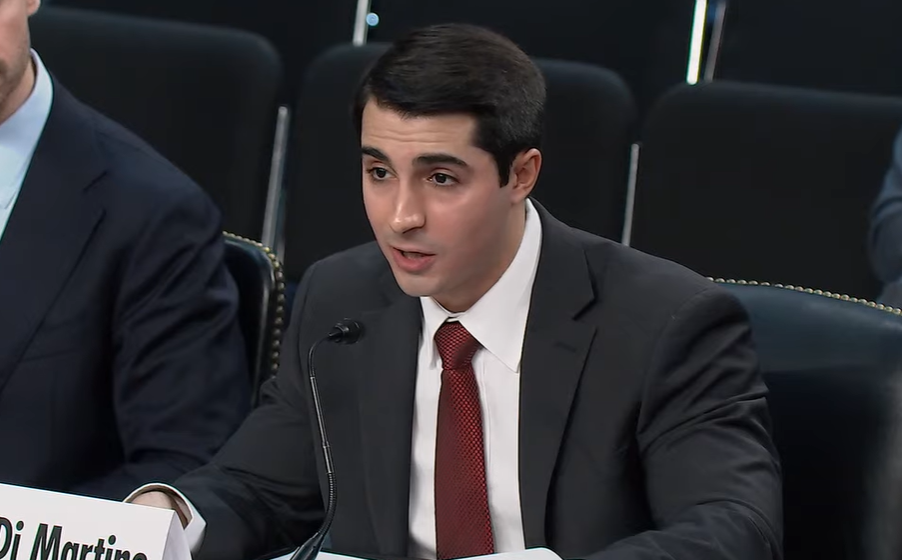
Watch the full testimony here.
Chairman Schweikert, Ranking Member Hassan, and members of the Joint Economic Committee:
It is a great honor to testify before the Joint Economic Committee on what I believe is one of America’s most important sources of future economic prosperity: high-skilled immigration. Nations prosper because of the confluence of two factors: institutions that protect liberty and innovation, and people willing and able to innovate and trade. America became the richest country in the history of the world because those two factors coincided in one place and time. The Founders designed a system of government that limited intrusion into personal affairs and allowed the American people to unleash unparalleled prosperity for themselves and their posterity. However, the American colonies, and later the United States, also benefited from attracting risk-takers, inventors, and entrepreneurs from around the world. A sound immigration policy that attracts talented people to America is therefore one of the most important tools available to boost Americans’ prosperity. Today, I want to argue that shifting legal immigration policy toward admitting younger, more highly educated immigrants, without changing the number of admissions, can help achieve three goals that members of both parties share: reduce the national debt, increase economic prosperity, and delay population decline.
While many governments seek to boost economic growth through sheer numbers, America has the opportunity, and historically has chosen, to boost growth through productive immigration. Countries such as Germany after the Syrian refugee crisis, and Spain and Canada more recently, increased GDP by welcoming large numbers of low-skilled immigrants. The consequence was a larger economy, but not necessarily greater prosperity per person, and in some cases lower wages or higher fiscal costs for parts of the native-born population. This is because immigrants are not just workers; they are also people. People do not just work; they also consume. They do not just pay taxes; some also receive public benefits. They do not just create businesses; some also impose social costs. Because of this, the free movement of people is not identical to the free movement of goods and services. Welcoming a thousand law-abiding, highly paid, English-speaking immigrants into a town is very different from welcoming a thousand impoverished, non-English-speaking immigrants with significantly greater integration needs.
Click here to read the full testimony.
______________________
Daniel Di Martino is a graduate fellow at the Manhattan Institute, a Ph.D. student in economics at Columbia University, and the founder of the Dissident Project, a speakers’ bureau for young immigrants from socialist countries.
Are you interested in supporting the Manhattan Institute’s public-interest research and journalism? As a 501(c)(3) nonprofit, donations in support of MI and its scholars’ work are fully tax-deductible as provided by law (EIN #13-2912529).