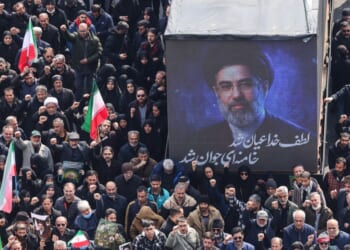
What do the living owe the dead? This question concerns me now because I am getting older, but it also lingers, I think, because we are at war in Iran. The first coffins, draped in our flag, have come home. More will come. Even more shrouds will be made for Iranians, some of them very small. As we count the dead, what do we owe them? The answer begins with telling the truth about why they fell.
Every day I consider, at least for a moment, this question. My grandfather’s military portrait peers at me from a perch in my office. He fell in the Hürtgen Forest in November 1944, killed by a Nazi landmine. His blood flows in my veins, and I have been blessed with a life hard for him to imagine, just two generations removed from the coal mines in which he toiled before the war. The story of his life and death planted within me a simple love for America at its best. He is buried in the Henri-Chapelle American Cemetery in Belgium, and I hope to visit that sacred space.
I’ve visited related spaces. In May 2011, I walked the beaches of Normandy and the American cemetery that sits above them. The bending rows of white crosses sing in their silence, accompanied by the rolling sea. As you step close, each marker bears a name, a rank, a place, and a date of demise; simple lyrics sometimes sing the loudest. For the few who were retrieved but never named, their grave comforts at least believers, for they are “known but to God.” He now sings on their behalf.
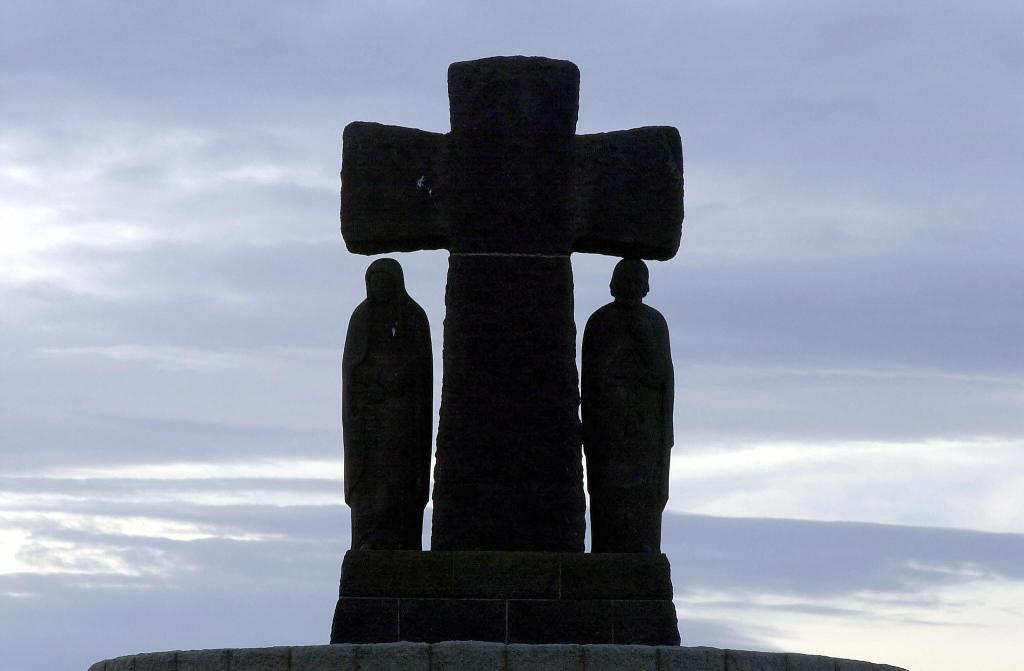
The same week, and in the same region of France, I visited the tiny town of La Cambe, which encloses a German cemetery. The village, which surely suffered at German hands, now offers a kind of rest to its enemies. Each soldier is identified by a simple stone on the ground. Each row has five squat, dark, closely huddled crosses. Where there is no identification, the marker reads, “ein deutscher soldat” (“a German soldier”). These blades of grass sing a dirge every ear should hear.
After seeing these two places, I considered a different question: What if my grandfather were buried in La Cambe instead of Henri-Chapelle? What would I owe him then? What if he had died for a wicked cause but fell so that his bunkmate might live? What if he had been compelled to choose between fighting for an unjust cause with the hope of returning to his family, and the certain death of refusing a murderous regime?
This problem is not new. Allen Tate’s 1927 poem, “Ode to the Confederate Dead,” also wrestled with it. Tate depicts a woeful man, stalled at the gate of a Confederate cemetery. The man cannot engage the place or the fallen who lie there. He is cut off from history, both by the liberal culture that surrounds him and by the complexity of the Confederate soldier himself. They were full of glory, defenders of the homeland, and yet complicit in the slaving wickedness that Tate will not name. Tate leaves our mournful and confused man, “Cursing only the leaves crying/ Like an old man in a storm.”
Tate, or at least the man at the gate he created, could not reconcile himself to the past, not because he fled it, but because it bound him in uncomfortable ways. There is no simple way to honor those who fell with flowers, or to care tenderly for the “angels that rot/ On the slabs, a wing chipped here, an arm there.” Instead of action, the man can only “Leave now/ The shut gate and the decomposing wall.”
What should the man at the cemetery do with his uncomfortable past? I will not pretend to answer the question, but only to note one path forward, one that joins Iran, Normandy, La Cambe, the Confederacy, and the portrait that hangs in my office. What we owe the dead, especially the dead of war, is the truth. And searching for the truth of the past begins by remembering it.
The truth of war is a cocktail of grief, horror, and honor. The fallen, no matter their cause, left families and futures. The rows of crosses, the angels on slabs, and the simple stones are endless, spreading in every direction. Only evil brings frail, young bodies in close quarters with efficient, insatiable machines. But their deaths can only be fully understood against the righteousness, or its absence, of the cause that called them.
I owe them all, including my grandfather, that full, deep drink from the past. To separate those ingredients of grief, horror, and proper honor is a moral distortion. To grieve without context robs the dead of their purpose and steals solace from the griever. My father and grandmother grieved Virgil Smith, but they were comforted, I know, by the moral surety of his cause. If the military portrait in my office was of a Wehrmacht soldier, instead of a PFC in the U.S. Army, my grief would be doubled and private instead of shared. But what about those who over-focus not on context, but on the idea of war itself? Some of my Christian brothers and sisters believe, in earnest, that war is never justified, no matter the circumstances. They are right to highlight the horrors—only the ignorant or vile see war as anything other than a sometimes necessary horror. But their revulsion still detaches all conflicts from their moral weight, which may rob the living of the courage and love needed to sometimes wage battle.
There is one more way falsehood triumphs. Many war films, like Glory, feature a parade early in the proceedings. Smart young men, marching in straight, tight lines, get a brassy send off, with at least implied promises of honor for those who fight. We rightly acknowledge worthy heroes, and it is good to celebrate the temporary end of war. But when bright forecasts of glory or hazy histories drown out the cries of battle, we find perhaps truth’s greatest martial foe. Old, powerful men are tempted to forget that battle keeps undertakers occupied.
When considering the question of what we owe the dead, another question, for me, predominates. Why did they fight? While the answer is not definitive, it shades the rest of our understanding. This is one reason why the war in Iran feels so strange. I still do not know why we are fighting, and so I cannot fully reckon with those coffins as they return.