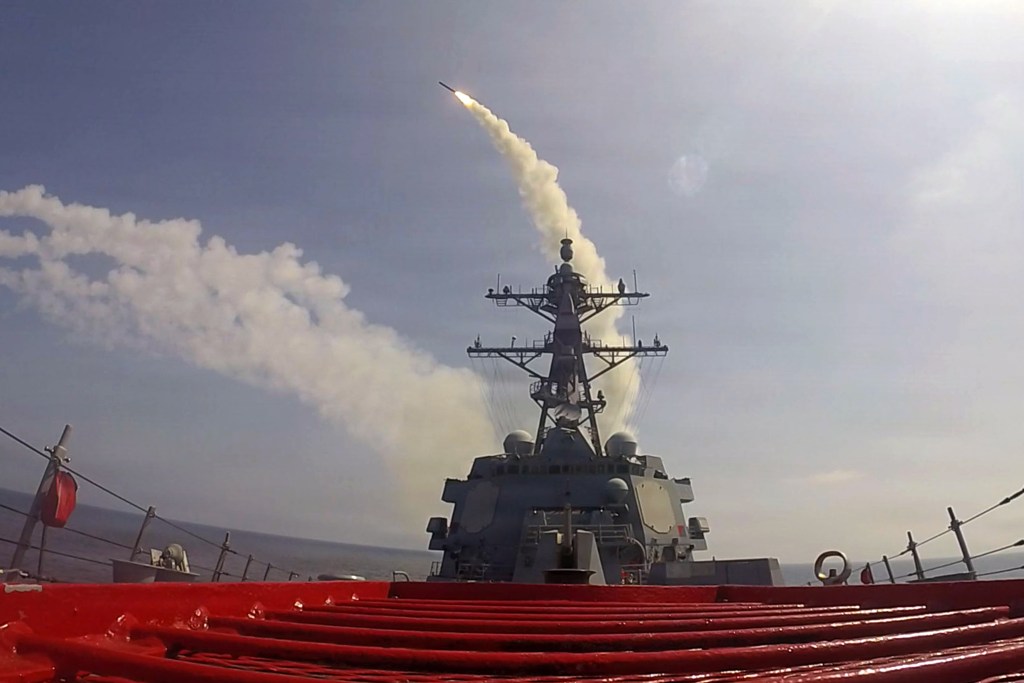
Exact stockpile figures are classified, but drawing on Defense Department procurement data, the Center for Strategic and International Studies (CSIS) assessed in December that the U.S. Missile Defense Agency had received 534 THAAD interceptors between 2013—when the first non-test unit was delivered—and 2025. It had also received 506 SM-3 interceptors, which are launched from naval ships. By contrast, earlier this month, the Israel Defense Forces assessed that Iran had about 2,500 ballistic missiles. “The math just favored [Iran], particularly because it’s not a one-for-one ratio of one interceptor for one incoming missile,” Kelly Grieco, a senior fellow at the Stimson Center, told TMD. “It’s usually that you have to use two or three to intercept each oncoming missile.”
If the U.S. interceptor stockpile were depleted, the result would not be an undefended battlefield, but a harder set of choices. Grieco explained that military commanders would “start making some decisions about what you’re going to intercept” based on “trade-offs and calculations.” For example, she said, “If you have a missile coming in, say, at a base, and it looks like it’s going to hit a runway, you might decide, ‘Okay, let it hit the runway, because we can repair the runway [later].’” A fuel depot would still get defended, unless things deteriorated further. “There may be times that you can’t even defend the fuel depot, depending on how constrained you are,” Grieco added.
Eugene Gholz, a Notre Dame political science professor and former senior adviser in the Defense Department during the Obama administration, told TMD the consequences of running low would be higher casualties but not necessarily outright failure. “We’ve been prosecuting an aggressive war on the presumption that we will take effectively zero casualties, and that’s not likely sustainable, right?” he said. “So, if we run out of interceptors, we’ll start to take a few more casualties. But that doesn’t stop us from continuing to prosecute the war if we want to. It’s just we like to think that wars are free for us, and historically, wars have not been free.”
To narrow the gap between their weapons supply and Iran’s, the U.S. and Israel have sought to destroy Iranian missile launchers and stockpiles before they can fire. That strategy exploits the basic vulnerability in launching a ballistic missile from a mobile transporter-erector-launcher, which requires a preparation sequence: transporting the weapon to a firing position, erecting it, and completing a fueling process that can take 30 minutes or more. During that window, the launcher is stationary and visible to satellite and drone surveillance. Every launch puts a target on the launcher itself, and Iran has been losing them quickly.
On March 13, a senior Israeli military official told Israel’s N12 News that Iran had an estimated 150 active missile launchers remaining, after U.S. and Israeli forces destroyed between 160 and 190 and put an additional 200 out of order. This came after two days after Defense Secretary Pete Hegseth indicated Iran can’t resupply those missiles. “Iran’s entire ballistic missile production capacity—every company that builds every component of those missiles—[has] been functionally defeated [and] destroyed,” he said on March 11.
The U.S. interceptor stockpile crunch is primarily a ballistic missile problem. Iranian drones—slower, lower-flying, and far cheaper—are largely being countered with less expensive weapons. “There’s actually little evidence that we’re using very expensive interceptors like PAC-3 MSE from Patriot to intercept drones,” Ryan Brobst of the Foundation for Defense of Democracies told TMD. Instead, U.S. and allied forces have turned to Apache helicopter cannons, laser-guided rockets that cost as little as $25,000 apiece, and the Coyote drone interceptor. The U.S. is also deploying Merops, an AI-guided drone-on-drone system tested in Ukraine that fits in the back of a pickup truck. Even so, six U.S. service members were killed in Kuwait by a Shahed that evaded air defenses, and defense officials have acknowledged that the drones are posing a bigger problem than anticipated.
But the campaign against Iran’s launchers and stockpiles has had the clearest effect on the overall tempo of the conflict. Iran launched 90 and 60 missiles on the first two days of the war, respectively, but that quickly dropped to about 20 per day and has since fallen to single digits. At a press conference on March 13, Hegseth said that since the conflict began on February 28, Iranian ballistic missile attacks had decreased by 90 percent, and one-way drone attacks had decreased by 95 percent.
(An exception was March 17, when Iranian forces launched 11 waves of ballistic missile attacks in response to separate Israeli strikes that killed the country’s national security chief, Ali Larijani, and the commander of the Basij paramilitary force, Gholamreza Soleimani.)
Even if the immediate supply holds, replenishing what the U.S. has spent—and building the reserves the military needs—is a problem of money, time, and industrial capacity. As Grieco told TMD: “We can’t simply spend our way out of this problem. We actually have to confront some of the strategic trade-offs.”
Defense Department documents from 2024 estimated the cost of each THAAD interceptor at nearly $12.8 million. SM-3 interceptors range from $9.7 to $12.5 million for the older Block IB models to nearly $28 million for the larger, more advanced Block IIA. The most direct way to lower per-unit costs is to buy in bulk: Brobst noted that multi-year procurement deals “would provide the predictability of demand for the manufacturers to invest in additional production capacity, as well as just [build] economies of scale.” But don’t expect a significant discount. “These are still likely to be quite expensive,” Brobst said, “which underscores the need to directly target adversary ballistic missiles” stored in Iran.
And even with funding secured, production cannot begin immediately. “There is an actual physics to how long it takes to make certain things,” Gholz said, noting that expanding output requires factory capacity and skilled labor—constraints reflected in the price tag.
The Pentagon moved to accelerate production before the current conflict began. In January, the Defense Department reached a deal with Lockheed Martin to quadruple THAAD interceptor production from 96 to 400 per year, and L3Harris Technologies announced a $1 billion Defense Department investment for the “rapid expansion of capacity” for missiles, including THAAD interceptors and SM models. In February, RTX—formerly Raytheon—signed up to seven-year framework agreements with the Defense Department to “significantly increase production capacity and speed deliveries” of several missile models, including SM-3s. But those deals are frameworks, not funded orders.
“The important piece is going to be getting Congress to actually fund the procurement of those systems,” Brobst said. “If the money isn’t there, the production isn’t going to be there either.”
And even funded production may not be sufficient if it only responds to the current crisis. Bradley Martin, a senior policy researcher at RAND and a retired Navy captain, told TMD that the U.S. needs to maintain “excess capacity” of defensive missiles at all times. “There needs to be planning for a surge,” he said. “That is just part of the reality of modern warfare.”
The larger concern, though, is not Iran—it is what comes after. “It’s probably a little scary in terms of potential for not having enough bullets, should China decide to kick something off,” Tom Karako, a senior fellow at CSIS who directs the think tank’s Missile Defense Project, told TMD.
Brobst agreed: “The biggest concern for the U.S. regarding interceptor stockpiles is the day after the conflict, in deterring China and Russia.”